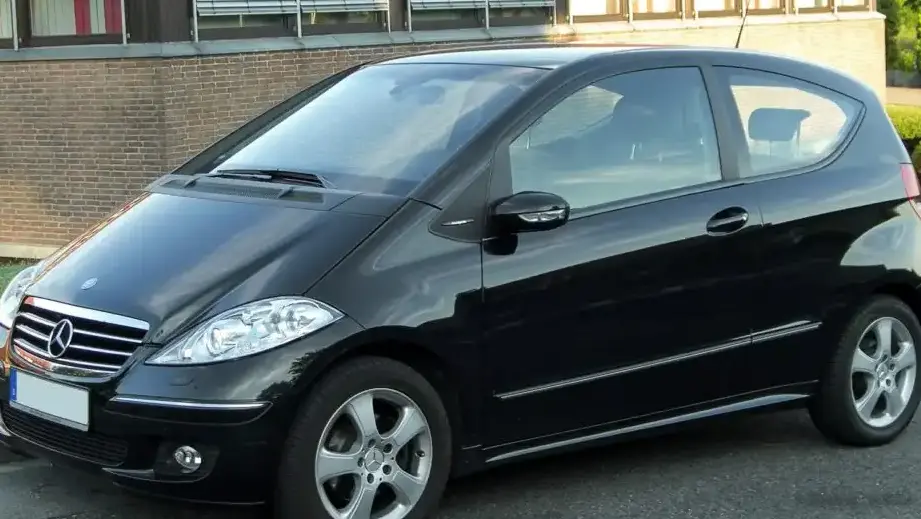
The Mercedes-Benz A-Class (W176) A 250, specifically the facelifted model produced from 2015 to 2018, represented a significant step forward in the compact luxury segment. Positioned as the performance-oriented variant within the W176 range, it offered a more engaging driving experience than the base A 180 and A 200 models. This iteration of the A-Class, built on the MFA (Modular Front-wheel Drive Architecture) platform, aimed to attract a younger demographic with its stylish design and advanced technology. The A 250 served as a bridge between the more economical trims and the higher-performance AMG variants, offering a balance of power, efficiency, and luxury features.
Technical Specifications
| Brand | Mercedes-Benz |
| Model | A-Class |
| Generation | A-Class (W176, facelift 2015) |
| Type (Engine) | A 250 (211 Hp) |
| Start of production | 2015 |
| End of production | 2018 |
| Powertrain Architecture | Internal Combustion engine |
| Body type | Hatchback |
| Seats | 5 |
| Doors | 5 |
| Fuel consumption (urban) | 8.7-8.6 l/100 km (27 – 27.4 US mpg, 32.5 – 32.8 UK mpg, 11.5 – 11.6 km/l) |
| Fuel consumption (extra urban) | 5.4-5.2 l/100 km (43.6 – 45.2 US mpg, 52.3 – 54.3 UK mpg, 18.5 – 19.2 km/l) |
| Fuel consumption (combined) | 6.7-6.6 l/100 km (35.1 – 35.6 US mpg, 42.2 – 42.8 UK mpg, 14.9 – 15.2 km/l) |
| CO2 emissions | 154-151 g/km |
| Fuel Type | Petrol (Gasoline) |
| Acceleration 0 – 100 km/h | 6.5 sec |
| Acceleration 0 – 62 mph | 6.5 sec |
| Acceleration 0 – 60 mph | 6.2 sec |
| Maximum speed | 240 km/h (149.13 mph) |
| Emission standard | Euro 6 |
| Weight-to-power ratio | 6.3 kg/Hp, 159.8 Hp/tonne |
| Weight-to-torque ratio | 3.8 kg/Nm, 265.2 Nm/tonne |
| Power | 211 Hp @ 5500 rpm |
| Power per litre | 106 Hp/l |
| Torque | 350 Nm @ 1200-4000 rpm (258.15 lb.-ft. @ 1200-4000 rpm) |
| Engine layout | Front, Transverse |
| Engine Model/Code | M 270.920 |
| Engine displacement | 1991 cm3 (121.5 cu. in.) |
| Number of cylinders | 4 |
| Engine configuration | Inline |
| Compression ratio | 9.8:1 |
| Number of valves per cylinder | 4 |
| Fuel injection system | Direct injection |
| Engine aspiration | Turbocharger, Intercooler |
| Engine oil capacity | 5.6 l (5.92 US qt | 4.93 UK qt) |
| Coolant | 7.8 l (8.24 US qt | 6.86 UK qt) |
| Kerb Weight | 1320 kg (2910.1 lbs.) |
| Max. weight | 1960 kg (4321.06 lbs.) |
| Max load | 640 kg (1410.96 lbs.) |
| Trunk (boot) space – minimum | 341 l (12.04 cu. ft.) |
| Trunk (boot) space – maximum | 1157 l (40.86 cu. ft.) |
| Fuel tank capacity | 50 l (13.21 US gal | 11 UK gal) |
| Max. roof load | 100 kg (220.46 lbs.) |
| Permitted trailer load with brakes (12%) | 1500 kg (3306.93 lbs.) |
| Permitted trailer load without brakes | 695 kg (1532.21 lbs.) |
| Length | 4299 mm (169.25 in.) |
| Width | 1780 mm (70.08 in.) |
| Width including mirrors | 2022 mm (79.61 in.) |
| Height | 1433 mm (56.42 in.) |
| Wheelbase | 2699 mm (106.26 in.) |
| Front track | 1553 mm (61.14 in.) |
| Rear (Back) track | 1552 mm (61.1 in.) |
| Front overhang | 913 mm (35.94 in.) |
| Rear overhang | 687 mm (27.05 in.) |
| Ride height (ground clearance) | 93 mm (3.66 in.) |
| Drag coefficient (Cd) | 0.32 |
| Minimum turning circle (turning diameter) | 11.00 m (36.09 ft.) |
| Approach angle | 13.7° |
| Departure angle | 17.3° |
| Ramp-over (brakeover) angle | 9.3° |
| Drivetrain Architecture | The Internal combustion engine (ICE) drives the front wheels of the vehicle. |
| Drive wheel | Front wheel drive |
| Number of gears and type of gearbox | 6 gears, manual transmission |
| Front suspension | Independent type McPherson |
| Rear suspension | Independent multi-link suspension |
| Front brakes | Ventilated discs |
| Rear brakes | Disc |
| Assisting systems | ABS (Anti-lock braking system) |
| Steering type | Steering rack and pinion |
| Power steering | Electric Steering |
| Tires size | 225/45 R17 |
| Wheel rims size | 17 |
Powertrain & Engine Architecture
The A 250 was powered by the M270.920 2.0-liter inline-four cylinder engine. This engine, a key component of Mercedes-Benz’s modular engine family, featured direct fuel injection and a single turbocharger with an intercooler. The direct injection system, operating at pressures up to 200 bar, ensured precise fuel delivery for optimal combustion and efficiency. The engine produced 211 horsepower at 5500 rpm and 350 Nm (258 lb-ft) of torque between 1200 and 4000 rpm. This broad torque curve provided strong acceleration across a wide range of engine speeds. The engine was transversely mounted in the front of the vehicle. The standard transmission was a 6-speed manual, although a 7G-DCT dual-clutch automatic transmission was also available as an option. The 7G-DCT offered quicker shifts and improved fuel economy, but at an additional cost.
Driving Characteristics
The A 250 offered a noticeably more spirited driving experience compared to the lower-powered A-Class variants. Acceleration from 0 to 60 mph took approximately 6.2 to 6.5 seconds, making it competitive with other hot hatches of the time. The turbocharger provided a noticeable boost in power, delivering strong acceleration in the mid-range. While not as raw or focused as the A 45 AMG, the A 250 provided a good balance of performance and comfort. The standard suspension offered a comfortable ride, while still providing adequate handling for everyday driving. The optional Sport suspension lowered the ride height and stiffened the dampers, resulting in a more engaging driving experience. The manual transmission offered precise shifts and a more connected feel, while the 7G-DCT automatic provided smooth and quick gear changes.
Equipment & Trim Levels
The A 250 typically came standard with features such as automatic climate control, a multi-function steering wheel, and a high-resolution infotainment display. Upholstery was typically a combination of fabric and Artico (Mercedes’ synthetic leather). Optional extras included leather upholstery, a panoramic sunroof, a premium sound system, and various driver assistance systems such as lane keeping assist and blind spot monitoring. The “Sport” trim level added features such as sport seats, aluminum pedals, and unique exterior styling elements. The “AMG Line” package further enhanced the sporty appearance with AMG body styling, sport suspension, and larger wheels.
Chassis & Braking
The W176 A-Class featured an independent McPherson strut front suspension and an independent multi-link rear suspension. This setup provided a good balance of ride comfort and handling. The A 250 typically came equipped with ventilated front disc brakes and solid rear disc brakes. ABS (Anti-lock Braking System) was standard, along with electronic stability control. The steering was a rack-and-pinion system with electric power steering. The front track width was 1553 mm, and the rear track width was 1552 mm. The relatively lightweight construction of the A-Class, with a kerb weight of around 1320 kg, contributed to its agile handling.
Market Reception & Comparison
The A 250 was generally well-received by automotive critics. It was praised for its stylish design, comfortable interior, and engaging driving experience. Compared to the A 180 and A 200 models, the A 250 offered a significant performance upgrade. However, some critics noted that the A 250 was not as sporty or refined as some of its competitors, such as the Audi A3 and BMW 1 Series. Fuel economy was respectable, with combined fuel consumption figures ranging from 6.6 to 6.7 l/100 km. Reliability was generally good, although some owners reported minor issues with the infotainment system.
Legacy
The W176 A-Class A 250 played a key role in revitalizing the Mercedes-Benz A-Class lineup. It successfully attracted a younger audience to the brand and established the A-Class as a serious contender in the compact luxury segment. The M270 engine proved to be a reliable and efficient powerplant, and many examples of the A 250 are still on the road today. On the used car market, the A 250 commands a premium over the lower-powered A-Class variants, reflecting its superior performance and equipment levels. Its blend of practicality, style, and performance continues to make it a desirable option for buyers seeking a premium compact hatchback.