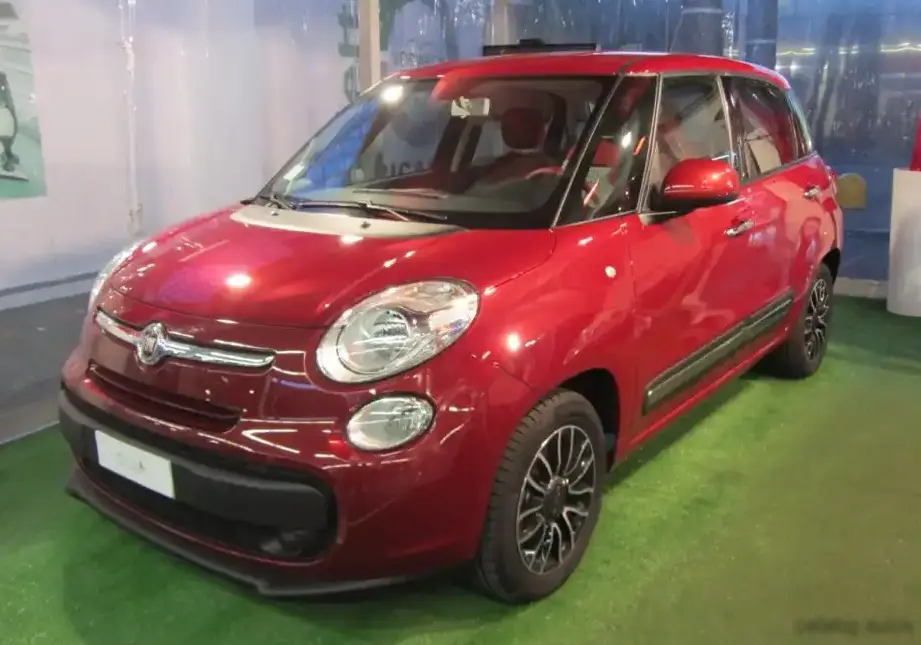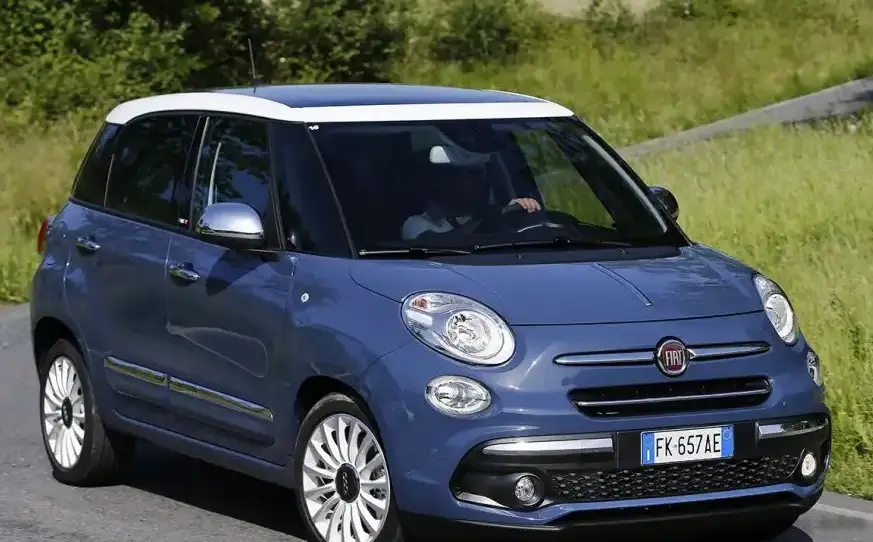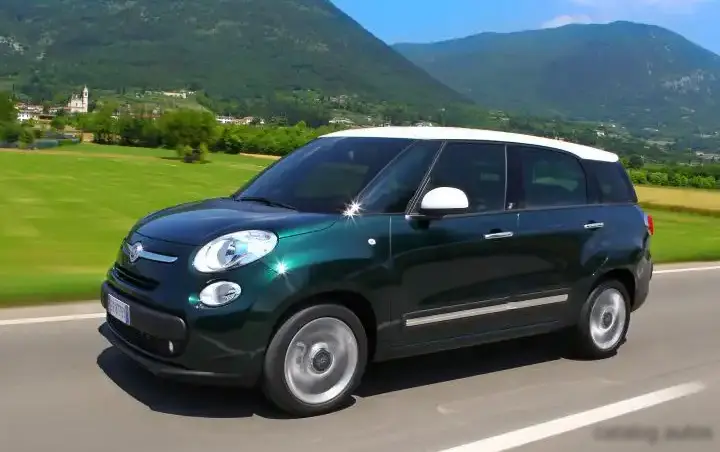
The Fiat 500L Living/Wagon 1.6 MultiJetII (120 hp) 7-seat variant was produced from 2014 to 2018 as part of the broader 500L model range. Positioned as a practical, family-oriented vehicle, the 500L aimed to expand Fiat’s offerings beyond the smaller, city-focused 500. The “Living/Wagon” designation refers to the extended wheelbase and increased cargo capacity compared to the standard 500L, offering optional seven-passenger seating. This particular 1.6 MultiJetII engine and manual transmission combination represented a mid-range option within the 500L lineup, balancing fuel efficiency with adequate performance for everyday driving.
Technical Specifications
| Brand | Fiat |
| Model | 500L |
| Generation | 500L Living/Wagon |
| Type (Engine) | 1.6 MultiJetII (120 Hp) 7 Seat |
| Start of production | 2014 |
| End of production | 2018 |
| Powertrain Architecture | Internal Combustion engine |
| Body type | Hatchback |
| Seats | 7 |
| Doors | 5 |
| Fuel consumption (urban) | 5.5 l/100 km (42.8 US mpg, 51.4 UK mpg, 18.2 km/l) |
| Fuel consumption (extra urban) | 4 l/100 km (58.8 US mpg, 70.6 UK mpg, 25 km/l) |
| Fuel consumption (combined) | 4.6 l/100 km (51.1 US mpg, 61.4 UK mpg, 21.7 km/l) |
| CO2 emissions | 120 g/km |
| Fuel Type | Diesel |
| Acceleration 0 – 100 km/h | 10.9 sec |
| Acceleration 0 – 62 mph | 10.9 sec |
| Acceleration 0 – 60 mph | 10.4 sec |
| Maximum speed | 189 km/h (117.44 mph) |
| Emission standard | Euro 5 |
| Weight-to-power ratio | 11.9 kg/Hp, 83.9 Hp/tonne |
| Weight-to-torque ratio | 4.5 kg/Nm, 223.8 Nm/tonne |
| Power | 120 Hp @ 3750 rpm |
| Power per litre | 75.1 Hp/l |
| Torque | 320 Nm @ 1750 rpm (236.02 lb.-ft. @ 1750 rpm) |
| Engine layout | Front, Transverse |
| Engine Model/Code | 955A3000 |
| Engine displacement | 1598 cm3 (97.52 cu. in.) |
| Number of cylinders | 4 |
| Engine configuration | Inline |
| Cylinder Bore | 79.5 mm (3.13 in.) |
| Piston Stroke | 80.5 mm (3.17 in.) |
| Compression ratio | 16.5:1 |
| Number of valves per cylinder | 4 |
| Fuel injection system | Diesel Commonrail |
| Engine aspiration | Turbocharger, Intercooler |
| Engine oil capacity | 4.75 l (5.02 US qt | 4.18 UK qt) |
| Coolant capacity | 6.35 l (6.71 US qt | 5.59 UK qt) |
| Kerb Weight | 1430 kg (3152.61 lbs.) |
| Trunk (boot) space – minimum | 560 l (19.78 cu. ft.) |
| Trunk (boot) space – maximum | 1584 l (55.94 cu. ft.) |
| Fuel tank capacity | 50 l (13.21 US gal | 11 UK gal) |
| Permitted trailer load with brakes (12%) | 1100 kg (2425.08 lbs.) |
| Permitted trailer load without brakes | 400 kg (881.85 lbs.) |
| Length | 4352 mm (171.34 in.) |
| Width | 1784 mm (70.24 in.) |
| Height | 1667 mm (65.63 in.) |
| Wheelbase | 2612 mm (102.83 in.) |
| Front track | 1522 mm (59.92 in.) |
| Rear track | 1519 mm (59.8 in.) |
| Minimum turning circle | 10.7 m (35.1 ft.) |
| Drivetrain Architecture | Front wheel drive |
| Number of gears and type of gearbox | 6 gears, manual transmission |
| Front suspension | Independent type McPherson |
| Rear suspension | Semi-independent, coil spring |
| Front brakes | Ventilated discs |
| Rear brakes | Disc |
| Assisting systems | ABS (Anti-lock braking system) |
| Steering type | Steering rack and pinion |
| Tires size | 205/55 R16; 225/45 R17 |
| Wheel rims size | 6.5J x 16; 7J x 17 |
Powertrain & Engine Architecture
The heart of this 500L variant is the 1.6 MultiJetII diesel engine, identified by the code 955A3000. This engine belongs to Fiat’s family of small-displacement diesel engines, known for their efficiency and relatively low emissions. The MultiJetII technology represents an evolution of Fiat’s common rail direct injection system, utilizing multiple injection events per combustion cycle to optimize fuel burn and reduce noise. The engine features a turbocharger with an intercooler, boosting power output to 120 horsepower at 3750 rpm and 320 Nm (236 lb-ft) of torque at 1750 rpm. The engine’s inline-four configuration and 16-valve (four valves per cylinder) design contribute to its responsiveness. The 6-speed manual transmission was the standard offering for this trim, providing drivers with control over gear selection and contributing to the vehicle’s fuel economy.
Driving Characteristics
The 1.6 MultiJetII engine, paired with the 6-speed manual transmission, provided a reasonably balanced driving experience. While not particularly sporty, the engine delivered sufficient power for everyday driving, including highway cruising and overtaking maneuvers. The torque peak at 1750 rpm meant that usable power was available from low engine speeds, making it easy to drive in urban environments. The manual transmission allowed for precise gear changes, and the gear ratios were well-suited to the engine’s characteristics. Compared to the lower-powered 1.3 MultiJet engine, the 1.6 offered noticeably more performance, while remaining more economical than the petrol options. However, it didn’t match the responsiveness of higher-performance versions of the 500L.
Equipment & Trim Levels
The 7-seat 1.6 MultiJetII trim typically included features such as air conditioning, power windows, central locking, and a basic audio system with USB connectivity. Safety equipment included ABS, electronic stability control, and multiple airbags. Higher trim levels offered options like alloy wheels, a touchscreen infotainment system, rear parking sensors, and a panoramic sunroof. Interior upholstery was typically cloth, with options for upgraded materials. The seven-seat configuration involved a split-folding rear bench and optional third-row seats that could be folded flat into the floor when not in use.
Chassis & Braking
The 500L Living/Wagon utilized a McPherson strut front suspension and a semi-independent coil spring rear suspension. This setup provided a comfortable ride quality, although it wasn’t particularly sporty. The front brakes were ventilated discs, while the rear brakes were solid discs. The steering was a rack and pinion system, offering reasonable precision. The vehicle’s weight of 1430 kg (3152.61 lbs) influenced its handling characteristics, making it feel somewhat heavier than smaller hatchbacks.
Market Reception & Comparison
The Fiat 500L Living/Wagon 1.6 MultiJetII 7-seat variant was generally well-received by critics as a practical and fuel-efficient family vehicle. Its spacious interior and versatile seating configuration were praised, as was its relatively low running costs. However, some reviewers noted that the interior materials felt somewhat low-quality and that the driving experience wasn’t particularly engaging. Compared to other MPVs and small vans in the European market, the 500L offered a unique blend of style and practicality. Its fuel economy was competitive with other diesel-powered vehicles in its class, and its reliability was generally considered to be good.
Legacy
The 1.6 MultiJetII engine has proven to be a relatively reliable powertrain, although, like all diesel engines, it requires regular maintenance, including oil changes and filter replacements. The diesel particulate filter (DPF) can be a potential issue if the vehicle is primarily used for short trips, as it may not have enough opportunity to regenerate. In the used car market, the 500L Living/Wagon 1.6 MultiJetII 7-seat variant represents a good value proposition for families seeking a spacious, economical, and practical vehicle. Its availability of seven seats and large cargo area make it a versatile option for those with larger families or those who frequently need to transport bulky items.