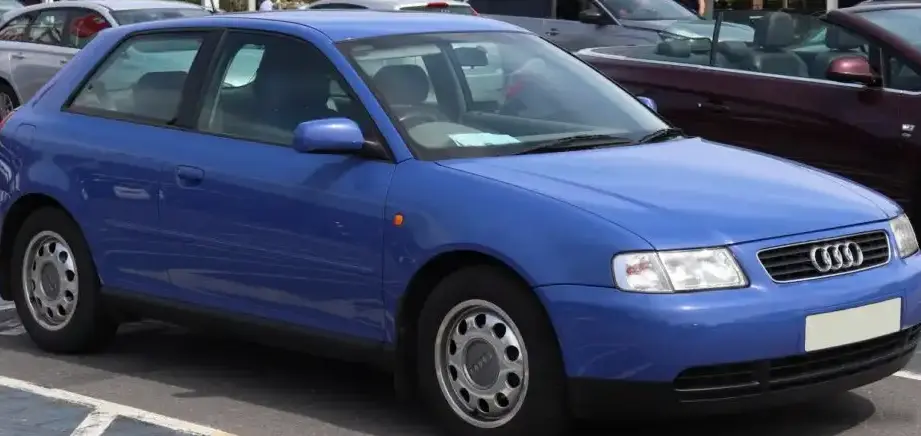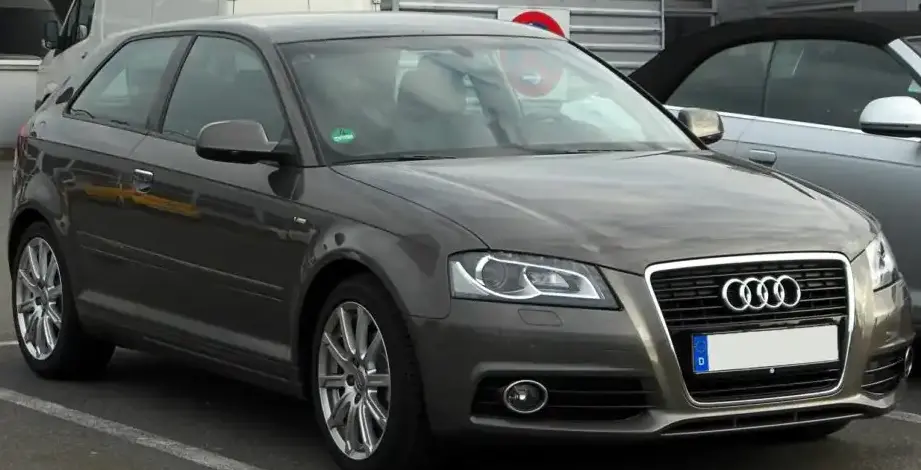
The Audi A3 (8P) facelift, produced from 2008 to 2013, represented a significant refresh of Audi’s popular compact hatchback. Within this generation, the 2.0 TFSI variant, boasting 200 horsepower and paired with the S tronic dual-clutch transmission, occupied a performance-oriented mid-range position in the A3 lineup. This model aimed to deliver a blend of sporty driving dynamics and everyday usability, appealing to buyers seeking a more engaging experience than the base engine options but without the higher price tag of the S3. It was a key offering in the European market, where the three-door hatchback configuration was particularly popular, and saw limited sales in North America where the A3 was primarily offered as a four-door sedan.
Technical Specifications
| Brand | Audi |
| Model | A3 |
| Generation | A3 (8P, facelift 2008) |
| Type (Engine) | 2.0 TFSI (200 Hp) S tronic |
| Start of production | 2008 |
| End of production | 2013 |
| Powertrain Architecture | Internal Combustion engine |
| Body type | Hatchback |
| Seats | 5 |
| Doors | 3 |
| Fuel consumption (urban) | 9.8 l/100 km (24 US mpg, 28.8 UK mpg, 10.2 km/l) |
| Fuel consumption (extra urban) | 5.7 l/100 km (41.3 US mpg, 49.6 UK mpg, 17.5 km/l) |
| Fuel consumption (combined) | 7.2 l/100 km (32.7 US mpg, 39.2 UK mpg, 13.9 km/l) |
| Fuel Type | Petrol (Gasoline) |
| Acceleration 0 – 100 km/h | 6.8 sec |
| Acceleration 0 – 62 mph | 6.8 sec |
| Acceleration 0 – 60 mph | 6.5 sec |
| Maximum speed | 238 km/h (147.89 mph) |
| Emission standard | Euro 4 |
| Weight-to-power ratio | 6.7 kg/Hp, 150.4 Hp/tonne |
| Weight-to-torque ratio | 4.8 kg/Nm, 210.5 Nm/tonne |
| Power | 200 Hp @ 5100 rpm |
| Power per litre | 100.8 Hp/l |
| Torque | 280 Nm @ 1700-5000 rpm (206.52 lb.-ft. @ 1700-5000 rpm) |
| Engine layout | Front, Transverse |
| Engine Model/Code | BWA, CAWB, CBFA, CCZA |
| Engine displacement | 1984 cm3 (121.07 cu. in.) |
| Number of cylinders | 4 |
| Engine configuration | Inline |
| Cylinder Bore | 82.5 mm (3.25 in.) |
| Piston Stroke | 92.8 mm (3.65 in.) |
| Compression ratio | 11.5:1 |
| Number of valves per cylinder | 4 |
| Fuel injection system | Direct injection |
| Engine aspiration | Turbocharger, Intercooler |
| Valvetrain | DOHC |
| Engine oil capacity | 4.6 l (4.86 US qt | 4.05 UK qt) |
| Kerb Weight | 1330 kg (2932.15 lbs.) |
| Max. weight | 1890 kg (4166.74 lbs.) |
| Max load | 560 kg (1234.59 lbs.) |
| Trunk (boot) space – minimum | 350 l (12.36 cu. ft.) |
| Trunk (boot) space – maximum | 1080 l (38.14 cu. ft.) |
| Fuel tank capacity | 55 l (14.53 US gal | 12.1 UK gal) |
| Length | 4238 mm (166.85 in.) |
| Width | 1765 mm (69.49 in.) |
| Height | 1421 mm (55.94 in.) |
| Wheelbase | 2578 mm (101.5 in.) |
| Front track | 1534 mm (60.39 in.) |
| Rear (Back) track | 1507 mm (59.33 in.) |
| Drag coefficient (Cd) | 0.33 |
| Minimum turning circle | 10.7 m (35.1 ft.) |
| Drivetrain Architecture | The Internal combustion engine (ICE) drives the front wheels of the vehicle. |
| Drive wheel | Front wheel drive |
| Number of gears | 6 |
| Gearbox type | automatic transmission S-Tronic |
| Front suspension | Spring Strut |
| Rear suspension | Coil spring |
| Front brakes | Ventilated discs |
| Rear brakes | Disc |
| Assisting systems | ABS (Anti-lock braking system) |
| Steering type | Steering rack and pinion |
| Power steering | Hydraulic Steering |
| Tires size | 205/55 R16; 225/45 R17 |
| Wheel rims size | 6.5J x 16; 7.5J x 17 |
INTRODUCTION
The Audi A3 (8P) facelift, launched in 2008, built upon the success of the original 8P model introduced in 1996. This refresh brought revised styling, improved interior materials, and updated technology. The 2.0 TFSI 200 hp S tronic variant was a key part of this update, offering a compelling combination of performance and efficiency. Positioned above the 1.6 and 1.4 TFSI models, it provided a noticeable power increase and a more sophisticated driving experience. The S tronic transmission, a seven-speed dual-clutch unit, was a significant upgrade over traditional automatic transmissions, offering faster shifts and improved fuel economy. This variant was primarily aimed at drivers who wanted a sporty and refined hatchback for daily use.
Powertrain & Engine Architecture
At the heart of the A3 2.0 TFSI was the EA888 engine family, specifically the BWA, CAWB, CBFA, or CCZA engine code depending on the exact production year and market. This 1984cc inline-four cylinder engine featured direct fuel injection (FSI) and a turbocharger with an intercooler. The direct injection system allowed for precise fuel delivery, improving both power and efficiency. The engine utilized a dual overhead camshaft (DOHC) valvetrain with four valves per cylinder, optimizing airflow for increased performance. The S tronic transmission, a seven-speed dual-clutch gearbox, was a crucial component of this powertrain. It operated by using two separate clutches for odd and even gears, allowing for incredibly fast and smooth gear changes. This transmission offered both fully automatic and manual shift modes, giving the driver control over the driving experience.
Driving Characteristics
The 200 hp 2.0 TFSI engine, coupled with the S tronic transmission, delivered a responsive and engaging driving experience. Acceleration from 0 to 60 mph took approximately 6.5 seconds, making it noticeably quicker than the lower-powered A3 variants. The S tronic transmission’s quick shifts minimized power interruption during acceleration, contributing to a seamless power delivery. While not as raw or focused as the S3, the 2.0 TFSI offered ample power for everyday driving and spirited weekend excursions. The gear ratios were tuned to provide a balance between acceleration and fuel efficiency. In automatic mode, the transmission intelligently selected the appropriate gear based on driving conditions, while the manual mode allowed drivers to take full control. Compared to the six-speed manual transmission available on other A3 models, the S tronic offered quicker shifts but some enthusiasts preferred the more direct feel of a manual gearbox.
Equipment & Trim Levels
The 2.0 TFSI S tronic typically came well-equipped, reflecting its mid-range positioning. Standard features often included alloy wheels (typically 16 or 17 inch), air conditioning, a multi-function steering wheel, and an Audi Concert audio system. Interior upholstery was usually a cloth or a combination of cloth and leather. Optional extras included a panoramic sunroof, leather upholstery, navigation system, parking sensors, and xenon headlights. Trim levels varied slightly depending on the market, but generally offered progressive upgrades in terms of interior appointments and technology. The Sport trim level, for example, often included sport seats, lowered suspension, and unique styling cues.
Chassis & Braking
The A3 8P facelift featured a MacPherson strut front suspension and a multi-link rear suspension, providing a comfortable yet controlled ride. The 2.0 TFSI models typically had slightly stiffer suspension settings compared to the base models to enhance handling. Braking systems consisted of ventilated front discs and solid rear discs. Anti-lock braking system (ABS) was standard, providing enhanced braking performance and stability. The weight distribution was well-balanced, contributing to the car’s neutral handling characteristics. Stabilizer bars were fitted to both the front and rear axles to reduce body roll during cornering.
Market Reception & Comparison
The Audi A3 2.0 TFSI S tronic was generally well-received by automotive critics. It was praised for its refined engine, quick-shifting transmission, and comfortable ride. Fuel economy was considered respectable for a performance-oriented hatchback, averaging around 32.7 US mpg in combined driving. Compared to the 1.8 TFSI models, the 2.0 TFSI offered a significant power boost, while the 1.6 TDI and 1.9 TDI diesel variants provided even better fuel economy but lacked the same level of performance. Reliability was generally good, although some owners reported issues with the turbocharger and the S tronic transmission, particularly with early production units.
Legacy
The Audi A3 8P 2.0 TFSI S tronic remains a popular choice in the used car market. The EA888 engine is known for its tunability, and many owners have opted to remap the engine for increased power. The S tronic transmission, while generally reliable, requires regular maintenance, including fluid changes, to ensure longevity. The combination of performance, practicality, and Audi’s reputation for build quality has ensured that this variant continues to hold its value. It represents a sweet spot in the 8P A3 lineup, offering a compelling blend of driving enjoyment and everyday usability.