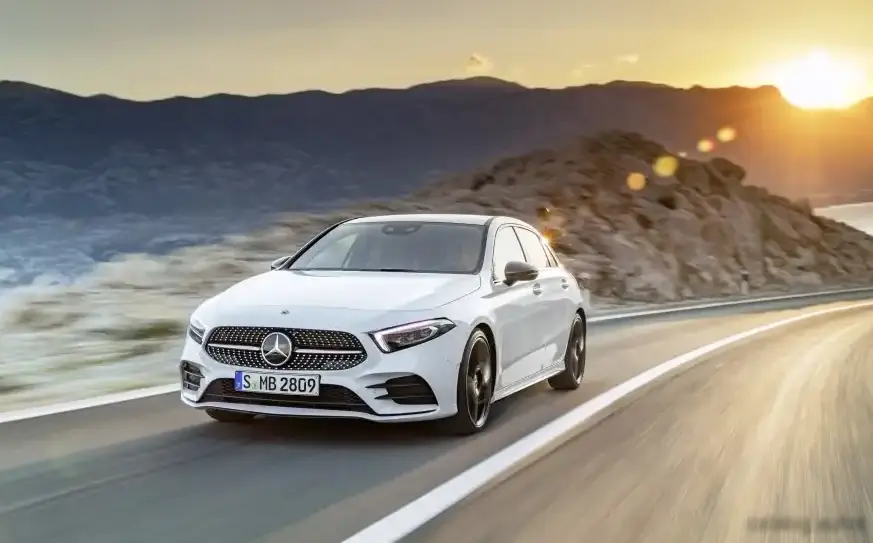
The Mercedes-Benz A-Class (W177) A 160, produced from 2018 to 2022, represents the entry point into the fourth generation of Mercedes-Benz’s compact hatchback. Positioned as the base model within the W177 range, the A 160 aimed to offer accessible premium motoring with a focus on fuel efficiency and everyday usability. It served as a crucial volume seller, particularly in European markets where smaller, fuel-efficient vehicles are highly sought after. This variant distinguished itself from higher-trim A-Class models like the A 250 with its smaller displacement engine and more economical focus.
Technical Specifications
| Brand | Mercedes-Benz |
| Model | A-Class |
| Generation | A-Class (W177) |
| Type (Engine) | A 160 (109 Hp) |
| Start of production | 2018 |
| End of production | 2022 |
| Powertrain Architecture | Internal Combustion engine |
| Body type | Hatchback |
| Seats | 5 |
| Doors | 5 |
| Fuel consumption at Low speed (WLTP) | 5.9 l/100 km (39.9 US mpg, 47.9 UK mpg, 16.9 km/l) |
| Fuel consumption at very high speed (WLTP) | 6.7 l/100 km (35.1 US mpg, 42.2 UK mpg, 14.9 km/l) |
| CO2 emissions (WLTP) | 133-151 g/km |
| Fuel consumption (economy) – urban | 7.5-7.7 l/100 km (31.4 – 30.5 US mpg, 37.7 – 36.7 UK mpg, 13.3 – 13 km/l) |
| Fuel consumption (economy) – extra urban | 4.4-4.6 l/100 km (53.5 – 51.1 US mpg, 64.2 – 61.4 UK mpg, 22.7 – 21.7 km/l) |
| Fuel consumption (economy) – combined | 5.5-5.8 l/100 km (42.8 – 40.6 US mpg, 51.4 – 48.7 UK mpg, 18.2 – 17.2 km/l) |
| CO2 emissions | 127-132 g/km |
| Fuel Type | Petrol (Gasoline) |
| Acceleration 0 – 100 km/h | 10.9 sec |
| Acceleration 0 – 62 mph | 10.9 sec |
| Acceleration 0 – 60 mph | 10.4 sec |
| Maximum speed | 200 km/h (124.27 mph) |
| Emission standard | Euro 6 d |
| Weight-to-power ratio | 11.7 kg/Hp, 85.5 Hp/tonne |
| Weight-to-torque ratio | 7.1 kg/Nm, 141.2 Nm/tonne |
| Power | 109 Hp |
| Power per litre | 81.8 Hp/l |
| Torque | 180 Nm @ 1375 rpm (132.76 lb.-ft. @ 1375 rpm) |
| Engine layout | Front, Transverse |
| Engine Model/Code | M 282.914 |
| Engine displacement | 1332 cm3 (81.28 cu. in.) |
| Number of cylinders | 4 |
| Engine configuration | Inline |
| Number of valves per cylinder | 4 |
| Fuel injection system | Direct injection |
| Engine aspiration | Turbocharger, Intercooler |
| Engine oil capacity | 5.1 l (5.39 US qt, 4.49 UK qt) |
| Coolant | 6.8 l (7.19 US qt, 5.98 UK qt) |
| Kerb Weight | 1275 kg (2810.89 lbs.) |
| Max. weight | 1860 kg (4100.6 lbs.) |
| Max load | 585 kg (1289.7 lbs.) |
| Fuel tank capacity | 43 l (11.36 US gal, 9.46 UK gal) |
| Permitted trailer load with brakes (12%) | 1300 kg (2866.01 lbs.) |
| Permitted trailer load without brakes | 675 kg (1488.12 lbs.) |
| Length | 4419 mm (173.98 in.) |
| Width | 1796 mm (70.71 in.) |
| Height | 1440 mm (56.69 in.) |
| Wheelbase | 2729 mm (107.44 in.) |
| Front track | 1567 mm (61.69 in.) |
| Front overhang | 914 mm (35.98 in.) |
| Rear overhang | 776 mm (30.55 in.) |
| Ride height (ground clearance) | 104 mm (4.09 in.) |
| Approach angle | 13.4° |
| Departure angle | 17.2° |
| Ramp-over (brakeover) angle | 9.4° |
| Drivetrain Architecture | The Internal combustion engine (ICE) drives the front wheels of the vehicle. |
| Drive wheel | Front wheel drive |
| Number of gears and type of gearbox | 7 gears, automatic transmission |
| Front brakes | Ventilated discs |
| Rear brakes | Disc |
| Assisting systems | ABS (Anti-lock braking system) |
| Steering type | Steering rack and pinion |
| Power steering | Electric Steering |
INTRODUCTION
The W177 A-Class represented a significant leap forward for Mercedes-Benz’s compact offerings, moving away from the “sandwich floor” design of its predecessors. The A 160, introduced in 2018, served as the entry-level model, offering a balance of affordability and Mercedes-Benz luxury. It was primarily aimed at buyers seeking a premium hatchback for urban driving and shorter commutes. The A 160 was offered with a 7-speed dual-clutch automatic transmission as standard, a departure from the availability of manual transmissions in some other A-Class variants.
Powertrain & Engine Architecture
The A 160 is powered by the M 282.914, a 1.332-liter turbocharged four-cylinder gasoline engine. This engine is part of Mercedes-Benz’s modular engine family, designed for efficiency and scalability. It features direct fuel injection, a single turbocharger with an intercooler, and four valves per cylinder. The engine utilizes a closed-loop fuel injection system managed by a sophisticated engine control unit (ECU) to optimize combustion and reduce emissions. The 7G-DCT (7-speed dual-clutch transmission) is a key component of the A 160’s powertrain. This transmission offers quick and smooth gear changes, contributing to both performance and fuel efficiency. The dual-clutch design allows for pre-selection of the next gear, minimizing interruption in power delivery.
Driving Characteristics
The A 160, with its 109 horsepower and 180 Nm (133 lb-ft) of torque, delivers adequate performance for everyday driving. Acceleration from 0 to 60 mph takes approximately 10.4 seconds, and the top speed is limited to 124 mph. While not a performance-oriented model, the A 160 provides sufficient power for merging onto highways and navigating city streets. The 7G-DCT transmission contributes to a refined driving experience, with smooth gear changes and responsive acceleration. The gear ratios are tuned for fuel efficiency, prioritizing lower engine speeds during cruising. Compared to the more powerful A 250, the A 160 feels noticeably less energetic, particularly during overtaking maneuvers. However, its lighter weight and efficient engine contribute to better fuel economy.
Equipment & Trim Levels
The A 160 came standard with a respectable level of equipment, including automatic climate control, a 7-inch touchscreen infotainment system, and a suite of safety features such as automatic emergency braking and lane keeping assist. Interior upholstery typically consisted of fabric seats, although leatherette options were available. Standard dashboard configuration featured a combination of analog gauges and a central display screen. Optional extras included larger touchscreen displays, premium audio systems, and various driver assistance packages. The A 160 was generally positioned as a more basic trim level, with fewer standard features compared to the A 200 or A 250 models.
Chassis & Braking
The W177 A-Class utilizes a MacPherson strut front suspension and a multi-link rear suspension. The A 160’s suspension is tuned for comfort, providing a relatively smooth ride quality. Front brakes are ventilated discs, while rear brakes are solid discs. The A 160 is equipped with ABS (Anti-lock Braking System) and electronic stability control (ESC) as standard safety features. The chassis is designed to provide a balance of handling and ride comfort, prioritizing stability and predictability over sporty dynamics. Stabilizer bars are fitted to both the front and rear axles to reduce body roll during cornering.
Market Reception & Comparison
The A 160 received mixed reviews from automotive critics. While praised for its fuel efficiency and comfortable ride, it was often criticized for its lack of outright performance. Compared to the A 200 and A 250 models, the A 160 offered a more affordable entry point into the A-Class range, but at the expense of power and refinement. Fuel economy figures were competitive, with combined fuel consumption ranging from 5.5 to 5.8 liters per 100 kilometers (42.8 to 40.6 US mpg). Reliability reports have generally been positive, with the M 282 engine proving to be relatively robust.
Legacy
The A 160 (W177) represents an important step in Mercedes-Benz’s strategy to offer a wider range of compact models. While not the most sought-after variant, it provided an accessible entry point into the A-Class lineup, attracting buyers who prioritized fuel efficiency and affordability. On the used car market, the A 160 offers good value for money, particularly for those seeking a well-equipped and reliable hatchback. The 7G-DCT transmission, while generally reliable, may require servicing at higher mileages. Overall, the A 160 remains a practical and economical choice for those seeking a premium compact car.