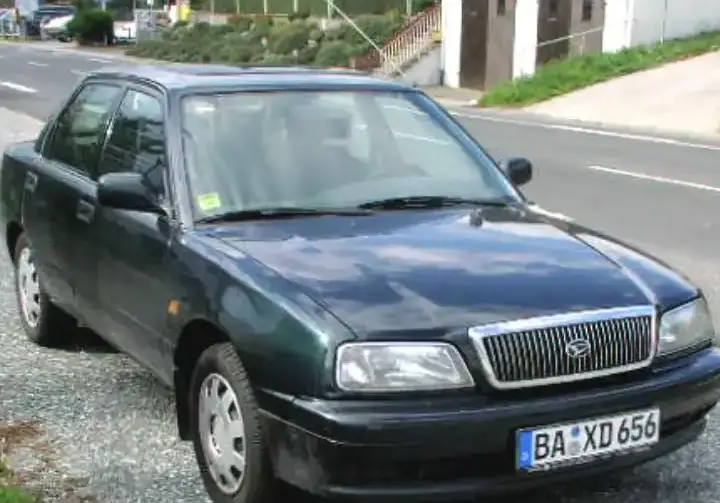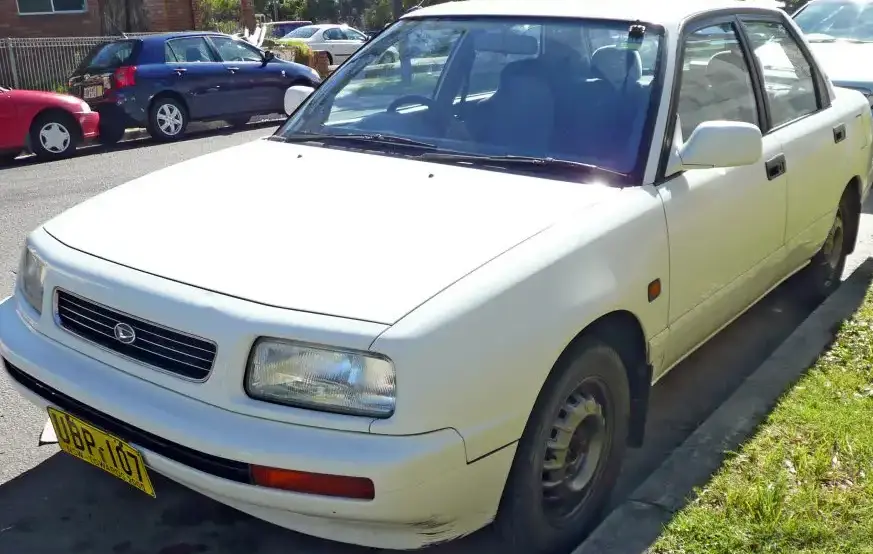
The Daihatsu Applause, a compact hatchback produced between 1989 and 1997, represented Daihatsu’s attempt to move upmarket and offer a more refined vehicle aimed at the Japanese domestic market (JDM) and export markets like Europe and Australia. The first generation, designated A101 and A111, was notable for its relatively spacious interior and comfortable ride. Within the Applause I range, the 1.6 16V (A101) variant, producing 105 horsepower, occupied a middle ground, offering a balance between performance and affordability. It served as a step up from the base 1.5L models, while remaining more accessible than the later, more powerful 1.8L options.
Technical Specifications
| Brand | Daihatsu |
| Model | Applause |
| Generation | Applause I (A101, A111) |
| Type (Engine) | 1.6 16V (A101) (105 Hp) |
| Start of production | 1989 |
| End of production | 1997 |
| Powertrain Architecture | Internal Combustion engine |
| Body type | Hatchback |
| Seats | 5 |
| Doors | 5 |
| Fuel consumption (combined) | 9.8 l/100 km (24 US mpg, 28.8 UK mpg, 10.2 km/l) |
| Fuel Type | Petrol (Gasoline) |
| Acceleration 0 – 100 km/h | 9.8 sec |
| Acceleration 0 – 62 mph | 9.8 sec |
| Acceleration 0 – 60 mph | 9.3 sec |
| Maximum speed | 185 km/h (114.95 mph) |
| Weight-to-power ratio | 8.9 kg/Hp, 112.9 Hp/tonne |
| Weight-to-torque ratio | 6.9 kg/Nm, 144.1 Nm/tonne |
| Power | 105 Hp @ 6000 rpm |
| Power per litre | 66 Hp/l |
| Torque | 134 Nm @ 4800 rpm (98.83 lb.-ft. @ 4800 rpm) |
| Engine layout | Front, Transverse |
| Engine displacement | 1590 cm3 (97.03 cu. in.) |
| Number of cylinders | 4 |
| Engine configuration | Inline |
| Cylinder Bore | 76 mm (2.99 in.) |
| Piston Stroke | 87.6 mm (3.45 in.) |
| Compression ratio | 9.5:1 |
| Number of valves per cylinder | 4 |
| Fuel injection system | Multi-port manifold injection |
| Engine aspiration | Naturally aspirated engine |
| Valvetrain | OHC |
| Kerb Weight | 930 kg (2050.3 lbs.) |
| Max. weight | 1420 kg (3130.56 lbs.) |
| Max load | 490 kg (1080.27 lbs.) |
| Trunk (boot) space – minimum | 412 l (14.55 cu. ft.) |
| Trunk (boot) space – maximum | 764 l (26.98 cu. ft.) |
| Fuel tank capacity | 50 l (13.21 US gal | 11 UK gal) |
| Length | 4315 mm (169.88 in.) |
| Width | 1660 mm (65.35 in.) |
| Height | 1385 mm (54.53 in.) |
| Wheelbase | 2470 mm (97.24 in.) |
| Front track | 1425 mm (56.1 in.) |
| Rear (Back) track | 1415 mm (55.71 in.) |
| Drivetrain Architecture | The Internal combustion engine (ICE) drives the front wheels of the vehicle. |
| Drive wheel | Front wheel drive |
| Number of gears and type of gearbox | 5 gears, manual transmission |
| Front suspension | Spring Strut |
| Rear suspension | Double wishbone |
| Front brakes | Ventilated discs |
| Rear brakes | Disc |
| Steering type | Steering rack and pinion |
| Power steering | Hydraulic Steering |
| Tires size | 185/60 R 14 |
Powertrain & Engine Architecture
The heart of the Applause 1.6 16V was the 4A91 engine, a 1.6-liter inline-four cylinder gasoline engine. This engine featured a single overhead camshaft (SOHC) design and utilized multi-port fuel injection for improved efficiency and responsiveness. The 16-valve configuration, achieved through four valves per cylinder, enhanced breathing and contributed to the engine’s 105 horsepower output. The engine’s block was constructed from cast iron, while the cylinder head was made of aluminum. The 4A91 engine was known for its relatively smooth operation and decent reliability. The five-speed manual transmission was the standard offering, providing drivers with good control over the engine’s power band. The transmission was a conventional setup with synchromesh on all forward gears.
Driving Characteristics
The 1.6L Applause offered a reasonably engaging driving experience for its class. While not a sports car, the 105 hp engine provided adequate power for everyday driving and even some spirited acceleration. The 0-60 mph time of around 9.3 seconds was respectable for the early 1990s. The five-speed manual transmission allowed drivers to keep the engine in its optimal power range, making overtaking maneuvers relatively easy. Compared to the base 1.5L models, the 1.6 16V offered noticeably improved acceleration and a more willing engine. However, it didn’t possess the outright performance of the later 1.8L variants. The steering was light and precise, contributing to a feeling of agility. The suspension, while tuned for comfort, provided reasonable body control in corners.
Equipment & Trim Levels
The Applause 1.6 16V typically came equipped with features considered standard for a compact hatchback of its era. These included power steering, central locking, electric windows, and an AM/FM radio. Higher trim levels, often denoted by suffixes like “S” or “E”, added features such as alloy wheels, upgraded interior upholstery, and a more comprehensive sound system. Interior materials were generally of good quality for the price point, and the cabin was well-laid out and functional. Optional extras included air conditioning, a sunroof, and upgraded audio systems.
Chassis & Braking
The Applause I utilized a front-engine, front-wheel-drive layout. The suspension consisted of MacPherson struts at the front and a double wishbone setup at the rear, providing a comfortable ride and decent handling characteristics. Braking duties were handled by ventilated discs at the front and solid discs at the rear. The braking system was adequate for the vehicle’s weight and performance, but lacked the sophistication of more modern systems. The steering was a rack-and-pinion system with hydraulic power assistance, offering light and precise steering feel.
Market Reception & Comparison
The Daihatsu Applause was generally well-received by automotive critics for its spacious interior, comfortable ride, and relatively affordable price. The 1.6 16V variant was praised for its improved performance compared to the base models. However, some critics noted that the Applause lacked the brand recognition of its more established competitors. In terms of fuel economy, the 1.6L Applause offered a reasonable 24 mpg combined, which was competitive for its time. Reliability was generally good, although some owners reported minor issues with the electrical system. Compared to other compact hatchbacks of the era, such as the Honda Civic or Toyota Corolla, the Applause offered a slightly more refined driving experience and a more spacious interior, but lacked the same level of brand prestige.
Legacy
The Daihatsu Applause, while not a mainstream success in many markets, established Daihatsu as a manufacturer capable of producing well-built and comfortable vehicles. The 1.6 16V powertrain proved to be relatively durable and reliable, and many examples are still on the road today. In the used car market, the Applause is appreciated by enthusiasts for its affordability, simplicity, and quirky charm. While parts availability can be a challenge in some regions, the 4A91 engine is generally easy to maintain and repair. The Applause represents a unique and often overlooked chapter in the history of Japanese automotive engineering.