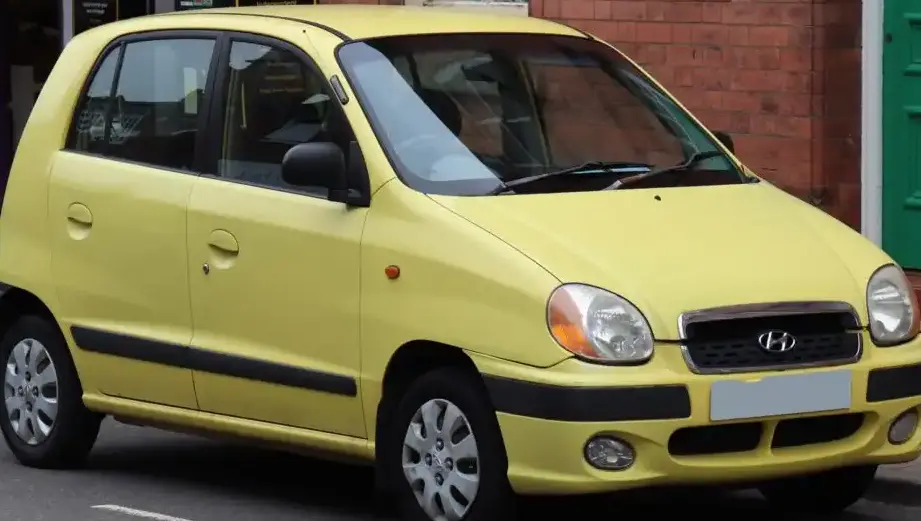
The Hyundai Atos 1.0 i, produced from 1997 to 2001, was a subcompact hatchback primarily aimed at the entry-level market, particularly in Europe and Asia. Representing Hyundai’s foray into the ultra-compact car segment, the Atos was designed to be an affordable and practical city car. This specific 1.0-liter, 56 horsepower variant served as the base model, offering a budget-friendly option within the Atos lineup. It was positioned below the slightly more powerful 1.5-liter versions, targeting buyers prioritizing fuel efficiency and low running costs over outright performance.
Technical Specifications
| Brand | Hyundai |
| Model | Atos |
| Generation | Atos |
| Type (Engine) | 1.0 i (56 Hp) |
| Start of production | 1997 |
| End of production | 2001 |
| Powertrain Architecture | Internal Combustion engine |
| Body type | Hatchback |
| Seats | 5 |
| Doors | 5 |
| Fuel consumption (urban) | 8 l/100 km (29.4 US mpg) |
| Fuel consumption (extra urban) | 5.4 l/100 km (43.6 US mpg) |
| Fuel Type | Petrol (Gasoline) |
| Acceleration 0 – 100 km/h | 15.1 sec |
| Acceleration 0 – 62 mph | 15.1 sec |
| Acceleration 0 – 60 mph | 14.3 sec |
| Maximum speed | 142 km/h (88.23 mph) |
| Weight-to-power ratio | 14.8 kg/Hp |
| Weight-to-torque ratio | 10.1 kg/Nm |
| Power | 56 Hp @ 5500 rpm |
| Power per litre | 56.1 Hp/l |
| Torque | 82 Nm @ 3100 rpm (60.48 lb.-ft. @ 3100 rpm) |
| Engine layout | Front, Transverse |
| Engine Model/Code | Epsilon / G4HC |
| Engine displacement | 999 cm3 (60.96 cu. in.) |
| Number of cylinders | 4 |
| Engine configuration | Inline |
| Cylinder Bore | 66 mm (2.6 in.) |
| Piston Stroke | 73 mm (2.87 in.) |
| Compression ratio | 9.5:1 |
| Number of valves per cylinder | 3 |
| Fuel injection system | Multi-port manifold injection |
| Engine aspiration | Naturally aspirated |
| Valvetrain | OHC |
| Engine oil capacity | 2.8 l (2.96 US qt | 2.46 UK qt) |
| Coolant | 6 l (6.34 US qt | 5.28 UK qt) |
| Kerb Weight | 830 kg (1829.84 lbs.) |
| Max. weight | 1220 kg (2689.64 lbs.) |
| Max load | 390 kg (859.8 lbs.) |
| Trunk (boot) space – minimum | 263 l (9.29 cu. ft.) |
| Trunk (boot) space – maximum | 1064 l (37.57 cu. ft.) |
| Fuel tank capacity | 35 l (9.25 US gal | 7.7 UK gal) |
| Length | 3495 mm (137.6 in.) |
| Width | 1495 mm (58.86 in.) |
| Height | 1615 mm (63.58 in.) |
| Wheelbase | 2380 mm (93.7 in.) |
| Front track | 1315 mm (51.77 in.) |
| Rear track | 1300 mm (51.18 in.) |
| Minimum turning circle | 9.1 m (29.86 ft.) |
| Drivetrain Architecture | Front wheel drive |
| Number of gears | 5 gears, manual transmission |
| Front suspension | Spring Strut |
| Rear suspension | Torsion |
| Front brakes | Disc |
| Rear brakes | Drum |
| Assisting systems | ABS (Anti-lock braking system) |
| Steering type | Steering rack and pinion |
| Power steering | Hydraulic |
| Tires size | 155/70 R13 |
Introduction
The Hyundai Atos 1.0 i, launched in 1997, was a key model in Hyundai’s strategy to establish a stronger foothold in the European and Asian small car markets. Built on a dedicated platform, the Atos aimed to provide a practical and affordable transportation solution. The 1.0-liter engine variant was the entry point to the range, designed for buyers seeking maximum fuel economy and low purchase price. It represented a significant step for Hyundai, showcasing improved build quality and design compared to earlier models.
Powertrain & Engine Architecture
The heart of the Atos 1.0 i is the Hyundai Epsilon (G4HC) engine, a 999cc inline-four cylinder petrol engine. This engine utilizes a single overhead camshaft (SOHC) valvetrain with three valves per cylinder (two intake, one exhaust). The engine employs multi-point fuel injection, contributing to improved fuel efficiency and smoother operation. While modest in output, the G4HC was known for its reliability and relatively simple maintenance requirements. The engine’s design prioritized fuel economy over outright power. The Atos 1.0 i was exclusively offered with a five-speed manual transmission, optimized for maximizing fuel efficiency and providing adequate acceleration for urban driving. The transmission featured a relatively long final drive ratio, further emphasizing fuel economy.
Driving Characteristics
The Atos 1.0 i’s driving experience is best described as utilitarian. With only 56 horsepower, acceleration is leisurely, taking approximately 15 seconds to reach 62 mph (100 km/h). The engine feels strained at higher speeds, and highway driving requires careful planning. However, within city limits, the Atos 1.0 i is surprisingly nimble and easy to maneuver. The light steering and compact dimensions make parking and navigating tight spaces a breeze. The five-speed manual transmission allows drivers to keep the engine in its optimal power band, although frequent shifting is necessary for maintaining momentum. Compared to the 1.5-liter versions, the 1.0-liter Atos offers significantly less power but boasts superior fuel economy.
Equipment & Trim Levels
The Atos 1.0 i, being the base model, came with a fairly basic level of equipment. Standard features typically included power steering, central locking, and a basic audio system. Interior upholstery was typically cloth, and the dashboard featured a simple, functional design. Optional extras included air conditioning, power windows, and upgraded audio systems. Trim levels were generally limited, with most variations focusing on the addition of optional equipment packages. The interior was designed for practicality and durability rather than luxury.
Chassis & Braking
The Atos 1.0 i features a relatively simple chassis design. Front suspension utilizes a MacPherson strut setup, while the rear employs a torsion beam axle. This configuration provides a comfortable ride quality, particularly on smooth roads. Braking duties are handled by disc brakes at the front and drum brakes at the rear. ABS (Anti-lock Braking System) was often included as standard equipment, enhancing safety. The suspension tuning prioritized ride comfort over sporty handling. The relatively lightweight construction of the Atos 1.0 i helped to compensate for the modest braking performance.
Market Reception & Comparison
The Hyundai Atos 1.0 i was generally well-received by critics as an affordable and practical city car. Its fuel efficiency and low running costs were particularly praised. However, its lack of power and basic interior were often cited as drawbacks. Compared to competitors like the Fiat Panda and the Renault Twingo, the Atos offered a competitive price point and a slightly more spacious interior. The 1.5-liter Atos models offered significantly better performance but came at a higher price. The 1.0-liter version appealed to buyers prioritizing economy and affordability above all else.
Legacy
The Hyundai Atos 1.0 i has proven to be a remarkably reliable vehicle, with many examples still on the road today. The G4HC engine is known for its durability and relatively simple maintenance requirements. In the used car market, the Atos 1.0 i remains an attractive option for buyers seeking an inexpensive and fuel-efficient city car. While not a performance icon, the Atos 1.0 i played a significant role in establishing Hyundai as a credible player in the European and Asian automotive markets. Its affordability and practicality made it a popular choice for first-time car buyers and those seeking a low-cost transportation solution.