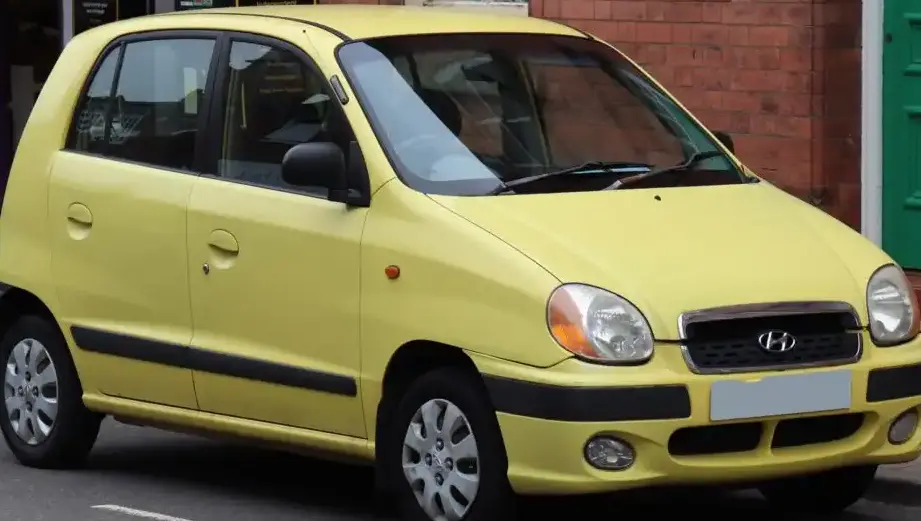
The Hyundai Atos 1.1 i 12V, producing 59 horsepower, was a subcompact hatchback manufactured by Hyundai from 2003 to 2008. Positioned as an entry-level vehicle, particularly in emerging markets, the Atos aimed to provide affordable and practical transportation. It was a key model in Hyundai’s strategy to expand its global presence, offering a budget-friendly alternative to established competitors. The Atos falls within the first generation of the model, known internally as the MX, and was primarily sold in Europe, Asia, and South America. This specific 1.1L variant, often equipped with a manual transmission, represented the base engine option within the Atos lineup.
Technical Specifications
| Brand | Hyundai |
| Model | Atos |
| Generation | Atos |
| Type (Engine) | 1.1 i 12V (59 Hp) |
| Start of production | 2003 |
| End of production | 2008 |
| Powertrain Architecture | Internal Combustion engine |
| Body type | Hatchback |
| Seats | 5 |
| Doors | 5 |
| Fuel consumption (urban) | 7.4 l/100 km (31.8 US mpg) |
| Fuel consumption (extra urban) | 5 l/100 km (47 US mpg) |
| Fuel consumption (combined) | 5.9 l/100 km (39.9 US mpg) |
| Fuel Type | Petrol (Gasoline) |
| Acceleration 0 – 100 km/h | 15.4 sec |
| Acceleration 0 – 62 mph | 15.4 sec |
| Acceleration 0 – 60 mph | 14.6 sec |
| Maximum speed | 152 km/h (94.45 mph) |
| Power | 59 Hp @ 5450 rpm |
| Torque | 83 Nm @ 2850 rpm (61.22 lb.-ft. @ 2850 rpm) |
| Engine layout | Front, Transverse |
| Engine Model/Code | Epsilon / G4HG |
| Engine displacement | 1086 cm3 (66.27 cu. in.) |
| Number of cylinders | 4 |
| Engine configuration | Inline |
| Cylinder Bore | 67 mm (2.64 in.) |
| Piston Stroke | 77 mm (3.03 in.) |
| Compression ratio | 10:1 |
| Number of valves per cylinder | 3 |
| Fuel injection system | Multi-port manifold injection |
| Engine aspiration | Naturally aspirated |
| Engine oil capacity | 3.1 l (3.28 US qt | 2.73 UK qt) |
| Coolant capacity | 4.5 l (4.76 US qt | 3.96 UK qt) |
| Trunk (boot) space – minimum | 263 l (9.29 cu. ft.) |
| Trunk (boot) space – maximum | 1084 l (38.28 cu. ft.) |
| Fuel tank capacity | 35 l (9.25 US gal | 7.7 UK gal) |
| Length | 3495 mm (137.6 in.) |
| Width | 1495 mm (58.86 in.) |
| Height | 1615 mm (63.58 in.) |
| Wheelbase | 2380 mm (93.7 in.) |
| Front track | 1315 mm (51.77 in.) |
| Rear track | 1300 mm (51.18 in.) |
| Minimum turning circle | 9.1 m (29.86 ft.) |
| Drivetrain Architecture | Front wheel drive |
| Number of gears | 5 |
| Gearbox type | Manual transmission |
| Front suspension | Wishbone |
| Rear suspension | Coil spring |
| Front brakes | Ventilated discs |
| Rear brakes | Drum |
| Assisting systems | ABS (Anti-lock braking system) |
| Steering type | Steering rack and pinion |
| Power steering | Hydraulic |
| Tires size | 155/80 R13 |
Powertrain & Engine Architecture
The Atos 1.1 i 12V is powered by Hyundai’s Epsilon (G4HG) engine, a 1.1-liter inline-four cylinder gasoline engine. This engine utilizes a single overhead camshaft (SOHC) design with three valves per cylinder (two intake, one exhaust). The engine employs multi-point fuel injection, delivering fuel directly to the intake ports. The 12-valve configuration, combined with the relatively small displacement, prioritized fuel efficiency over outright performance. The engine’s modest output of 59 horsepower at 5450 rpm and 83 Nm (61.22 lb-ft) of torque at 2850 rpm reflects its focus on economy. The engine is known for its simplicity and relatively low maintenance requirements. The standard transmission for this variant was a five-speed manual, although a four-speed automatic was also offered in some markets, albeit with a noticeable impact on performance and fuel economy.
Driving Characteristics
The Atos 1.1L with the manual transmission offered a basic, but functional driving experience. Acceleration was leisurely, taking approximately 15.4 seconds to reach 62 mph (100 km/h). The engine felt strained at higher speeds, and highway driving required frequent downshifting. The five-speed manual transmission helped to keep the engine within its optimal power band, but the overall experience was geared towards urban commuting rather than spirited driving. Compared to the slightly more powerful 1.3L or 1.5L variants, the 1.1L felt noticeably underpowered, especially when fully loaded with passengers and cargo. The automatic transmission version suffered even further in terms of acceleration and responsiveness.
Equipment & Trim Levels
The Atos 1.1 i 12V typically came with a fairly basic level of equipment. Standard features generally included power steering, central locking, and an AM/FM radio. Air conditioning was often an optional extra, as were power windows and alloy wheels. Interior upholstery was typically cloth, with a simple dashboard layout. Higher trim levels, available in some markets, added features such as a tachometer, upgraded audio systems, and body-colored bumpers and mirrors. The overall interior design prioritized practicality and durability over luxury.
Chassis & Braking
The Atos utilized a front-wheel-drive layout with a relatively simple suspension setup. The front suspension consisted of wishbones, while the rear suspension employed a coil spring arrangement. Braking was typically accomplished with ventilated discs on the front wheels and drum brakes on the rear. ABS (Anti-lock Braking System) was often included as standard equipment, enhancing safety. The chassis was designed for affordability and ease of manufacturing, rather than dynamic handling. Stabilizer bars were generally absent on the base 1.1L model, contributing to a noticeable degree of body roll during cornering.
Market Reception & Comparison
The Hyundai Atos 1.1 i 12V was generally well-received as an affordable and reliable city car. Critics praised its fuel efficiency and low running costs, but noted its lack of performance and refinement. Compared to other subcompacts of the time, such as the Fiat Panda or the Renault Twingo, the Atos offered a competitive price point but lacked the same level of driving enjoyment. The 1.1L engine was considered adequate for urban driving, but less suitable for longer journeys or carrying heavy loads. The automatic transmission version was often criticized for its sluggish performance and reduced fuel economy.
Legacy
The Hyundai Atos, particularly the 1.1L variant, has proven to be a durable and reliable vehicle. Many examples are still on the road today, testament to the engine’s robustness and the overall build quality. In the used car market, the Atos 1.1 i 12V remains an attractive option for budget-conscious buyers seeking a simple and economical mode of transportation. While not known for its performance or luxury, the Atos established Hyundai as a viable competitor in the global subcompact car segment, paving the way for the company’s subsequent success.