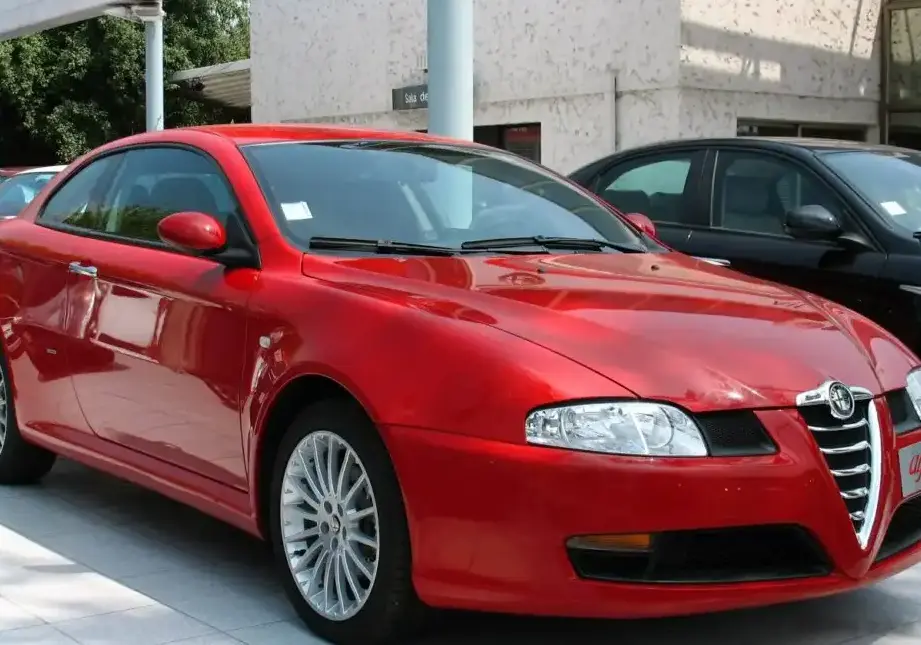
The Alfa Romeo GT Coupe (937), specifically the 1.9 16V JTD M-Jet variant producing 150 horsepower, was a front-wheel-drive coupe manufactured between 2003 and 2010. Positioned as a more economical and practical alternative to the more performance-focused models within the 937 range, this diesel-powered version aimed to broaden the GT’s appeal in European markets where diesel engines were highly favored. It represented a key offering in Alfa Romeo’s attempt to blend Italian styling with fuel efficiency and everyday usability. The 937 platform was a significant departure for Alfa Romeo, moving away from traditional rear-wheel-drive layouts.
Technical Specifications
| Brand | Alfa Romeo |
| Model | GT |
| Generation | GT Coupe (937) |
| Type (Engine) | 1.9 16V JTD M-Jet (150 Hp) |
| Start of production | 2003 |
| End of production | 2010 |
| Powertrain Architecture | Internal Combustion engine |
| Body type | Coupe |
| Seats | 4 |
| Doors | 2 |
| Fuel consumption (urban) | 8.5 l/100 km (27.7 US mpg, 33.2 UK mpg, 11.8 km/l) |
| Fuel consumption (extra urban) | 4.9 l/100 km (48 US mpg, 57.6 UK mpg, 20.4 km/l) |
| Fuel consumption (combined) | 6.2 l/100 km (37.9 US mpg, 45.6 UK mpg, 16.1 km/l) |
| CO2 emissions | 165 g/km |
| Fuel Type | Diesel |
| Acceleration 0 – 100 km/h | 9.2 sec |
| Acceleration 0 – 62 mph | 9.2 sec |
| Acceleration 0 – 60 mph | 8.7 sec |
| Maximum speed | 209 km/h (129.87 mph) |
| Emission standard | Euro 4 |
| Weight-to-power ratio | 9.6 kg/Hp, 104.2 Hp/tonne |
| Weight-to-torque ratio | 4.7 kg/Nm, 211.8 Nm/tonne |
| Power | 150 Hp @ 4000 rpm |
| Power per litre | 78.5 Hp/l |
| Torque | 305 Nm @ 2000 rpm (224.96 lb.-ft. @ 2000 rpm) |
| Engine layout | Front, Transverse |
| Engine Model/Code | 937A5000 |
| Engine displacement | 1910 cm3 (116.56 cu. in.) |
| Number of cylinders | 4 |
| Engine configuration | Inline |
| Cylinder Bore | 82 mm (3.23 in.) |
| Piston Stroke | 90.4 mm (3.56 in.) |
| Compression ratio | 18:1 |
| Number of valves per cylinder | 4 |
| Fuel injection system | Diesel Commonrail |
| Engine aspiration | Turbocharger, Intercooler |
| Valvetrain | DOHC |
| Engine oil capacity | 4.5 l (4.76 US qt | 3.96 UK qt) |
| Coolant | 7.2 l (7.61 US qt | 6.34 UK qt) |
| Kerb Weight | 1440 kg (3174.66 lbs.) |
| Max. weight | 1885 kg (4155.71 lbs.) |
| Max load | 445 kg (981.06 lbs.) |
| Trunk (boot) space – minimum | 320 l (11.3 cu. ft.) |
| Trunk (boot) space – maximum | 905 l (31.96 cu. ft.) |
| Fuel tank capacity | 63 l (16.64 US gal | 13.86 UK gal) |
| Max. roof load | 50 kg (110.23 lbs.) |
| Permitted trailer load with brakes (12%) | 1300 kg (2866.01 lbs.) |
| Permitted towbar download | 60 kg (132.28 lbs.) |
| Length | 4489 mm (176.73 in.) |
| Width | 1763 mm (69.41 in.) |
| Height | 1355 mm (53.35 in.) |
| Wheelbase | 2596 mm (102.2 in.) |
| Front track | 1524 mm (60 in.) |
| Rear (Back) track | 1510 mm (59.45 in.) |
| Front overhang | 967 mm (38.07 in.) |
| Rear overhang | 926 mm (36.46 in.) |
| Minimum turning circle (turning diameter) | 11.5 m (37.73 ft.) |
| Drivetrain Architecture | The Internal combustion engine (ICE) drives the front wheels of the vehicle. |
| Drive wheel | Front wheel drive |
| Number of gears and type of gearbox | 6 gears, manual transmission |
| Front suspension | Independent multi-link suspension, Transverse stabilizer |
| Rear suspension | McPherson, Transverse stabilizer |
| Front brakes | Ventilated discs, 284×22 mm |
| Rear brakes | Disc, 276×10 mm |
| Assisting systems | ABS (Anti-lock braking system) |
| Steering type | Steering rack and pinion |
| Power steering | Hydraulic Steering |
| Tires size | 205/60 R15; 205/55 R16 |
| Wheel rims size | 6J x 15; 7J x 16 |
Powertrain & Engine Architecture
The heart of this GT variant is the 1.9-liter, 16-valve JTD M-Jet diesel engine, identified by the code 937A5000. This engine belongs to the Fiat/Alfa Romeo family of common-rail direct injection diesels. The M-Jet technology, introduced by Fiat, represented an evolution of the common-rail system, utilizing multiple injection events per combustion cycle to improve efficiency, reduce noise, and lower emissions. The engine features a turbocharger with an intercooler, boosting power output to 150 horsepower at 4000 rpm and 305 Nm (224.96 lb-ft) of torque at 2000 rpm. The engine utilizes a double overhead camshaft (DOHC) valvetrain and a compression ratio of 18:1. The engine was paired with a 6-speed manual transmission, delivering power to the front wheels. While an automatic transmission was offered on other GT models, it wasn’t available with this specific 1.9 JTD M-Jet engine.
Driving Characteristics
The 1.9 JTD M-Jet equipped GT offered a distinctly different driving experience compared to the more powerful petrol-powered versions. While lacking the outright acceleration of the 2.0 JTS or the V6 models, it provided ample torque for everyday driving and comfortable cruising. The 6-speed manual transmission allowed for effective use of the engine’s torque band, providing responsive acceleration. The 0-60 mph time of around 8.7 seconds was respectable for a diesel coupe of this era. The focus was on fuel economy and relaxed performance rather than sporty handling. The front-wheel-drive configuration, while contributing to fuel efficiency, didn’t offer the same level of dynamic balance as a rear-wheel-drive setup.
Equipment & Trim Levels
The 1.9 JTD M-Jet variant typically came with a reasonably well-equipped specification, though it generally sat in the mid-range of the GT lineup. Standard features included air conditioning, power windows, central locking, and an RDS stereo system. Interior upholstery was typically cloth, though leather options were available. Optional extras included alloy wheels, a sunroof, parking sensors, and upgraded audio systems. The dashboard layout was consistent across the GT range, featuring a sporty three-dial instrument cluster. The trim level often dictated the availability of features like climate control and different interior finishes.
Chassis & Braking
The GT Coupe utilized an independent multi-link suspension at the front and a McPherson strut setup at the rear, providing a comfortable ride and reasonable handling. Stabilizer bars were fitted to both axles to reduce body roll. Braking consisted of ventilated discs at the front (284x22mm) and solid discs at the rear (276x10mm). Anti-lock Braking System (ABS) was standard. The suspension tuning was geared towards comfort and stability, rather than outright sportiness, reflecting the car’s intended role as a stylish and efficient coupe.
Market Reception & Comparison
The 1.9 JTD M-Jet GT was generally well-received by critics as a practical and economical alternative within the GT range. Its fuel economy – around 37.9 US mpg combined – was a significant selling point, particularly in Europe. Compared to the 2.0 JTS petrol engine, the diesel offered superior fuel efficiency and torque, but lacked the same level of refinement and responsiveness. The V6 models offered significantly more power but came with a higher price tag and increased running costs. Reliability was generally good, although, like all diesel engines, it was susceptible to issues with the fuel injection system and turbocharger if not properly maintained.
Legacy
The Alfa Romeo GT Coupe, including the 1.9 JTD M-Jet variant, has developed a following among enthusiasts. The diesel engine, while not as sought-after as the petrol versions, is known for its durability and fuel efficiency. Today, these cars can be found on the used car market at relatively affordable prices. Maintenance costs are generally reasonable, although sourcing parts for the diesel engine can sometimes be more challenging than for the petrol models. The 1.9 JTD M-Jet GT represents a unique blend of Italian style, diesel efficiency, and practical usability, making it an interesting and appealing option for those seeking a distinctive coupe.