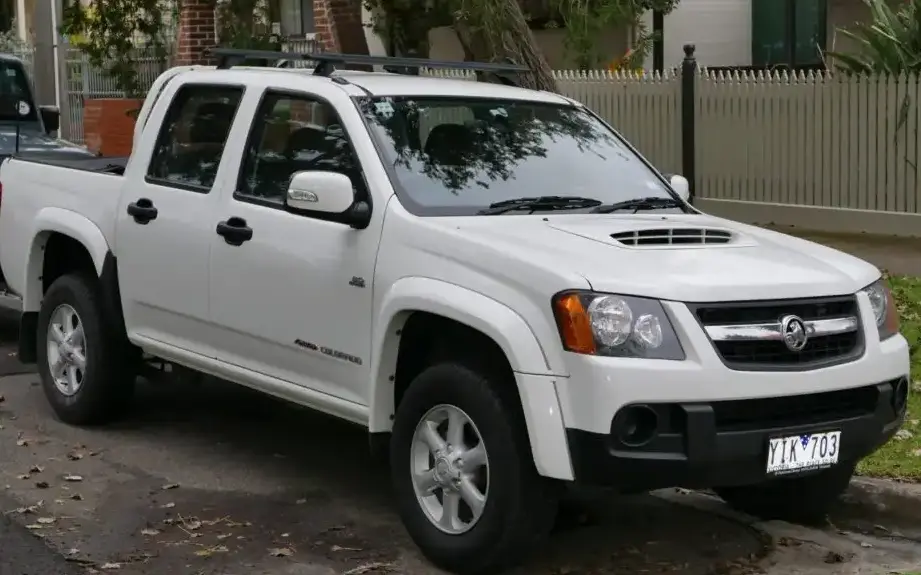
The Holden Colorado I Crew Cab 3.6 V6, produced between 2008 and 2012, represented Holden’s entry into the increasingly popular Australian and New Zealand utility vehicle market. Based on the General Motors Colorado/Isuzu D-Max platform, the Colorado aimed to provide a robust and capable workhorse with a degree of passenger comfort. This particular variant, equipped with the 3.6-liter Alloytec V6 engine producing 214 horsepower, occupied a mid-range position within the Colorado lineup, offering a balance between performance and affordability. It was positioned above the base 2.8-liter turbocharged diesel models and below potential future high-performance or specialized trims. The Crew Cab configuration, featuring four doors and seating for five, broadened the Colorado’s appeal beyond purely commercial applications.
Technical Specifications
| Brand | Holden |
| Model | Colorado |
| Generation | Colorado I Crew Cab |
| Type (Engine) | 3.6 V6 (214 Hp) |
| Start of production | 2008 |
| End of production | 2012 |
| Powertrain Architecture | Internal Combustion engine |
| Body type | Pick-up |
| Seats | 5 |
| Doors | 4 |
| Fuel Type | Petrol (Gasoline) |
| Weight-to-power ratio | 7.8 kg/Hp, 127.6 Hp/tonne |
| Weight-to-torque ratio | 5.4 kg/Nm, 186.6 Nm/tonne |
| Power | 214 Hp @ 5300 rpm |
| Power per litre | 60 Hp/l |
| Torque | 313 Nm @ 2800 rpm, 230.86 lb.-ft. @ 2800 rpm |
| Engine layout | Front, Longitudinal |
| Engine Model/Code | Alloytec / HFV6 |
| Engine displacement | 3564 cm3, 217.49 cu. in. |
| Number of cylinders | 6 |
| Engine configuration | V-engine |
| Cylinder Bore | 94 mm, 3.7 in. |
| Piston Stroke | 85.6 mm, 3.37 in. |
| Compression ratio | 9.6:1 |
| Number of valves per cylinder | 4 |
| Fuel injection system | Multi-port manifold injection |
| Engine aspiration | Naturally aspirated engine |
| Valvetrain | DOHC |
| Engine oil capacity | 6.5 l, 6.87 US qt | 5.72 UK qt |
| Coolant | 12.3 l, 13 US qt | 10.82 UK qt |
| Kerb Weight | 1677-1722 kg, 3697.15 – 3796.36 lbs. |
| Max. weight | 2800 kg, 6172.94 lbs. |
| Max load | 1078-1123 kg, 2376.58 – 2475.79 lbs. |
| Fuel tank capacity | 76 l, 20.08 US gal | 16.72 UK gal |
| Permitted trailer load with brakes (12%) | 2500 kg, 5511.56 lbs. |
| Permitted trailer load without brakes | 750 kg, 1653.47 lbs. |
| Length | 4900 mm, 192.91 in. |
| Width | 1800 mm, 70.87 in. |
| Height | 1735-1750 mm, 68.31 – 68.9 in. |
| Wheelbase | 3050 mm, 120.08 in. |
| Ride height (ground clearance) | 210-225 mm, 8.27 – 8.86 in. |
| Minimum turning circle (turning diameter) | 11.8 m, 38.71 ft. |
| Drivetrain Architecture | The Internal combustion engine (ICE) drives the rear wheels of the vehicle. |
| Drive wheel | Rear wheel drive |
| Number of gears and type of gearbox | 5 gears, manual transmission |
| Front suspension | Double wishbone |
| Rear suspension | Dependent suspension of two longitudinal semi-elliptic leaf springs |
| Front brakes | Ventilated discs, 280 mm |
| Rear brakes | Drum, 295 mm |
| Assisting systems | ABS (Anti-lock braking system) |
| Steering type | Steering rack and pinion |
| Power steering | Electric Steering |
| Tires size | 225/75 R15; 245/70 R16 |
| Wheel rims size | 6.5J x 15; 7J x 16 |
Powertrain & Engine Architecture
The heart of this Colorado variant is the General Motors Alloytec V6 engine, designated HFV6. This 3.6-liter engine is a naturally aspirated, 60-degree V6 featuring a cast aluminum cylinder block and heads. It utilizes a dual overhead camshaft (DOHC) valvetrain with four valves per cylinder, contributing to its relatively high power output for its displacement. Fuel delivery is managed by a multi-port fuel injection system. The Alloytec engine was known for its smooth operation and decent power delivery, though it wasn’t particularly fuel-efficient compared to contemporary diesel alternatives. The engine is longitudinally mounted in the chassis, driving the rear wheels through a five-speed manual transmission. While an automatic transmission was available on other Colorado trims, this specific 214 hp configuration was exclusively offered with the manual gearbox in the Australian market.
Driving Characteristics
The 3.6-liter V6, paired with the five-speed manual transmission, provided a reasonably engaging driving experience. The engine produced peak power at 5300 rpm and maximum torque at 2800 rpm. This meant that while it required some revving to access its full potential, it offered a usable powerband for everyday driving and towing. Compared to the more common 2.8-liter diesel, the V6 offered quicker acceleration and a more refined feel, but at the cost of significantly lower fuel economy. The manual transmission allowed for greater driver control, particularly when navigating challenging terrain or hauling loads. However, the gear ratios weren’t optimized for fuel efficiency, and the fifth gear was relatively short, resulting in higher engine speeds at highway cruising speeds.
Equipment & Trim Levels
The Colorado I Crew Cab 3.6 V6 typically came with a standard equipment list that included air conditioning, power windows, power mirrors, and a basic audio system. Safety features such as ABS brakes were also standard. Interior upholstery was typically cloth, with a durable and functional design. Optional extras included alloy wheels, a more advanced audio system, and a limited-slip differential. The trim level was generally considered a step up from the base work-truck models, offering a slightly more comfortable and refined interior. However, it lacked the luxury features found in some higher-end pickup trucks.
Chassis & Braking
The Colorado I Crew Cab utilized a body-on-frame construction, providing a robust and durable platform for demanding applications. The front suspension consisted of a double wishbone setup, while the rear suspension employed a traditional leaf spring arrangement. This configuration prioritized load-carrying capacity and durability over ride comfort. Braking duties were handled by ventilated discs at the front and drum brakes at the rear. The ABS system provided enhanced braking control, particularly on slippery surfaces. Steering was rack and pinion with power assistance, offering reasonable precision and ease of use.
Market Reception & Comparison
The Holden Colorado I Crew Cab 3.6 V6 received mixed reviews. Critics praised its engine’s smoothness and power, but noted its relatively high fuel consumption compared to the diesel alternatives. The manual transmission was appreciated by enthusiasts, but some found it less convenient for everyday use. Compared to the 2.8-liter diesel models, the V6 offered a more refined driving experience but lacked the diesel’s superior torque and fuel economy. Against competitors like the Toyota Hilux and Ford Ranger, the Colorado offered a competitive price point and a spacious cabin, but its overall refinement and fuel efficiency lagged behind some rivals.
Legacy
The Holden Colorado I, including the 3.6 V6 variant, has established a reputation for reasonable reliability, although the Alloytec V6 engine is known to be susceptible to oil leaks as it ages. Parts availability is generally good, and the relatively simple mechanical design makes it accessible for DIY repairs. In the used car market, these Colorados represent an affordable entry point into the pickup truck segment. While not as fuel-efficient or refined as some newer models, the 3.6 V6 offers a unique combination of power and simplicity that appeals to a certain segment of buyers. The model remains a popular choice for those seeking a capable and durable work vehicle or a comfortable family truck.