Technical Specifications
| Brand | Citroen |
| Model | C3 |
| Generation | C3 II (Phase II, 2013) |
| Type (Engine) | 1.6 BlueHDi (99 Hp) start/stop |
| Start of production | 2015 |
| End of production | 2016 |
| Powertrain Architecture | Internal Combustion engine |
| Body type | Hatchback |
| Seats | 5 |
| Doors | 5 |
| Fuel consumption (urban) | 3.6 l/100 km (65.3 US mpg, 78.5 UK mpg, 27.8 km/l) |
| Fuel consumption (extra urban) | 2.9 l/100 km (81.1 US mpg, 97.4 UK mpg, 34.5 km/l) |
| Fuel consumption (combined) | 3.1 l/100 km (75.9 US mpg, 91.1 UK mpg, 32.3 km/l) |
| CO2 emissions | 81 g/km |
| Fuel Type | Diesel |
| Acceleration 0 – 100 km/h | 10.8 sec |
| Acceleration 0 – 62 mph | 10.8 sec |
| Acceleration 0 – 60 mph | 10.3 sec |
| Maximum speed | 190 km/h (118.06 mph) |
| Emission standard | Euro 6 |
| Weight-to-power ratio | 11 kg/Hp, 91.2 Hp/tonne |
| Weight-to-torque ratio | 4.3 kg/Nm, 234.1 Nm/tonne |
| Power | 99 Hp @ 3750 rpm |
| Power per litre | 63.5 Hp/l |
| Torque | 254 Nm @ 1750 rpm (187.34 lb.-ft. @ 1750 rpm) |
| Engine layout | Front, Transverse |
| Engine Model/Code | BHY DV6FD |
| Engine displacement | 1560 cm3 (95.2 cu. in.) |
| Number of cylinders | 4 |
| Engine configuration | Inline |
| Cylinder Bore | 75 mm (2.95 in.) |
| Piston Stroke | 88.3 mm (3.48 in.) |
| Compression ratio | 18:1 |
| Number of valves per cylinder | 4 |
| Fuel injection system | Diesel Commonrail |
| Engine aspiration | Turbocharger, Intercooler |
| Engine oil capacity | 3.75 l (3.96 US qt | 3.3 UK qt) |
| Kerb Weight | 1085 kg (2392.02 lbs.) |
| Max. weight | 1652 kg (3642.04 lbs.) |
| Max load | 567 kg (1250.02 lbs.) |
| Trunk (boot) space – minimum | 300 l (10.59 cu. ft.) |
| Fuel tank capacity | 48 l (12.68 US gal | 10.56 UK gal) |
| Max. roof load | 70 kg (154.32 lbs.) |
| Permitted trailer load without brakes | 570 kg (1256.63 lbs.) |
| Permitted towbar download | 46 kg (101.41 lbs.) |
| Length | 3941 mm (155.16 in.) |
| Width | 1728 mm (68.03 in.) |
| Width including mirrors | 1986 mm (78.19 in.) |
| Height | 1538 mm (60.55 in.) |
| Wheelbase | 2466 mm (97.09 in.) |
| Front track | 1465-1469 mm (57.68 – 57.83 in.) |
| Rear (Back) track | 1467-1471 mm (57.76 – 57.91 in.) |
| Front overhang | 815 mm (32.09 in.) |
| Rear overhang | 660 mm (25.98 in.) |
| Drag coefficient (Cd) | 0.31 |
| Minimum turning circle (turning diameter) | 10.4 m (34.12 ft.) |
| Drivetrain Architecture | The Internal combustion engine (ICE) drives the front wheels of the vehicle. |
| Drive wheel | Front wheel drive |
| Number of gears and type of gearbox | 5 gears, manual transmission |
| Front suspension | Independent, type McPherson with coil spring and anti-roll bar |
| Rear suspension | Semi-independent, coil spring |
| Front brakes | Ventilated discs |
| Rear brakes | Drum |
| Assisting systems | ABS (Anti-lock braking system) |
| Steering type | Steering rack and pinion |
| Tires size | 195/55 R16 |
| Wheel rims size | 16 |
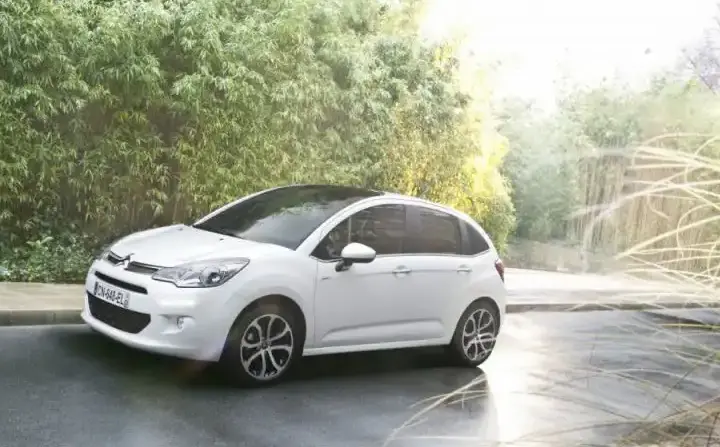
The Citroen C3 II (Phase II), specifically the 1.6 BlueHDi 99 horsepower variant with start/stop technology, was produced from 2015 to 2016. This model represents a mid-life refresh of the second-generation C3, a supermini hatchback positioned as a practical and economical choice within the European market. It falls within the 1HX0/A3 platform family, sharing components with the Peugeot 208 and other vehicles from the PSA Group. This particular engine and trim level aimed to provide a balance between fuel efficiency and acceptable performance for everyday driving.
Powertrain & Engine Architecture
The heart of this C3 variant is the 1.6 BlueHDi engine, specifically the BHY DV6FD variant. This engine is a four-cylinder, inline diesel utilizing a common rail direct injection system and a turbocharger with intercooling. The BlueHDi designation signifies the inclusion of Selective Catalytic Reduction (SCR) technology, employing AdBlue (Diesel Exhaust Fluid) to reduce nitrogen oxide (NOx) emissions, ensuring compliance with stringent Euro 6 emission standards. The engine produces 99 horsepower at 3750 rpm and 254 Nm (187 lb-ft) of torque at 1750 rpm. This torque output, available relatively low in the rev range, is a characteristic of modern diesel engines, contributing to good in-gear acceleration. The engine features a compression ratio of 18:1. The engine is paired with a five-speed manual transmission, which was the standard offering for this configuration.
Driving Characteristics
The 1.6 BlueHDi 99 hp/manual transmission combination in the C3 II offers a practical, if not particularly sporty, driving experience. Acceleration from 0-60 mph takes around 10.3 seconds, and top speed is approximately 118 mph. The focus is on fuel economy and usability rather than outright performance. The engine provides adequate power for everyday driving, including urban commutes and highway cruising, but it can feel strained when fully loaded or tackling steep inclines. The five-speed gearbox is well-matched to the engine’s characteristics, with relatively short gearing aiding acceleration, while higher gears prioritize fuel efficiency. Compared to higher-powered versions of the C3, such as those with the 1.6 THP petrol engine, this variant offers significantly less performance but substantially better fuel economy.
Equipment & Trim Levels
The 1.6 BlueHDi 99 hp variant typically occupied a mid-range position in the C3 II lineup. Standard equipment generally included air conditioning, electric front windows, a basic audio system with USB connectivity, and ABS brakes. Safety features such as ESP (Electronic Stability Program) were also commonly included. Higher trim levels offered additional features like alloy wheels, a touchscreen infotainment system, rear parking sensors, and automatic headlights and wipers. Interior upholstery was typically cloth, with a functional and durable design. The dashboard layout was straightforward and user-friendly.
Chassis & Braking
The C3 II utilizes a McPherson strut front suspension and a semi-independent coil spring rear suspension. This setup provides a comfortable ride quality, well-suited for absorbing bumps and imperfections in the road surface. The front brakes are ventilated discs, providing adequate stopping power, while the rear brakes are drums. This configuration was common for vehicles in this weight class and price range. The steering is a rack and pinion system, offering reasonable precision and feedback.
Market Reception & Comparison
The Citroen C3 II 1.6 BlueHDi 99 hp was generally well-received by critics for its fuel efficiency and low running costs. It was seen as a sensible choice for drivers prioritizing economy over performance. Compared to other superminis in its class, such as the Ford Fiesta and Volkswagen Polo, the C3 offered a competitive fuel economy figure and a comfortable ride. However, some critics noted that the interior quality was not as refined as some of its rivals. The 1.6 BlueHDi engine proved to be reliable, although regular servicing and the use of quality AdBlue were essential to maintain optimal performance and emissions compliance.
Legacy
The 1.6 BlueHDi engine became a mainstay in the PSA Group’s lineup, known for its fuel efficiency and relatively low emissions. While early versions of the engine experienced some issues with diesel particulate filter (DPF) clogging, later iterations proved to be more robust. In the used car market, the C3 II 1.6 BlueHDi 99 hp remains a popular choice for budget-conscious buyers seeking a practical and economical supermini. Its reputation for reliability and low running costs continues to make it a viable option, provided it has been well-maintained and the DPF has been properly cared for.