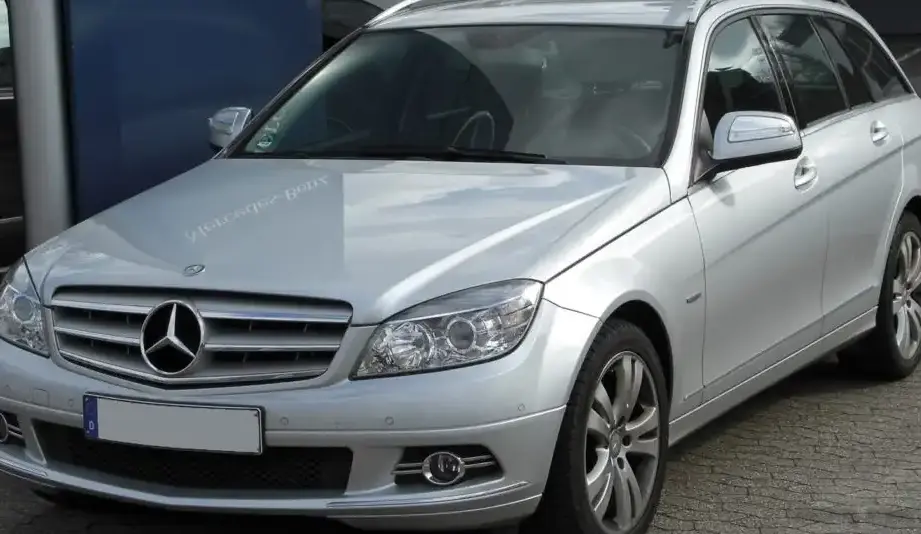
The Mercedes-Benz C-Class T-modell (S204) C 180 CDI BlueEFFICIENCY, produced from April 2010 to 2011, represented an entry-level diesel variant within the broader S204 wagon range. Positioned as a fuel-efficient option, it catered to buyers prioritizing economy and practicality over outright performance. This model was part of the third generation (W204) C-Class, which introduced significant advancements in technology and refinement compared to its predecessors. The “T-modell” designation signifies the estate (wagon) body style, popular in European markets for its versatility. The BlueEFFICIENCY branding denoted Mercedes-Benz’s efforts to improve fuel economy and reduce emissions through various engineering optimizations.
Technical Specifications
| Brand | Mercedes-Benz |
| Model | C-class |
| Generation | C-class T-modell (S204) |
| Type (Engine) | C 180 CDI BlueEFFICIENCY (120 Hp) |
| Start of production | April, 2010 |
| End of production | 2011 |
| Powertrain Architecture | Internal Combustion engine |
| Body type | Station wagon (estate) |
| Seats | 5 |
| Doors | 5 |
| Fuel consumption (urban) | 6.7-7.4 l/100 km (35.1 – 31.8 US mpg, 42.2 – 38.2 UK mpg, 14.9 – 13.5 km/l) |
| Fuel consumption (extra urban) | 4.4-5.1 l/100 km (53.5 – 46.1 US mpg, 64.2 – 55.4 UK mpg, 22.7 – 19.6 km/l) |
| Fuel consumption (combined) | 5.2-5.9 l/100 km (45.2 – 39.9 US mpg, 54.3 – 47.9 UK mpg, 19.2 – 16.9 km/l) |
| CO2 emissions | 137-155 g/km |
| Fuel Type | Diesel |
| Acceleration 0 – 100 km/h | 10.8 sec |
| Acceleration 0 – 62 mph | 10.8 sec |
| Acceleration 0 – 60 mph | 10.3 sec |
| Maximum speed | 201 km/h (124.9 mph) |
| Emission standard | Euro 5 |
| Weight-to-power ratio | 13 kg/Hp, 76.9 Hp/tonne |
| Weight-to-torque ratio | 5.2 kg/Nm, 192.3 Nm/tonne |
| Power | 120 Hp @ 2800-4600 rpm |
| Power per litre | 56 Hp/l |
| Torque | 300 Nm @ 1400-2800 rpm (221.27 lb.-ft. @ 1400-2800 rpm) |
| Engine layout | Front, Longitudinal |
| Engine Model/Code | OM 651.913 |
| Engine displacement | 2143 cm3 (130.77 cu. in.) |
| Number of cylinders | 4 |
| Engine configuration | Inline |
| Cylinder Bore | 83 mm (3.27 in.) |
| Piston Stroke | 99 mm (3.9 in.) |
| Compression ratio | 16.2:1 |
| Number of valves per cylinder | 4 |
| Fuel injection system | Diesel Commonrail |
| Engine aspiration | Turbocharger, Intercooler |
| Valvetrain | DOHC |
| Engine oil capacity | 6.5 l (6.87 US qt | 5.72 UK qt) |
| Kerb Weight | 1560 kg (3439.21 lbs.) |
| Max. weight | 2175 kg (4795.05 lbs.) |
| Max load | 615 kg (1355.84 lbs.) |
| Trunk (boot) space – minimum | 485 l (17.13 cu. ft.) |
| Trunk (boot) space – maximum | 1500 l (52.97 cu. ft.) |
| Fuel tank capacity | 59 l (15.59 US gal | 12.98 UK gal) |
| Max. roof load | 100 kg (220.46 lbs.) |
| Permitted trailer load with brakes (12%) | 1800 kg (3968.32 lbs.) |
| Permitted trailer load without brakes | 750 kg (1653.47 lbs.) |
| Permitted towbar download | 75 kg (165.35 lbs.) |
| Length | 4596 mm (180.94 in.) |
| Width | 1770 mm (69.69 in.) |
| Width including mirrors | 2009 mm (79.09 in.) |
| Height | 1459 mm (57.44 in.) |
| Wheelbase | 2760 mm (108.66 in.) |
| Front track | 1541 mm (60.67 in.) |
| Rear track | 1544 mm (60.79 in.) |
| Front overhang | 765 mm (30.12 in.) |
| Rear overhang | 1071 mm (42.17 in.) |
| Drag coefficient (Cd) | 0.29 |
| Minimum turning circle | 10.84 m (35.56 ft.) |
| Drivetrain Architecture | Rear wheel drive |
| Number of gears | 6 gears, manual transmission |
| Front suspension | Independent, type McPherson with coil spring and anti-roll bar |
| Rear suspension | Independent multi-link spring suspension with stabilizer |
| Front brakes | Ventilated discs |
| Rear brakes | Disc |
| Assisting systems | ABS (Anti-lock braking system) |
| Steering type | Steering rack and pinion |
| Power steering | Hydraulic Steering |
| Tires size | 205/55 R16; 225/45 R17 |
| Wheel rims size | 7J x 16; 7.5J x 17 |
Powertrain & Engine Architecture
The C 180 CDI BlueEFFICIENCY utilized the OM651.913 2.1-liter inline-four cylinder diesel engine. This engine was a cornerstone of Mercedes-Benz’s diesel offerings during this period, known for its robust construction and relatively good fuel economy. The OM651 featured a common rail direct injection system, delivering fuel at extremely high pressures for optimized combustion. A turbocharger with an intercooler further enhanced power output and efficiency. The engine employed a double overhead camshaft (DOHC) valvetrain with four valves per cylinder, contributing to its breathing efficiency. The 6-speed manual transmission was standard, providing a balance between fuel economy and driver control. The engine’s longitudinal mounting allowed for a rear-wheel-drive configuration, a traditional layout for Mercedes-Benz passenger cars.
Driving Characteristics
The 120 hp output and 300 Nm (221 lb-ft) of torque delivered by the C 180 CDI BlueEFFICIENCY resulted in a driving experience focused on efficiency rather than outright speed. Acceleration from 0-100 km/h (0-62 mph) took approximately 10.8 seconds. While adequate for everyday driving, it was noticeably slower than higher-powered C-Class variants like the C 220 CDI or C 350. The manual transmission offered precise shifts, but the relatively long gearing prioritized fuel economy over spirited acceleration. The engine provided a usable amount of torque from low RPMs, making it suitable for relaxed cruising and overtaking maneuvers. Compared to the automatic transmission options available on other C-Class models, the manual offered a more engaging driving experience and slightly better fuel economy.
Equipment & Trim Levels
The C 180 CDI BlueEFFICIENCY typically came equipped with a reasonable level of standard features. These included air conditioning, a basic audio system, power windows, and central locking. Interior upholstery was generally cloth, with options for leather upgrades. Standard safety equipment included ABS, airbags, and electronic stability control. Optional extras included a sunroof, upgraded audio systems, navigation, and parking sensors. The “BlueEFFICIENCY” package included features like low rolling resistance tires and optimized aerodynamics to further improve fuel economy. Trim levels were relatively simple, with options primarily focused on cosmetic enhancements and additional comfort features.
Chassis & Braking
The S204 C-Class featured an independent suspension system on both the front and rear axles. The front suspension utilized McPherson struts with coil springs and an anti-roll bar, while the rear employed a multi-link setup, also with a stabilizer bar. This configuration provided a good balance between ride comfort and handling. The C 180 CDI, being the entry-level variant, typically featured smaller wheels and tires compared to higher-spec models. Braking duties were handled by ventilated discs at the front and solid discs at the rear. ABS (Anti-lock Braking System) was standard, enhancing braking performance and stability.
Market Reception & Comparison
The C 180 CDI BlueEFFICIENCY was generally well-received by critics for its fuel efficiency and practicality. However, its performance was often criticized as being somewhat underwhelming, particularly when compared to more powerful C-Class models. The 1.8L engine was considered a good compromise for those prioritizing economy, but drivers seeking a more engaging driving experience often opted for the C 220 CDI or petrol-powered variants. Fuel economy figures of around 5.2-5.9 l/100 km (45.2-39.9 US mpg) were competitive for its class. Reliability was generally good, although diesel particulate filter (DPF) issues could occur with infrequent long-distance driving.
Legacy
The OM651 engine family, including the 2.1-liter variant found in the C 180 CDI BlueEFFICIENCY, proved to be a durable and reliable powerplant. These engines are still commonly found on the used car market today, and with proper maintenance, can provide many years of service. The C 180 CDI BlueEFFICIENCY remains a popular choice for buyers seeking an affordable and fuel-efficient estate car. While not the most exciting C-Class variant, it represents a practical and economical option within the broader S204 range. The focus on fuel efficiency and reduced emissions foreshadowed the increasing importance of these factors in the automotive industry.