Technical Specifications
| Brand | Audi |
| Model | A3 |
| Generation | A3 Cabriolet (8V) |
| Type (Engine) | 2.0 TDI (150 Hp) clean diesel |
| Start of production | 2013 |
| End of production | 2016 |
| Powertrain Architecture | Internal Combustion engine |
| Body type | Cabriolet |
| Seats | 4 |
| Doors | 2 |
| Fuel consumption (urban) | 5.1 l/100 km (46.1 US mpg, 55.4 UK mpg, 19.6 km/l) |
| Fuel consumption (extra urban) | 3.7 l/100 km (63.6 US mpg, 76.3 UK mpg, 27 km/l) |
| Fuel consumption (combined) | 4.2 l/100 km (56 US mpg, 67.3 UK mpg, 23.8 km/l) |
| CO2 emissions | 110 g/km |
| Fuel Type | Diesel |
| Acceleration 0 – 100 km/h | 8.9 sec |
| Acceleration 0 – 62 mph | 8.9 sec |
| Acceleration 0 – 60 mph | 8.5 sec |
| Maximum speed | 224 km/h (139.19 mph) |
| Emission standard | Euro 6 |
| Weight-to-power ratio | 9.7 kg/Hp, 102.7 Hp/tonne |
| Weight-to-torque ratio | 4.3 kg/Nm, 232.9 Nm/tonne |
| Power | 150 Hp @ 3500-4000 rpm |
| Power per litre | 76.2 Hp/l |
| Torque | 340 Nm @ 1750-3000 rpm (250.77 lb.-ft. @ 1750-3000 rpm) |
| Engine layout | Front, Transverse |
| Engine Model/Code | CRBC, CRLB, CRUA, DBGA, DEJA, DCYA |
| Engine displacement | 1968 cm3 (120.09 cu. in.) |
| Number of cylinders | 4 |
| Engine configuration | Inline |
| Cylinder Bore | 81 mm (3.19 in.) |
| Piston Stroke | 95.5 mm (3.76 in.) |
| Compression ratio | 16.2:1 |
| Number of valves per cylinder | 4 |
| Fuel injection system | Diesel Commonrail |
| Engine aspiration | Turbocharger, Intercooler |
| Valvetrain | DOHC |
| Engine oil capacity | 4.7 l (4.97 US qt | 4.14 UK qt) |
| Kerb Weight | 1460 kg (3218.75 lbs.) |
| Max. weight | 1960 kg (4321.06 lbs.) |
| Max load | 500 kg (1102.31 lbs.) |
| Trunk (boot) space – minimum | 320 l (11.3 cu. ft.) |
| Trunk (boot) space – maximum | 678 l (23.94 cu. ft.) |
| Fuel tank capacity | 50 l (13.21 US gal | 11 UK gal) |
| Permitted trailer load with brakes (8%) | 1800 kg (3968.32 lbs.) |
| Permitted trailer load without brakes | 750 kg (1653.47 lbs.) |
| Permitted towbar download | 75 kg (165.35 lbs.) |
| Length | 4421 mm (174.06 in.) |
| Width | 1793 mm (70.59 in.) |
| Width including mirrors | 1960 mm (77.17 in.) |
| Height | 1409 mm (55.47 in.) |
| Wheelbase | 2595 mm (102.17 in.) |
| Front track | 1555 mm (61.22 in.) |
| Rear (Back) track | 1526 mm (60.08 in.) |
| Front overhang | 869 mm (34.21 in.) |
| Rear overhang | 957 mm (37.68 in.) |
| Drag coefficient (Cd) | 0.30 |
| Minimum turning circle (turning diameter) | 10.9 m (35.76 ft.) |
| Drivetrain Architecture | The Internal combustion engine (ICE) drives the front wheels of the vehicle. |
| Drive wheel | Front wheel drive |
| Number of gears and type of gearbox | 6 gears, manual transmission |
| Front suspension | Independent type McPherson |
| Rear suspension | Independent multi-link suspension |
| Front brakes | Ventilated discs |
| Rear brakes | Disc |
| Assisting systems | ABS (Anti-lock braking system) |
| Steering type | Steering rack and pinion |
| Power steering | Electric Steering |
| Tires size | 205/55 R16 |
| Wheel rims size | 7J x 16 |
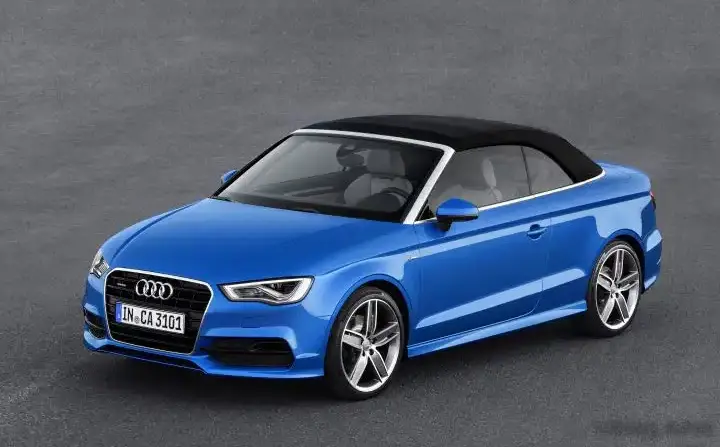
The Audi A3 Cabriolet (8V) 2.0 TDI 150 hp clean diesel, launched in 2013, offered a sophisticated and fuel-efficient open-top driving experience. It was a key component of Audi’s strategy to broaden the appeal of the A3 range, attracting customers who desired a premium convertible without the higher price tag of larger models. This variant was particularly popular in Europe, where diesel engines were favored for their fuel economy and torque characteristics. The 8V generation A3 Cabriolet represented a significant step forward in terms of design, technology, and overall refinement compared to its predecessor.
Powertrain & Engine Architecture
At the heart of this A3 Cabriolet variant lies the Volkswagen Group’s 2.0-liter four-cylinder diesel engine, specifically the CRBC, CRLB, CRUA, DBGA, DEJA, or DCYA engine code depending on the specific production year and market. This engine is a turbocharged common rail direct injection diesel, known for its robust construction and efficiency. The common rail system, operating at extremely high pressures, ensures precise fuel delivery and optimized combustion. The engine features a double overhead camshaft (DOHC) valvetrain with four valves per cylinder, enhancing breathing and contributing to its power output. An intercooler is integrated into the turbocharger system to cool the intake air, further increasing power and efficiency. The 150 hp and 340 Nm (250.77 lb-ft) of torque are delivered between 1750 and 3000 rpm, providing a broad and usable powerband. The engine is transversely mounted in the front of the vehicle. The 6-speed manual transmission was standard, offering precise shifts and contributing to the car’s overall driving dynamics.
Driving Characteristics
The 2.0 TDI 150 hp engine, paired with the 6-speed manual transmission, provided a comfortable and capable driving experience. While not overtly sporty, the engine delivered sufficient power for everyday driving and overtaking maneuvers. Acceleration from 0-60 mph took approximately 8.5 seconds, and the car had a top speed of 139.19 mph. The torque-rich diesel engine meant that strong acceleration was available from relatively low engine speeds, making it easy to navigate city traffic and maintain comfortable cruising speeds on the highway. The manual gearbox offered a direct connection to the engine, allowing drivers to fully utilize the available power. Compared to the more powerful petrol variants (like the 1.8 TFSI), the TDI offered superior fuel economy and a more relaxed driving experience. However, it lacked the responsiveness and outright performance of its petrol counterparts.
Equipment & Trim Levels
The A3 Cabriolet 2.0 TDI 150 hp typically came equipped with a respectable level of standard features. These included air conditioning, a multi-function steering wheel, electric windows, and an Audi Concert radio system. Higher trim levels, such as Sport or S line, added features like sport seats, alloy wheels, and upgraded interior trim. Optional extras included navigation systems, leather upholstery, parking sensors, and a wind deflector to reduce turbulence in the cabin when the roof was lowered. The interior design was typically understated and elegant, reflecting Audi’s commitment to quality and refinement.
Chassis & Braking
The A3 Cabriolet 8V utilized an independent McPherson strut suspension at the front and an independent multi-link suspension at the rear. This setup provided a good balance of ride comfort and handling. The front brakes were ventilated discs, while the rear brakes were solid discs. Anti-lock Braking System (ABS) was standard, enhancing safety and stability. The chassis was designed to provide a rigid and stable platform, minimizing body roll and ensuring a confident driving experience, even with the roof down. The weight distribution was carefully optimized to enhance handling characteristics.
Market Reception & Comparison
The Audi A3 Cabriolet 2.0 TDI 150 hp was generally well-received by automotive critics. It was praised for its fuel efficiency, comfortable ride, and stylish design. However, some reviewers noted that the engine could be somewhat noisy compared to petrol alternatives. Compared to other trims in the A3 Cabriolet lineup, the TDI offered the best fuel economy, making it an attractive option for drivers who prioritized efficiency. The petrol-powered 1.8 TFSI offered more performance, while the higher-output diesel variants (like the 2.0 TDI 184 hp) provided even greater performance but at a higher price point.
Legacy
The 2.0 TDI engine in this configuration has proven to be a relatively reliable powertrain, although, like all diesel engines, it is susceptible to issues related to the diesel particulate filter (DPF) if not properly maintained. Regular servicing and the use of high-quality diesel fuel are essential to ensure long-term reliability. On the used car market, the A3 Cabriolet 2.0 TDI 150 hp remains a popular choice, offering a good balance of style, comfort, and fuel efficiency. Its relatively low running costs and proven reliability make it an attractive option for buyers seeking a premium convertible at a reasonable price.