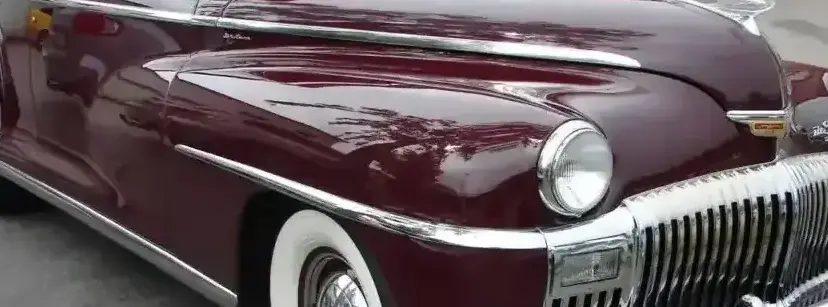
The DeSoto Deluxe Carry-All Sedan (Second Series) 3.9, produced from 1949 to 1950, represented a significant offering in the post-war American automotive landscape. Positioned as a family-oriented vehicle, the Carry-All Sedan was a six-passenger offering within the broader DeSoto Deluxe range. It aimed to provide comfortable and reliable transportation during a period of economic recovery and increasing suburbanization. This variant, equipped with a 3.9-liter inline-six engine producing 112 horsepower, served as a mainstream option within the Deluxe lineup, slotting below more luxurious or performance-oriented trims if offered, and above any potential base models.
Technical Specifications
| Brand | DeSoto |
| Model | Deluxe |
| Generation | Deluxe Carry-All Sedan (Second Series) |
| Type (Engine) | 3.9 (112 Hp) |
| Start of production | 1949 |
| End of production | 1950 |
| Powertrain Architecture | Internal Combustion engine |
| Body type | Sedan |
| Seats | 6 |
| Doors | 4 |
| Fuel Type | Petrol (Gasoline) |
| Power | 112 Hp @ 3600 rpm |
| Power per litre | 28.9 Hp/l |
| Torque | 264 Nm @ 1600 rpm |
| Torque (lb-ft) | 194.72 lb.-ft. @ 1600 rpm |
| Engine displacement | 3877 cm3 |
| Engine displacement (cu. in.) | 236.59 cu. in. |
| Number of cylinders | 6 |
| Engine configuration | Inline |
| Cylinder Bore | 87.31 mm |
| Cylinder Bore (in.) | 3.44 in. |
| Piston Stroke | 107.95 mm |
| Piston Stroke (in.) | 4.25 in. |
| Compression ratio | 7:1 |
| Number of valves per cylinder | 2 |
| Fuel injection system | Carburettor |
| Engine aspiration | Naturally aspirated engine |
| Engine oil capacity | 4.7 l |
| Engine oil capacity (US qt) | 4.97 US qt |
| Engine oil capacity (UK qt) | 4.14 UK qt |
| Coolant capacity | 16.1 l |
| Coolant capacity (US qt) | 17.01 US qt |
| Coolant capacity (UK qt) | 14.17 UK qt |
| Fuel tank capacity | 64 l |
| Fuel tank capacity (US gal) | 16.91 US gal |
| Fuel tank capacity (UK gal) | 14.08 UK gal |
| Length | 5253 mm |
| Length (in.) | 206.81 in. |
| Width | 1862 mm |
| Width (in.) | 73.31 in. |
| Height | 1687 mm |
| Height (in.) | 66.42 in. |
| Wheelbase | 3188 mm |
| Wheelbase (in.) | 125.51 in. |
| Drag coefficient (Cd) | 0.60 |
| Minimum turning circle | 13 m |
| Minimum turning circle (ft) | 42.65 ft. |
| Drivetrain Architecture | Rear wheel drive |
| Drive wheel | Rear wheel drive |
| Number of gears | 3 |
| Type of gearbox | Manual transmission |
| Front suspension | Independent coil spring |
| Front brakes | Drum, 279 mm |
| Rear brakes | Drum, 279 mm |
Powertrain & Engine Architecture
The heart of the 1949-1950 DeSoto Deluxe Carry-All Sedan was its 3.9-liter (236.59 cubic inch) inline-six cylinder engine. This engine, designated for this output as producing 112 horsepower at 3600 rpm and 264 Nm (194.72 lb-ft) of torque at 1600 rpm, featured a relatively conventional design for the era. It utilized a cast iron block and cylinder head, with two valves per cylinder operated by a single overhead camshaft. Fuel delivery was managed by a carburetor, a common practice for the time. The 7:1 compression ratio was typical for engines running on the gasoline available in the late 1940s and early 1950s. The engine’s inline configuration contributed to its relatively smooth operation, although it wasn’t as inherently balanced as a V-configuration engine. The three-speed manual transmission was the standard offering, providing drivers with control over gear selection. The transmission was a fully synchronized unit, a relatively modern feature for the time, improving shift quality and reducing driver fatigue.
Driving Characteristics
The 112 horsepower and 264 Nm of torque provided by the 3.9-liter engine delivered adequate, but not exhilarating, performance for the DeSoto Deluxe Carry-All Sedan. Acceleration was modest by modern standards, but sufficient for highway cruising and everyday driving. The three-speed manual transmission required deliberate shifting, and the gear ratios were optimized for fuel economy and relaxed cruising rather than rapid acceleration. First gear was relatively low for starting from a standstill, while third gear provided a comfortable cruising speed on the highway. Compared to potential higher-output DeSoto models (if available), this variant would have felt noticeably less powerful, lacking the extra punch for quicker overtaking maneuvers. The rear-wheel-drive configuration provided predictable handling, but lacked the sophistication of more modern suspension systems. The overall driving experience was characteristic of American cars of the period – comfortable, spacious, and focused on providing a smooth ride. The steering, while not particularly quick, was relatively light, making it easy to maneuver in city traffic.
Equipment & Trim Levels
The Deluxe Carry-All Sedan was positioned as a well-equipped family vehicle. Standard features typically included comfortable cloth upholstery, a spacious interior capable of seating six passengers, and a functional dashboard layout. While not lavishly appointed, the interior offered a degree of style and practicality. The dashboard featured a combination of analog gauges providing information on speed, fuel level, and engine temperature. Available options likely included a radio, heater, whitewall tires, and potentially upgraded interior trim materials. Deluxe models often featured more chrome trim and brighter interior accents compared to more basic trims. The Carry-All Sedan’s trim level focused on providing a balance of comfort, convenience, and value, making it an attractive option for families seeking a reliable and spacious vehicle. The emphasis was on providing a comfortable and practical environment for passengers.
Chassis & Braking
The DeSoto Deluxe Carry-All Sedan utilized a body-on-frame construction, a common practice for American cars of the era. This construction method provided a robust and durable platform, but also contributed to the vehicle’s relatively heavy weight. The chassis featured an independent coil spring suspension in the front, providing a relatively comfortable ride. The rear suspension employed a solid axle with leaf springs. Braking duties were handled by drum brakes on all four wheels, measuring 279 mm in diameter. While adequate for the vehicle’s weight and performance capabilities, the drum brakes lacked the stopping power and fade resistance of more modern disc brake systems. Steering was accomplished via a conventional steering gear, providing a somewhat indirect feel. The suspension was tuned for comfort, prioritizing a smooth ride over sporty handling.
Market Reception & Comparison
The 1949-1950 DeSoto Deluxe Carry-All Sedan was generally well-received by the motoring press and the public. Critics praised its spacious interior, comfortable ride, and reliable powertrain. However, some noted that its styling was somewhat conservative compared to competitors like the more flamboyant designs offered by Buick or Cadillac. In terms of fuel economy, the 3.9-liter engine delivered respectable figures for the time, averaging around 16-18 miles per gallon, although it wasn’t particularly fuel-efficient by modern standards. Compared to other trims in the DeSoto lineup, the 3.9-liter variant offered a compelling value proposition, providing a good balance of features, performance, and price. It competed with similar offerings from other American manufacturers, such as Ford, Chevrolet, and Plymouth, all vying for the attention of the growing post-war family market.
Legacy
The DeSoto Deluxe Carry-All Sedan, particularly the 3.9-liter variant, holds a place in automotive history as a representative example of post-war American family transportation. While not a particularly rare or highly sought-after classic today, well-maintained examples are appreciated by collectors and enthusiasts. The inline-six engine proved to be relatively durable and reliable, and many examples remain on the road today, often benefiting from decades of careful maintenance and restoration. The Carry-All Sedan’s legacy lies in its contribution to the evolution of the American automobile and its role in shaping the automotive landscape of the 1950s. Finding parts can be challenging, but a dedicated community of DeSoto enthusiasts exists to support restoration and maintenance efforts. The vehicle represents a simpler era of automotive design and engineering, prioritizing practicality and durability over outright performance and technological innovation.