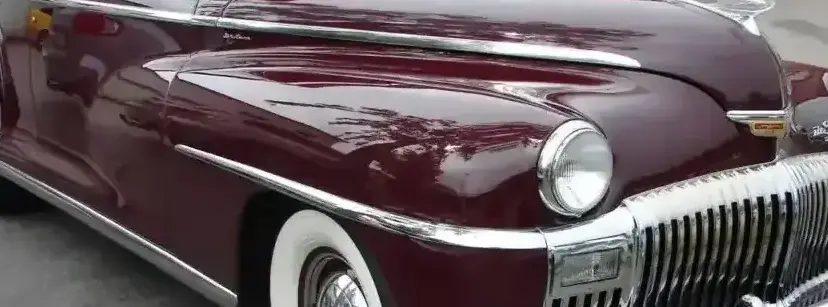
The DeSoto Deluxe Carry-All Sedan (Second Series) with the 3.9-liter (236.59 cu. in.) engine producing 112 horsepower, equipped with the innovative “Tip-Toe Shift” automatic transmission, represented a significant offering in the post-war American automotive landscape. Produced for the 1949 and 1950 model years, this variant occupied a middle ground within the Deluxe lineup, aiming to provide a blend of comfort, space, and modern convenience for family transportation. It was part of the broader second-generation Deluxe series, which saw DeSoto attempting to establish itself as a premium, yet accessible, brand in a rapidly expanding market.
Technical Specifications
| Brand | DeSoto |
| Model | Deluxe |
| Generation | Deluxe Carry-All Sedan (Second Series) |
| Type (Engine) | 3.9 (112 Hp) Tip-Toe Shift |
| Start of production | 1949 |
| End of production | 1950 |
| Powertrain Architecture | Internal Combustion engine |
| Body type | Sedan |
| Seats | 6 |
| Doors | 4 |
| Fuel Type | Petrol (Gasoline) |
| Power | 112 Hp @ 3600 rpm |
| Power per litre | 28.9 Hp/l |
| Torque | 264 Nm @ 1600 rpm / 194.72 lb.-ft. @ 1600 rpm |
| Engine displacement | 3877 cm3 / 236.59 cu. in. |
| Number of cylinders | 6 |
| Engine configuration | Inline |
| Cylinder Bore | 87.31 mm / 3.44 in. |
| Piston Stroke | 107.95 mm / 4.25 in. |
| Compression ratio | 7:1 |
| Number of valves per cylinder | 2 |
| Fuel injection system | Carburettor |
| Engine aspiration | Naturally aspirated engine |
| Engine oil capacity | 4.7 l / 4.97 US qt | 4.14 UK qt |
| Coolant | 16.1 l / 17.01 US qt | 14.17 UK qt |
| Fuel tank capacity | 64 l / 16.91 US gal | 14.08 UK gal |
| Length | 5253 mm / 206.81 in. |
| Width | 1862 mm / 73.31 in. |
| Height | 1687 mm / 66.42 in. |
| Wheelbase | 3188 mm / 125.51 in. |
| Drag coefficient (Cd) | 0.60 |
| Minimum turning circle (turning diameter) | 13 m / 42.65 ft. |
| Drivetrain Architecture | The Internal combustion engine (ICE) drives the rear wheels of the vehicle. |
| Drive wheel | Rear wheel drive |
| Number of gears and type of gearbox | 4 gears, automatic transmission Tip-Toe Shift |
| Front suspension | Independent coil spring |
| Front brakes | Drum, 279 mm |
| Rear brakes | Drum, 279 mm |
Powertrain & Engine Architecture
The heart of the 1949-1950 DeSoto Deluxe Carry-All Sedan was its 3.9-liter (236.59 cubic inch) inline-six cylinder engine. This engine, while not groundbreaking in terms of technology, was a robust and reliable powerplant designed for smooth operation and reasonable fuel economy. It featured a cast iron block and cylinder head, with a 7:1 compression ratio. Fuel delivery was managed by a single, downdraft carburetor, a common setup for the era. The valvetrain employed two valves per cylinder, operated by a conventional pushrod system. The engine produced 112 horsepower at 3600 rpm and 264 Nm (194.72 lb-ft) of torque at 1600 rpm.
The “Tip-Toe Shift” automatic transmission was a key feature of this variant. Developed by DeSoto, it was a four-speed automatic transmission utilizing a fluid coupling and planetary gearsets. It was marketed as providing exceptionally smooth and effortless shifting, contributing to the car’s overall comfort. While not as sophisticated as some later automatic transmissions, it represented a significant step forward in convenience for the average driver.
Driving Characteristics
The 112-horsepower engine and Tip-Toe Shift automatic transmission delivered a driving experience focused on comfortable cruising rather than outright performance. Acceleration was adequate for the time, but not particularly brisk. The automatic transmission, while smooth, did result in some power loss compared to the available manual transmission options. The gear ratios were optimized for relaxed highway driving, making it well-suited for long journeys. The relatively high torque output at low engine speeds helped with everyday driving situations, such as merging onto highways or climbing hills. Compared to other DeSoto Deluxe models equipped with the larger engine or manual transmissions, this variant offered a more refined and less demanding driving experience, albeit at the expense of some performance.
Equipment & Trim Levels
The Deluxe Carry-All Sedan, in its 3.9-liter automatic guise, was positioned as a mid-range offering within the DeSoto lineup. Standard equipment included a spacious interior with seating for six passengers, a heater, and a basic set of instrumentation. Interior upholstery typically consisted of cloth and vinyl, with a focus on durability and comfort. The dashboard featured a straightforward design with a speedometer, fuel gauge, and ammeter. Optional extras included a radio, whitewall tires, and various trim enhancements. The Carry-All Sedan body style, with its generous passenger volume, was particularly popular with families.
Chassis & Braking
The DeSoto Deluxe Carry-All Sedan utilized a body-on-frame construction, typical of American automobiles of the era. The chassis featured an independent coil spring suspension at the front, providing a relatively comfortable ride. The rear suspension employed leaf springs. Braking was accomplished via drum brakes on all four wheels, measuring 279 mm in diameter. While adequate for the time, the drum brakes lacked the stopping power of later disc brake systems. Steering was handled by a conventional steering gear, providing a somewhat indirect feel.
Market Reception & Comparison
The DeSoto Deluxe Carry-All Sedan with the 3.9-liter engine and Tip-Toe Shift transmission was generally well-received by critics and consumers. It was praised for its comfortable ride, spacious interior, and the convenience of the automatic transmission. However, some reviewers noted that the engine lacked the power of larger displacement options available in competing models. Fuel economy was typical for the era, averaging around 15-20 miles per gallon. Compared to other DeSoto Deluxe trims, such as those equipped with the larger engine, this variant offered a more affordable entry point into the DeSoto brand, appealing to a broader range of buyers. It competed with similar offerings from other American manufacturers, such as Ford, Chevrolet, and Plymouth.
Legacy
The 1949-1950 DeSoto Deluxe Carry-All Sedan, particularly the 3.9-liter automatic variant, holds a modest but significant place in automotive history. While not a particularly rare or highly sought-after classic car, it represents a well-built and reliable example of post-war American automotive engineering. The Tip-Toe Shift automatic transmission, while not widely adopted by other manufacturers, was a notable innovation. Today, surviving examples are often found in restored condition, appreciated by collectors and enthusiasts for their classic styling and nostalgic appeal. The inline-six engine, while relatively simple in design, proved to be durable and capable of providing years of reliable service, contributing to the car’s enduring legacy.