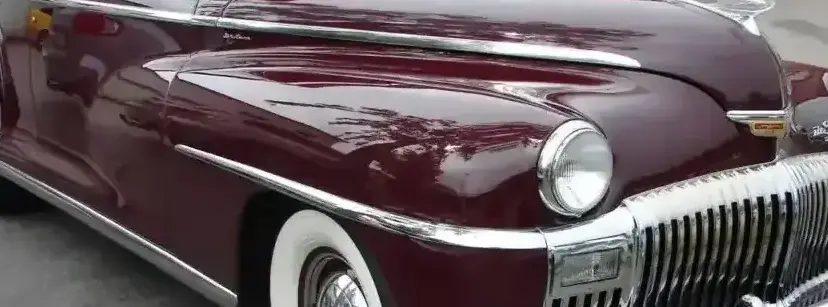
The DeSoto Deluxe Club Coupe (Second Series) 3.9, produced from 1949 to 1950, represented a significant offering in the post-war American automotive landscape. Positioned as a mid-range model within the DeSoto lineup, it aimed to provide comfortable and stylish transportation for families. This particular variant, powered by a 3.9-liter inline-six engine producing 112 horsepower, was a popular choice for buyers seeking a balance between affordability and performance. The Second Series updates brought subtle styling refinements over the initial 1949 models, solidifying the Deluxe Club Coupe’s place in DeSoto’s sales figures during a period of economic recovery and burgeoning automotive demand.
Technical Specifications
| Brand | DeSoto |
| Model | Deluxe |
| Generation | Deluxe Club Coupe (Second Series) |
| Type (Engine) | 3.9 (112 Hp) |
| Start of production | 1949 |
| End of production | 1950 |
| Powertrain Architecture | Internal Combustion engine |
| Body type | Coupe |
| Seats | 6 |
| Doors | 2 |
| Fuel Type | Petrol (Gasoline) |
| Power | 112 Hp @ 3600 rpm |
| Power per litre | 28.9 Hp/l |
| Torque | 264 Nm @ 1600 rpm / 194.72 lb.-ft. @ 1600 rpm |
| Engine displacement | 3877 cm3 / 236.59 cu. in. |
| Number of cylinders | 6 |
| Engine configuration | Inline |
| Cylinder Bore | 87.3 mm / 3.44 in. |
| Piston Stroke | 107.95 mm / 4.25 in. |
| Compression ratio | 7:1 |
| Number of valves per cylinder | 2 |
| Fuel injection system | Carburettor |
| Engine aspiration | Naturally aspirated engine |
| Engine oil capacity | 4.7 l / 4.97 US qt | 4.14 UK qt |
| Coolant | 16.1 l / 17.01 US qt | 14.17 UK qt |
| Fuel tank capacity | 64 l / 16.91 US gal | 14.08 UK gal |
| Length | 5253 mm / 206.81 in. |
| Width | 1862 mm / 73.31 in. |
| Height | 1687 mm / 66.42 in. |
| Wheelbase | 3188 mm / 125.51 in. |
| Drag coefficient (Cd) | 0.60 |
| Minimum turning circle (turning diameter) | 13 m / 42.65 ft. |
| Drivetrain Architecture | The Internal combustion engine (ICE) drives the rear wheels of the vehicle. |
| Drive wheel | Rear wheel drive |
| Number of gears and type of gearbox | 3 gears, manual transmission |
| Front suspension | Independent coil spring |
| Front brakes | Drum, 279 mm |
| Rear brakes | Drum, 279 mm |
Powertrain & Engine Architecture
The heart of the 1949-1950 DeSoto Deluxe Club Coupe 3.9 was the DeSoto-built inline-six cylinder engine. Displacing 3877 cubic centimeters (236.59 cubic inches), this engine utilized a cast iron block and cylinder head. The engine featured a 7:1 compression ratio and was fed by a single downdraft carburetor, a common setup for the era. The valvetrain employed two valves per cylinder, operated by a conventional pushrod system. The engine’s 112 horsepower peak was achieved at 3600 rpm, while its 264 Nm (194.72 lb-ft) of torque was readily available at 1600 rpm, providing reasonable low-end grunt for everyday driving. The engine was mated to a three-speed manual transmission as standard, delivering power to the rear wheels. While an automatic transmission was becoming increasingly available in American cars during this period, it wasn’t offered with this specific engine and trim combination.
Driving Characteristics
The 3.9-liter engine in the Deluxe Club Coupe provided adequate, though not exhilarating, performance for the time. The three-speed manual transmission required deliberate shifting, and the engine’s powerband was relatively narrow. Acceleration was respectable for a car of its size and weight, but it wasn’t designed for rapid overtaking. The rear-wheel-drive configuration offered predictable handling, and the independent coil spring front suspension contributed to a reasonably comfortable ride. Compared to the more powerful DeSoto models equipped with larger displacement engines, the 3.9-liter version prioritized fuel economy and affordability over outright speed. Drivers could expect a cruising speed of around 55-65 mph on open highways, but sustained high-speed driving would strain the engine.
Equipment & Trim Levels
The Deluxe Club Coupe was positioned as a well-equipped vehicle for its price point. Standard features included a spacious interior with seating for six passengers, upholstered in durable cloth or vinyl. The dashboard featured a combination of analog gauges, providing information on speed, fuel level, oil pressure, and coolant temperature. A steering wheel with a horn ring was standard, as were front and rear bench seats. Optional extras included a radio, heater, whitewall tires, and various trim enhancements. The Club Coupe body style offered a more streamlined and sporty appearance compared to the four-door sedan, appealing to buyers who desired a touch of style with their practicality. Interior trim options were relatively limited, focusing on durable materials and functional design.
Chassis & Braking
The DeSoto Deluxe Club Coupe utilized a body-on-frame construction, typical of American cars of the late 1940s and early 1950s. The chassis featured an independent coil spring suspension at the front, providing a smoother ride compared to solid axle setups. The rear suspension employed leaf springs, offering a more robust solution for handling heavier loads. Braking duties were handled by drum brakes on all four wheels, measuring 279 mm in diameter. While adequate for the time, the drum brakes lacked the stopping power and fade resistance of modern disc brake systems. Steering was accomplished via a conventional steering gear, providing a relatively direct feel. The car’s substantial weight (approximately 1,670 kg or 3,680 lbs) contributed to its stable handling characteristics.
Market Reception & Comparison
The DeSoto Deluxe Club Coupe 3.9 was generally well-received by automotive critics and consumers alike. It was praised for its comfortable ride, spacious interior, and stylish design. However, some reviewers noted that the engine’s performance was somewhat lacking compared to competitors offering larger displacement engines. Compared to other DeSoto models, such as the Custom Club Coupe with its more luxurious appointments and available V8 engine, the Deluxe Club Coupe represented a more affordable entry point into the DeSoto brand. Fuel economy was considered reasonable for the era, averaging around 18-22 miles per gallon. Reliability was generally good, although routine maintenance was essential to keep the engine running smoothly.
Legacy
The 1949-1950 DeSoto Deluxe Club Coupe 3.9, while not a groundbreaking vehicle, holds a significant place in automotive history as a representative of post-war American design and engineering. The inline-six engine proved to be a durable and reliable powerplant, and many examples remain on the road today. In the used car market, these DeSotos are sought after by collectors and enthusiasts who appreciate their classic styling and historical significance. Parts availability can be a challenge, but a dedicated network of DeSoto enthusiasts and suppliers helps to keep these vehicles running. The Deluxe Club Coupe serves as a reminder of a time when American cars were characterized by their size, comfort, and distinctive styling.