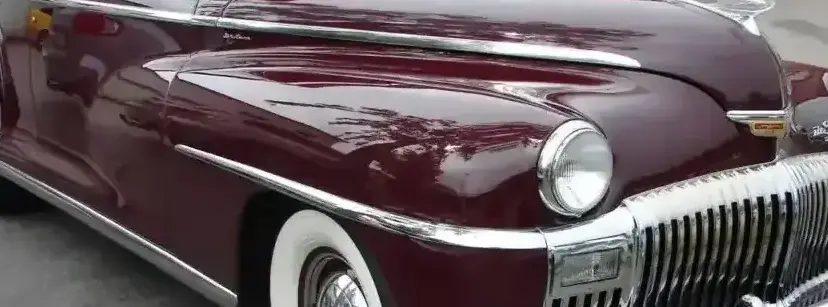
The DeSoto Deluxe II 8-Passenger, powered by a 4.1-liter (250.56 cubic inch) inline-six engine producing 116 horsepower, represented a significant offering in the early 1950s American automotive landscape. Produced for the 1951 and 1952 model years, this variant occupied a crucial position within the DeSoto Deluxe II range, catering to families and those requiring substantial passenger capacity. It was a period of post-war optimism and burgeoning automotive design, and the Deluxe II aimed to provide comfortable and reliable transportation for the growing American middle class.
Technical Specifications
| Brand | DeSoto |
| Model | Deluxe |
| Generation | Deluxe II 8-Passenger |
| Type (Engine) | 4.1 (116 Hp) |
| Start of production | 1951 |
| End of production | 1952 |
| Powertrain Architecture | Internal Combustion engine |
| Body type | Sedan |
| Seats | 8 |
| Doors | 4 |
| Fuel Type | Petrol (Gasoline) |
| Power | 116 Hp @ 3600 rpm |
| Power per litre | 28.3 Hp/l |
| Torque | 282 Nm @ 1600 rpm / 207.99 lb.-ft. @ 1600 rpm |
| Engine displacement | 4106 cm3 / 250.56 cu. in. |
| Number of cylinders | 6 |
| Engine configuration | Inline |
| Cylinder Bore | 87.31 mm / 3.44 in. |
| Piston Stroke | 114.3 mm / 4.5 in. |
| Compression ratio | 7:1 |
| Number of valves per cylinder | 2 |
| Fuel injection system | Carburettor |
| Engine aspiration | Naturally aspirated engine |
| Engine oil capacity | 4.7 l / 4.97 US qt | 4.14 UK qt |
| Coolant | 16.1 l / 17.01 US qt | 14.17 UK qt |
| Fuel tank capacity | 64 l / 16.91 US gal | 14.08 UK gal |
| Length | 5699 mm / 224.37 in. |
| Width | 1934 mm / 76.14 in. |
| Height | 1680 mm / 66.14 in. |
| Wheelbase | 3543 mm / 139.49 in. |
| Front track | 1430 mm / 56.3 in. |
| Rear (Back) track | 1512 mm / 59.53 in. |
| Ride height (ground clearance) | 210 mm / 8.27 in. |
| Drag coefficient (Cd) | 0.60 |
| Minimum turning circle (turning diameter) | 13.5 m / 44.29 ft. |
| Drivetrain Architecture | The Internal combustion engine (ICE) drives the rear wheels of the vehicle. |
| Drive wheel | Rear wheel drive |
| Number of gears and type of gearbox | 3 gears, manual transmission |
| Front suspension | Independent coil spring |
| Rear suspension | Leaf spring |
| Front brakes | Drum, 305 mm |
| Rear brakes | Drum, 305 mm |
Powertrain & Engine Architecture
The heart of the DeSoto Deluxe II 8-Passenger was the 4.1-liter inline-six cylinder engine. This engine, designated for internal purposes with various codes depending on minor specification changes, was a robust and relatively simple design. It featured a cast iron block and cylinder head, with a 7:1 compression ratio. Fuel delivery was managed by a single carburetor, typical for the era. The valvetrain employed two valves per cylinder, operated by a conventional pushrod system. The engine’s 116 horsepower output at 3600 rpm, and 282 Nm (207.99 lb-ft) of torque at 1600 rpm, provided adequate, though not exceptional, performance for the large sedan. The engine was known for its durability and relatively easy maintenance, characteristics valued by owners in the 1950s.
Driving Characteristics
With its 4,000+ pound curb weight, the 8-Passenger Deluxe II wasn’t designed for sporty driving. The 3-speed manual transmission, standard for this variant, offered a relatively wide gear spread, prioritizing fuel economy and smooth cruising over rapid acceleration. The engine delivered its peak torque at a low 1600 rpm, providing reasonable pulling power for everyday driving, but climbing hills or overtaking required downshifting. Compared to potential V8-powered DeSoto models (which were not available in the 8-passenger configuration), the 4.1-liter six offered a more economical, albeit less powerful, driving experience. The focus was on providing a comfortable and reliable ride for a full complement of passengers.
Equipment & Trim Levels
The Deluxe II 8-Passenger was positioned as a family-oriented vehicle, and its standard equipment reflected this. Interiors were typically finished in durable cloth upholstery, with a focus on practicality rather than luxury. The dashboard featured a straightforward layout with essential gauges – speedometer, fuel level, temperature, and oil pressure. While not lavishly appointed, the interior offered ample space for eight adults. Optional extras included a radio, heater, and whitewall tires. The trim level was consistent across the 8-passenger model, with limited customization options available.
Chassis & Braking
The DeSoto Deluxe II 8-Passenger utilized a body-on-frame construction, common for American cars of the period. The front suspension employed independent coil springs, providing a relatively comfortable ride. The rear suspension relied on a traditional leaf spring setup, designed to handle the weight of passengers and luggage. Braking was accomplished via drum brakes on all four wheels, measuring 305mm in diameter. While adequate for the time, the drum brakes lacked the stopping power of later disc brake systems. Steering was of the conventional worm and roller type, requiring considerable effort at low speeds.
Market Reception & Comparison
The DeSoto Deluxe II 8-Passenger was generally well-received by the American public, particularly those with large families. Critics praised its spacious interior, comfortable ride, and reliable engine. However, it was often noted that the 4.1-liter engine was somewhat underpowered for the vehicle’s size and weight. Compared to other large sedans of the era, such as those offered by Chevrolet and Ford, the DeSoto Deluxe II offered a slightly more upscale image and a reputation for durability. Fuel economy, while not a primary concern for most buyers at the time, was considered average for a vehicle of its size.
Legacy
The DeSoto Deluxe II 8-Passenger, while not a particularly rare or highly sought-after classic today, represents a significant piece of American automotive history. The 4.1-liter inline-six engine proved to be remarkably durable, and many examples remain on the road today, testament to its robust design. In the used car market, these DeSotos are appreciated by collectors and enthusiasts for their classic styling and nostalgic appeal. Parts availability can be a challenge, but a dedicated community of DeSoto owners and restorers helps to keep these vehicles running. The Deluxe II 8-Passenger serves as a reminder of a time when American cars were large, comfortable, and built to last.