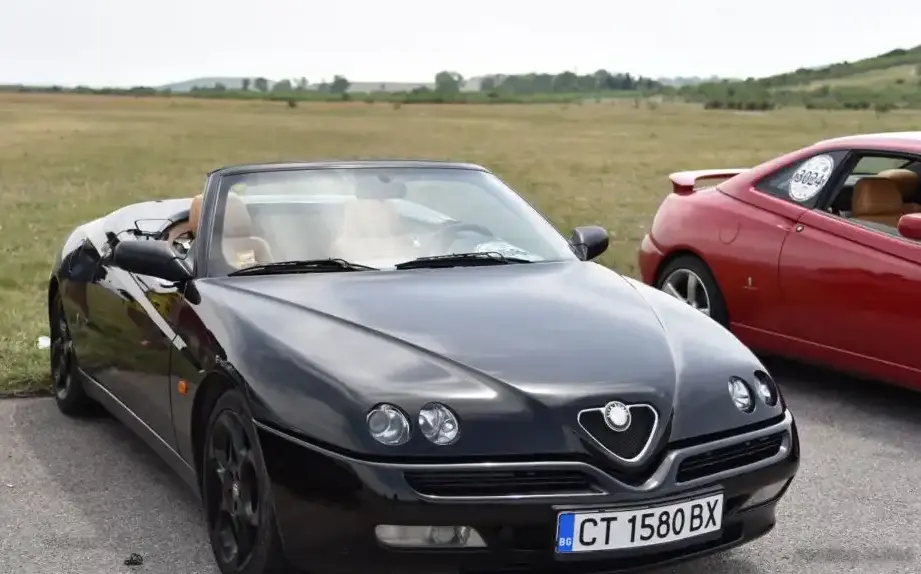
The Alfa Romeo Spider (916) 2.0 Twin Spark, produced from 1995 to 2002, represents a significant evolution in the storied history of Alfa Romeo’s open-top roadsters. This generation, designated the 916 series, marked a departure from the Pininfarina-designed predecessors, adopting a more contemporary and rounded aesthetic penned by Enrico Fumia. The 2.0 Twin Spark variant, delivering 150 horsepower, occupied a sweet spot in the lineup, offering a balance of performance and affordability. It was positioned as the mainstream offering, appealing to buyers who desired the Spider experience without the higher price tag of the more potent V6 models. The 916 Spider was primarily aimed at the European market, where it enjoyed considerable success as a stylish and engaging sports car.
Technical Specifications
| Brand | Alfa Romeo |
| Model | Spider |
| Generation | Spider (916) |
| Type (Engine) | 2.0 Twin Spark (150 Hp) |
| Start of production | 1995 |
| End of production | 2002 |
| Powertrain Architecture | Internal Combustion engine |
| Body type | Cabriolet |
| Seats | 2 |
| Doors | 2 |
| Fuel consumption (urban) | 13.3 l/100 km (17.7 US mpg, 21.2 UK mpg, 7.5 km/l) |
| Fuel consumption (extra urban) | 6.8 l/100 km (34.6 US mpg, 41.5 UK mpg, 14.7 km/l) |
| Fuel consumption (combined) | 9.2 l/100 km (25.6 US mpg, 30.7 UK mpg, 10.9 km/l) |
| Fuel Type | Petrol (Gasoline) |
| Acceleration 0 – 100 km/h | 8.4 sec |
| Acceleration 0 – 62 mph | 8.4 sec |
| Acceleration 0 – 60 mph | 8 sec |
| Maximum speed | 210 km/h (130.49 mph) |
| Weight-to-power ratio | 9.1 kg/Hp, 109.5 Hp/tonne |
| Weight-to-torque ratio | 7.6 kg/Nm, 132.1 Nm/tonne |
| Power | 150 Hp @ 6300 rpm |
| Power per litre | 76.1 Hp/l |
| Torque | 181 Nm @ 3800 rpm (133.5 lb.-ft. @ 3800 rpm) |
| Engine layout | Front, Transverse |
| Engine Model/Code | AR 16201 |
| Engine displacement | 1970 cm3 (120.22 cu. in.) |
| Number of cylinders | 4 |
| Engine configuration | Inline |
| Cylinder Bore | 83 mm (3.27 in.) |
| Piston Stroke | 91 mm (3.58 in.) |
| Compression ratio | 10:1 |
| Number of valves per cylinder | 4 |
| Fuel injection system | Multi-port manifold injection |
| Engine aspiration | Naturally aspirated engine |
| Valvetrain | DOHC |
| Engine oil capacity | 4.4 l (4.65 US qt | 3.87 UK qt) |
| Coolant | 8.4 l (8.88 US qt | 7.39 UK qt) |
| Kerb Weight | 1370 kg (3020.33 lbs.) |
| Max. weight | 1630 kg (3593.53 lbs.) |
| Max load | 260 kg (573.2 lbs.) |
| Trunk (boot) space – minimum | 110 l (3.88 cu. ft.) |
| Fuel tank capacity | 70 l (18.49 US gal | 15.4 UK gal) |
| Length | 4285 mm (168.7 in.) |
| Width | 1780 mm (70.08 in.) |
| Height | 1315 mm (51.77 in.) |
| Wheelbase | 2540 mm (100 in.) |
| Front track | 1499 mm (59.02 in.) |
| Rear (Back) track | 1497 mm (58.94 in.) |
| Drivetrain Architecture | The Internal combustion engine (ICE) drives the front wheels of the vehicle. |
| Drive wheel | Front wheel drive |
| Number of gears and type of gearbox | 5 gears, manual transmission |
| Front suspension | Spring Strut |
| Rear suspension | Coil spring |
| Front brakes | Ventilated discs |
| Rear brakes | Disc |
| Assisting systems | ABS (Anti-lock braking system) |
| Steering type | Steering rack and pinion |
| Power steering | Hydraulic Steering |
| Tires size | 205/50 R16 |
| Wheel rims size | 7J x 16 |
Powertrain & Engine Architecture
The heart of the 2.0 Twin Spark is the AR 16201 engine, a naturally aspirated, four-cylinder powerplant. The “Twin Spark” designation refers to the engine’s dual spark plug per cylinder configuration, a feature designed to improve combustion efficiency and reduce emissions. This engine utilizes a multi-port fuel injection system, delivering fuel directly into the intake ports. The engine boasts a double overhead camshaft (DOHC) valvetrain, operating four valves per cylinder, which contributes to its relatively high specific output. The 1970cc displacement is achieved with a bore of 83mm and a stroke of 91mm. The engine’s 150 horsepower and 181 Nm (133.5 lb-ft) of torque were considered respectable for its time and displacement. The standard transmission was a five-speed manual, providing a direct and engaging driving experience. While an automatic transmission was offered, it was less common and generally considered to detract from the sporty character of the Spider.
Driving Characteristics
The 2.0 Twin Spark Spider, with its manual transmission, offered a lively and engaging driving experience. Acceleration to 60 mph took around 8 seconds, and it could reach a top speed of 130 mph. The engine felt responsive, particularly in the mid-range, making it well-suited for spirited driving on winding roads. The five-speed gearbox had a relatively short throw, enhancing the connection between driver and machine. Compared to the more powerful V6 versions, the 2.0 Twin Spark lacked outright grunt, but it compensated with lighter weight and a more balanced chassis. The automatic transmission version, while offering convenience, noticeably dulled the driving experience, with slower acceleration and less engine braking. The gear ratios were optimized for everyday usability rather than outright performance.
Equipment & Trim Levels
The 2.0 Twin Spark Spider typically came equipped with features such as power windows, central locking, and an AM/FM radio. Leather upholstery was a popular option, as were alloy wheels. Air conditioning was also a common addition. Higher trim levels might include features like a sunroof, upgraded sound system, and more luxurious interior appointments. The interior design was typically Italianate, with a focus on style and ergonomics. The dashboard layout was straightforward, with clearly marked gauges and controls. The seats were supportive and comfortable, designed for long-distance cruising.
Chassis & Braking
The 916 Spider utilized a front-engine, front-wheel-drive layout. The suspension consisted of independent spring struts at the front and a coil spring setup at the rear. The braking system featured ventilated discs at the front and solid discs at the rear, with ABS (Anti-lock Braking System) as standard equipment. The steering was a rack-and-pinion system with hydraulic power assistance, providing precise and responsive handling. The chassis was relatively lightweight, contributing to the car’s agility. Stabilizer bars were fitted front and rear to reduce body roll during cornering.
Market Reception & Comparison
The Alfa Romeo Spider 2.0 Twin Spark was generally well-received by automotive critics. It was praised for its stylish design, engaging handling, and relatively affordable price. However, some critics noted that the engine lacked the outright power of its V6 counterparts. Fuel economy was reasonable for a sports car of its era, averaging around 25.6 US mpg in combined driving. Compared to other roadsters on the market, such as the Mazda MX-5, the Spider offered a more sophisticated and luxurious experience, but at a higher price point. Reliability was a mixed bag, with some owners reporting issues with electrical components and cooling system.
Legacy
The Alfa Romeo Spider (916) 2.0 Twin Spark remains a popular choice among enthusiasts today. The engine, while not without its quirks, is generally considered reliable if properly maintained. Parts availability can be a challenge, but a dedicated community of Alfa Romeo owners and specialists exists to provide support. The 916 Spider is valued for its classic Italian styling, engaging driving dynamics, and relatively affordable entry price into the world of Alfa Romeo ownership. The 2.0 Twin Spark variant, in particular, is seen as a sweet spot in the lineup, offering a good balance of performance, reliability, and cost. It represents a significant chapter in the history of Alfa Romeo’s iconic roadster, and continues to provide driving pleasure to enthusiasts around the world.