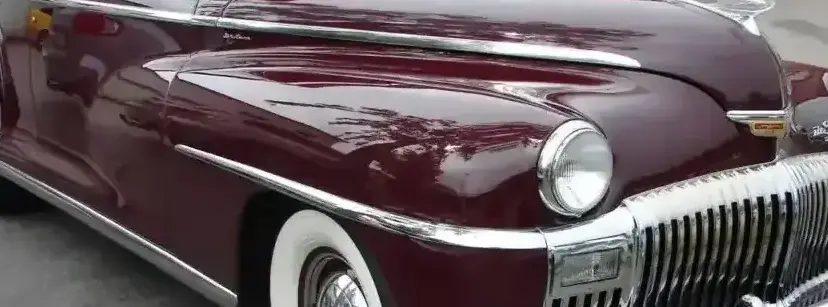
The DeSoto Deluxe II Carry-All Sedan, equipped with the 4.1-liter (250.56 cubic inch) inline-six engine producing 116 horsepower, was a significant offering from the DeSoto division of Chrysler Corporation during the 1951 and 1952 model years. Positioned as a family-oriented vehicle, the Carry-All Sedan represented a blend of post-war styling and practical functionality. This particular variant, paired with the innovative “Tip-Toe Shift” automatic transmission, aimed to provide a comfortable and convenient driving experience for the American consumer. It sat within the Deluxe II range, offering a step up in features and refinement compared to the base Deluxe model, but remained below the more luxurious DeSoto Custom models.
Technical Specifications
| Brand | DeSoto |
| Model | Deluxe |
| Generation | Deluxe II Carry-All Sedan |
| Type (Engine) | 4.1 (116 Hp) Tip-Toe Shift |
| Start of production | 1951 |
| End of production | 1952 |
| Powertrain Architecture | Internal Combustion engine |
| Body type | Sedan |
| Seats | 6 |
| Doors | 4 |
| Fuel Type | Petrol (Gasoline) |
| Power | 116 Hp @ 3600 rpm |
| Power per litre | 28.3 Hp/l |
| Torque | 282 Nm @ 1600 rpm |
| Torque (lb.-ft.) | 207.99 lb.-ft. @ 1600 rpm |
| Engine displacement | 4106 cm3 |
| Engine displacement (cu. in.) | 250.56 cu. in. |
| Number of cylinders | 6 |
| Engine configuration | Inline |
| Cylinder Bore | 87.31 mm |
| Cylinder Bore (in.) | 3.44 in. |
| Piston Stroke | 114.3 mm |
| Piston Stroke (in.) | 4.5 in. |
| Compression ratio | 7:1 |
| Number of valves per cylinder | 2 |
| Fuel injection system | Carburettor |
| Engine aspiration | Naturally aspirated engine |
| Engine oil capacity | 4.7 l |
| Engine oil capacity (US qt) | 4.97 US qt |
| Engine oil capacity (UK qt) | 4.14 UK qt |
| Coolant capacity | 14.2 l |
| Coolant capacity (US qt) | 15 US qt |
| Coolant capacity (UK qt) | 12.49 UK qt |
| Fuel tank capacity | 64 l |
| Fuel tank capacity (US gal) | 16.91 US gal |
| Fuel tank capacity (UK gal) | 14.08 UK gal |
| Length | 5290 mm |
| Length (in.) | 208.27 in. |
| Width | 1908 mm |
| Width (in.) | 75.12 in. |
| Height | 1660 mm |
| Height (in.) | 65.35 in. |
| Wheelbase | 3188 mm |
| Wheelbase (in.) | 125.51 in. |
| Front track | 1430 mm |
| Front track (in.) | 56.3 in. |
| Rear track | 1512 mm |
| Rear track (in.) | 59.53 in. |
| Ride height (ground clearance) | 210 mm |
| Ride height (in.) | 8.27 in. |
| Drag coefficient (Cd) | 0.60 |
| Minimum turning circle | 13 m |
| Minimum turning circle (ft) | 42.65 ft. |
| Drivetrain Architecture | Rear wheel drive |
| Drive wheel | Rear wheel drive |
| Number of gears | 4 |
| Gearbox type | automatic transmission Tip-Toe Shift |
| Front suspension | Independent coil spring |
| Rear suspension | Leaf spring |
| Front brakes | Drum, 305 mm |
| Rear brakes | Drum, 305 mm |
Powertrain & Engine Architecture
The heart of the DeSoto Deluxe II Carry-All Sedan was the 4.1-liter (250.56 cu. in.) inline-six cylinder engine. This engine, designated within Chrysler’s engine family as a variation of the robust and reliable flathead six, featured a 7:1 compression ratio and utilized a single carburetor for fuel delivery. The engine’s design emphasized low-end torque, making it well-suited for the demands of family motoring. The valvetrain employed two valves per cylinder, operated by a conventional pushrod system. The “Tip-Toe Shift” automatic transmission was a two-speed unit, a relatively early example of automatic technology. It operated fluidly, offering simplified gear changes compared to a manual transmission, and was marketed towards drivers seeking ease of use. The transmission’s design, while innovative for its time, lacked the efficiency and responsiveness of later automatic transmissions.
Driving Characteristics
The 116 horsepower and 207.99 lb.-ft. of torque delivered by the 4.1-liter engine, coupled with the two-speed automatic transmission, resulted in a driving experience focused on comfortable cruising rather than spirited acceleration. The Tip-Toe Shift transmission, while convenient, did contribute to a noticeable delay in response compared to manual transmission equipped models. The gear ratios were optimized for relaxed highway driving, but could feel somewhat strained during quick acceleration or when navigating hilly terrain. Compared to the higher-output DeSoto engines, such as those found in the Custom models, this 4.1-liter configuration offered a more economical and accessible option for buyers prioritizing practicality and fuel efficiency.
Equipment & Trim Levels
The Deluxe II Carry-All Sedan came standard with a range of features considered desirable for the era. These included a spacious interior with seating for six passengers, upholstered in durable cloth or vinyl. The dashboard featured a combination of analog gauges providing information on speed, fuel level, and engine temperature. Standard exterior features included chrome trim, full wheel covers, and whitewall tires. Optional extras included a radio, heater, and upgraded upholstery materials. The Carry-All Sedan’s trim level positioned it as a step above the base Deluxe, offering a more refined interior and a greater level of standard equipment.
Chassis & Braking
The DeSoto Deluxe II Carry-All Sedan utilized a body-on-frame construction, typical of American automobiles of the period. The front suspension employed independent coil springs, providing a relatively comfortable ride. The rear suspension utilized leaf springs, which were robust and capable of handling the vehicle’s weight. Braking duties were handled by drum brakes on all four wheels, measuring 305 mm in diameter. While adequate for the vehicle’s weight and performance, the drum brakes lacked the stopping power and fade resistance of later disc brake systems. Steering was accomplished via a conventional steering gear, providing a somewhat indirect but manageable steering feel.
Market Reception & Comparison
The DeSoto Deluxe II Carry-All Sedan with the 4.1-liter engine and Tip-Toe Shift transmission was generally well-received by contemporary automotive critics. It was praised for its comfortable ride, spacious interior, and convenient automatic transmission. However, some critics noted the engine’s lack of outright power and the transmission’s somewhat sluggish response. Compared to other DeSoto models, such as the Custom, this variant offered a more affordable entry point into the DeSoto lineup. In terms of fuel economy, the 4.1-liter engine offered reasonable efficiency for its time, although it was not as economical as some of the smaller-displacement engines offered by competitors.
Legacy
The DeSoto Deluxe II Carry-All Sedan, while not a particularly rare or highly sought-after classic today, represents a significant example of American automotive design and engineering from the early 1950s. The 4.1-liter inline-six engine, while not known for exceptional performance, proved to be a durable and reliable powerplant. The Tip-Toe Shift automatic transmission, though primitive by modern standards, was a pioneering example of automatic transmission technology. Today, surviving examples of the Deluxe II Carry-All Sedan are often found in restored condition, cherished by collectors and enthusiasts as a reminder of a bygone era of American automotive history. The powertrain, while requiring regular maintenance, generally holds up well with proper care, making it a relatively accessible classic for those interested in vintage automobile ownership.