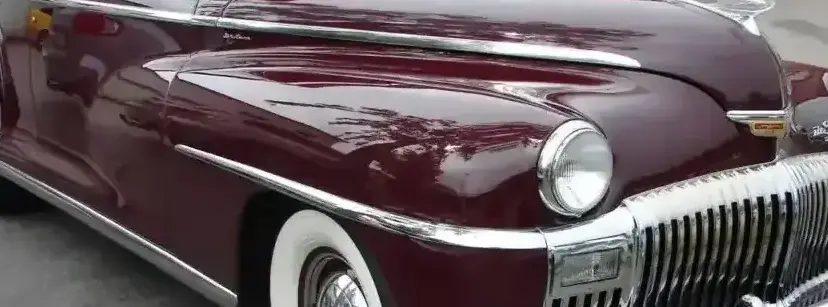
The DeSoto Deluxe II Club Coupe with the 4.1-liter engine, producing 116 horsepower, was a mainstay of the DeSoto lineup during the 1951 and 1952 model years. Positioned as a mid-range offering within the Deluxe II series, it represented a balance between affordability and the larger, more luxurious models offered by DeSoto. This coupe played a significant role in DeSoto’s attempt to capture a segment of the American car market seeking stylish, reliable transportation in the post-war era. It was built upon DeSoto’s existing chassis and benefited from styling updates intended to modernize the brand’s image.
Technical Specifications
| Brand | DeSoto |
| Model | Deluxe |
| Generation | Deluxe II Club Coupe |
| Type (Engine) | 4.1 (116 Hp) |
| Start of production | 1951 |
| End of production | 1952 |
| Powertrain Architecture | Internal Combustion engine |
| Body type | Coupe |
| Seats | 6 |
| Doors | 2 |
| Fuel Type | Petrol (Gasoline) |
| Power | 116 Hp @ 3600 rpm |
| Power per litre | 28.3 Hp/l |
| Torque | 282 Nm @ 1600 rpm / 207.99 lb.-ft. @ 1600 rpm |
| Engine displacement | 4106 cm3 / 250.56 cu. in. |
| Number of cylinders | 6 |
| Engine configuration | Inline |
| Cylinder Bore | 87.31 mm / 3.44 in. |
| Piston Stroke | 114.3 mm / 4.5 in. |
| Compression ratio | 7:1 |
| Number of valves per cylinder | 2 |
| Fuel injection system | Carburettor |
| Engine aspiration | Naturally aspirated engine |
| Engine oil capacity | 4.7 l / 4.97 US qt | 4.14 UK qt |
| Coolant | 14.2 l / 15 US qt | 12.49 UK qt |
| Fuel tank capacity | 64 l / 16.91 US gal | 14.08 UK gal |
| Length | 5290 mm / 208.27 in. |
| Width | 1908 mm / 75.12 in. |
| Height | 1660 mm / 65.35 in. |
| Wheelbase | 3188 mm / 125.51 in. |
| Front track | 1430 mm / 56.3 in. |
| Rear (Back) track | 1512 mm / 59.53 in. |
| Ride height (ground clearance) | 210 mm / 8.27 in. |
| Drag coefficient (Cd) | 0.60 |
| Minimum turning circle (turning diameter) | 13 m / 42.65 ft. |
| Drivetrain Architecture | The Internal combustion engine (ICE) drives the rear wheels of the vehicle. |
| Drive wheel | Rear wheel drive |
| Number of gears and type of gearbox | 3 gears, manual transmission |
| Front suspension | Independent coil spring |
| Rear suspension | Leaf spring |
| Front brakes | Drum, 305 mm |
| Rear brakes | Drum, 305 mm |
Powertrain & Engine Architecture
The heart of the 1951-1952 DeSoto Deluxe II Club Coupe was its 4.1-liter (250.6 cubic inch) inline-six cylinder engine. This engine, a robust and relatively simple design, was a carryover from previous DeSoto models, though it received refinements for improved reliability and performance. The engine featured a cast iron block and cylinder head, with a 7:1 compression ratio. Fuel was delivered via a single, two-barrel carburetor, a common setup for the era. The valvetrain employed two valves per cylinder, operated by a conventional pushrod system. The engine produced 116 horsepower at 3600 rpm and 282 Nm (208 lb-ft) of torque at 1600 rpm. The engine was mated to a three-speed manual transmission as standard, sending power to the rear wheels.
Driving Characteristics
The 1951-1952 DeSoto Deluxe II Club Coupe, equipped with the 4.1-liter engine and manual transmission, offered a driving experience typical of American cars of the period. Acceleration was adequate for the time, but not particularly brisk. The engine delivered its peak torque at relatively low engine speeds, making it suitable for everyday driving and providing reasonable pulling power. The three-speed manual transmission required deliberate shifting, and the gear ratios were spaced to prioritize fuel economy and cruising comfort over outright performance. Compared to other DeSoto models with larger displacement engines, the 4.1-liter version felt less powerful, but it offered a more economical and accessible option for buyers.
Equipment & Trim Levels
The Deluxe II Club Coupe was positioned as a mid-range model, offering a good balance of features and affordability. Standard equipment included a spacious interior with seating for six passengers, a heater, and a basic instrument panel. The interior was typically trimmed with cloth upholstery, although optional upgrades to leather were available. Exterior styling featured chrome trim, whitewall tires, and a two-tone paint scheme. Optional extras included a radio, a clock, and various accessories to enhance comfort and convenience. The Club Coupe body style, with its two doors and fixed rear window, was a popular choice for buyers seeking a stylish and practical vehicle.
Chassis & Braking
The DeSoto Deluxe II Club Coupe utilized a traditional body-on-frame construction. The chassis featured an independent coil spring suspension at the front, providing a relatively comfortable ride. The rear suspension employed leaf springs, a common design for rear-wheel-drive cars of the era. Braking was accomplished via drum brakes on all four wheels, measuring 305mm in diameter. While adequate for the time, the drum brakes lacked the stopping power of more modern braking systems. Steering was provided by a conventional steering gear, offering a somewhat indirect feel. The car’s relatively long wheelbase (3188 mm / 125.5 inches) contributed to a stable ride, but also made it less maneuverable in tight spaces.
Market Reception & Comparison
The 1951-1952 DeSoto Deluxe II Club Coupe was generally well-received by critics and consumers. It was praised for its stylish design, comfortable interior, and reliable powertrain. However, some reviewers noted that the 4.1-liter engine lacked the power of larger displacement engines offered by competitors. Compared to other DeSoto models, such as those equipped with the larger 4.8-liter V8 engine, the 4.1-liter version offered better fuel economy but less performance. In terms of reliability, the 4.1-liter engine proved to be durable and relatively trouble-free, making it a popular choice among buyers seeking a dependable vehicle.
Legacy
The DeSoto Deluxe II Club Coupe with the 4.1-liter engine represents a significant chapter in DeSoto’s history. While the brand ultimately faded away in the 1960s, the Deluxe II models remain popular among classic car enthusiasts. The 4.1-liter engine, while not a high-performance unit, is known for its durability and relative simplicity, making it easier to maintain and repair than more complex engines. Today, well-preserved examples of the 1951-1952 DeSoto Deluxe II Club Coupe are sought after by collectors and are often seen at classic car shows. The car’s enduring appeal lies in its combination of stylish design, comfortable interior, and reliable powertrain, representing a bygone era of American automotive history.