Technical Specifications
| Brand | DeSoto |
| Model | Firedome |
| Generation | Firedome Four-Door Sedan (facelift 1954) |
| Type (Engine) | 4.5 V8 (170 Hp) |
| Start of production | 1953 |
| End of production | 1954 |
| Powertrain Architecture | Internal Combustion engine |
| Body type | Sedan |
| Seats | 6 |
| Doors | 4 |
| Fuel Type | Petrol (Gasoline) |
| Weight-to-power ratio | 10 kg/Hp, 99.9 Hp/tonne |
| Weight-to-torque ratio | 4.9 kg/Nm, 203.4 Nm/tonne |
| Power | 170 Hp @ 4400 rpm |
| Power per litre | 37.6 Hp/l |
| Torque | 346 Nm @ 2400 rpm, 255.2 lb.-ft. @ 2400 rpm |
| Engine Model/Code | S19-1001 |
| Engine displacement | 4524 cm3, 276.07 cu. in. |
| Number of cylinders | 8 |
| Engine configuration | V-engine |
| Cylinder Bore | 92.075 mm, 3.63 in. |
| Piston Stroke | 84.931 mm, 3.34 in. |
| Compression ratio | 7.5:1 |
| Number of valves per cylinder | 2 |
| Fuel injection system | Carburettor |
| Engine aspiration | Naturally aspirated engine |
| Valvetrain | OHV |
| Engine oil capacity | 4.7 l, 4.97 US qt | 4.14 UK qt |
| Coolant | 21.8 l, 23.04 US qt | 19.18 UK qt |
| Kerb Weight | 1701 kg, 3750.06 lbs |
| Fuel tank capacity | 64 l, 16.91 US gal | 14.08 UK gal |
| Length | 5448 mm, 214.49 in |
| Width | 1969 mm, 77.52 in |
| Height | 1632 mm, 64.25 in |
| Wheelbase | 3188 mm, 125.51 in |
| Front track | 1403 mm, 55.24 in |
| Rear (Back) track | 1438 mm, 56.61 in |
| Front overhang | 940 mm, 37.01 in |
| Rear overhang | 1321 mm, 52.01 in |
| Ride height (ground clearance) | 178 mm, 7.01 in |
| Drag coefficient (Cd) | 0.6 |
| Minimum turning circle (turning diameter) | 12.8 m, 41.99 ft |
| Approach angle | 23° |
| Departure angle | 17° |
| Ramp-over (brakeover) angle | 15° |
| Drivetrain Architecture | The Internal combustion engine (ICE) drives the rear wheels of the vehicle. |
| Drive wheel | Rear wheel drive |
| Number of gears and type of gearbox | 3 gears, manual transmission |
| Front suspension | Independent coil spring |
| Rear suspension | Leaf spring |
| Front brakes | Drum, 305 mm |
| Rear brakes | Drum, 305 mm |
| Steering type | Worm-reduction unit |
| Power steering | Hydraulic Steering |
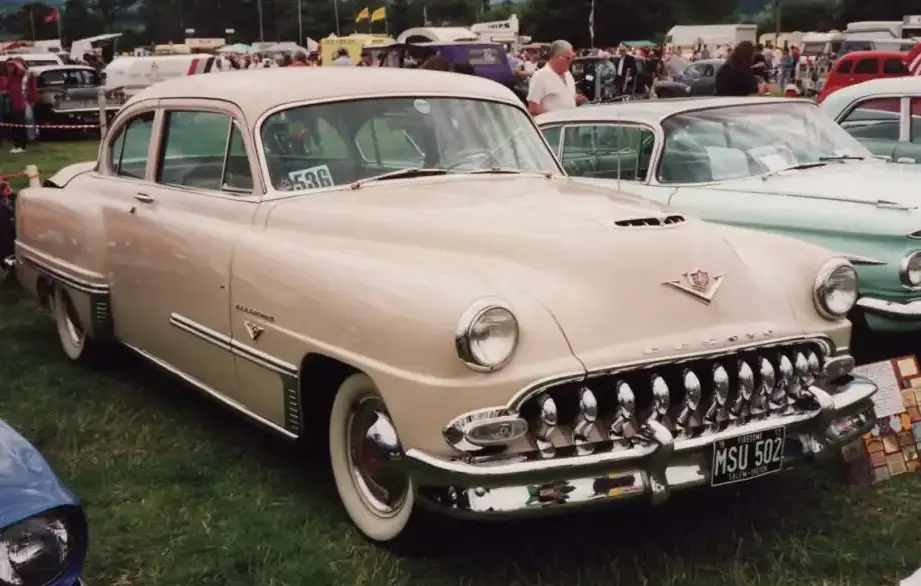
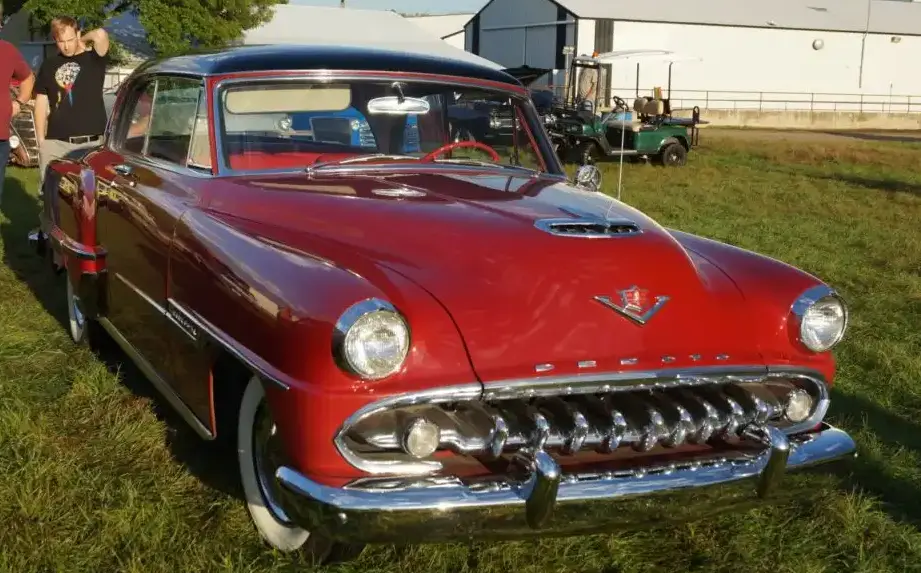
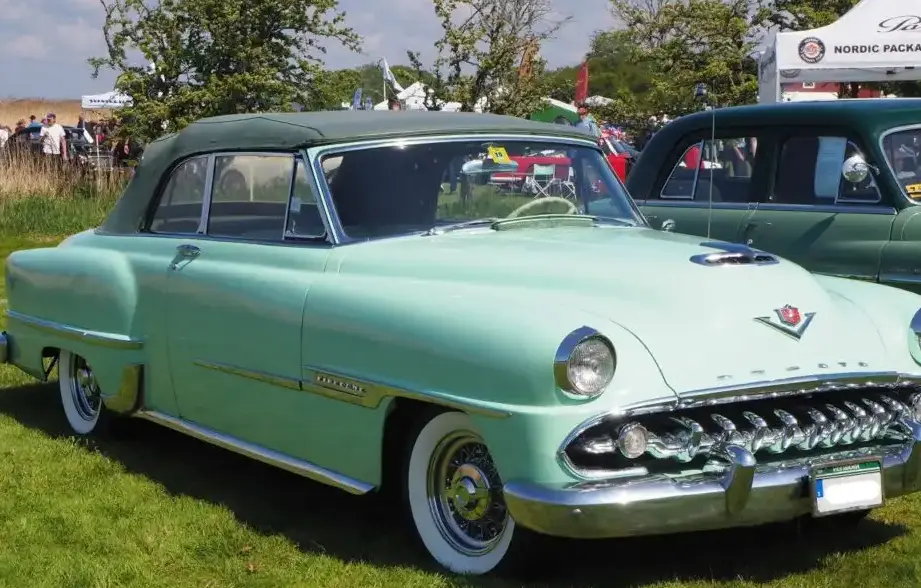
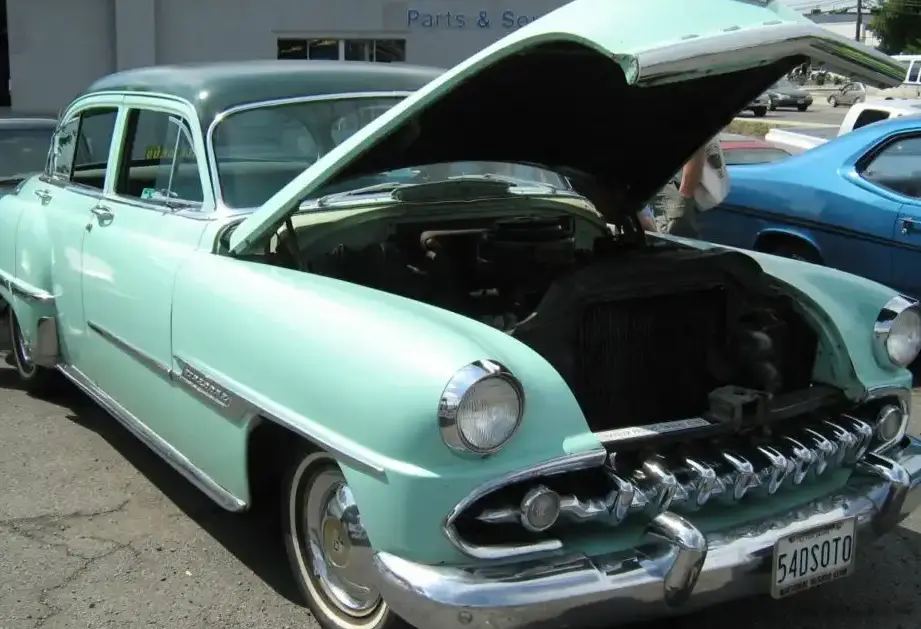
The 1954 DeSoto Firedome Four-Door Sedan, particularly the facelifted model, stands as a notable example of American automotive design and engineering from the mid-1950s. Produced between 1953 and 1954, the Firedome occupied a crucial position within the DeSoto lineup, serving as the division’s full-size offering. It aimed to provide a step up in luxury and features compared to the more economical DeSoto Deluxe, while remaining more accessible than the flagship Chrysler models. The 1954 revision brought with it a series of styling enhancements, designed to bolster its appeal in a fiercely competitive market. This specific variant was equipped with a 4.5-liter V8 engine generating 170 horsepower, and was typically paired with a three-speed manual transmission, although a convenient automatic transmission was available as an optional upgrade.
Powertrain & Engine Architecture
The 1954 Firedome’s powerplant was the S19-1001 4.5-liter (276.07 cubic inch) V8 engine. This engine incorporated a cast iron block and aluminum cylinder heads, a relatively advanced configuration for the early 1950s. It employed a traditional overhead valve (OHV) valvetrain, featuring two valves per cylinder. Fuel delivery was handled by a Carter carburetor, a common practice for the period. The 7.5:1 compression ratio represented a balance between achieving respectable performance and accommodating the fuel quality prevalent at the time. The engine produced 170 horsepower at 4400 rpm and 346 Nm (255.2 lb-ft) of torque at 2400 rpm. While a three-speed manual transmission was standard, DeSoto offered a Chrysler-built PowerFlite two-speed automatic transmission as an optional feature, appealing to drivers prioritizing ease of operation.
Driving Characteristics
The Firedome, when equipped with the 170 hp V8 and the three-speed manual transmission, delivered performance that was adequate for the era, though not particularly sporty. Acceleration was sufficient for highway cruising and passing, but it wasn’t engineered for spirited driving. The manual transmission provided a direct connection to the engine, allowing drivers to effectively utilize the available power. The optional automatic transmission, while enhancing convenience, resulted in a slight reduction in acceleration due to its limited number of gears. The car’s considerable weight (1701 kg / 3750 lbs) contributed to a somewhat substantial feel, especially when contrasted with lighter, more agile competitors. The leaf spring rear suspension offered a comfortable ride, but its handling characteristics in corners were not particularly refined.
Equipment & Trim Levels
The 1954 Firedome was reasonably well-appointed for a vehicle of its time. Standard features included a spacious interior capable of accommodating six passengers, a full-width bench seat, and a generously sized trunk. Interior trim generally consisted of cloth and vinyl upholstery, with options for more upscale materials such as leather. The dashboard featured a straightforward layout with essential instrumentation, including a speedometer, fuel gauge, and temperature gauge. Available options included power steering, power brakes, a radio, a heater, and whitewall tires. The Firedome occupied a middle ground within the DeSoto range, offering more features and refinement than the Deluxe model, but falling short of the luxurious appointments found in the Chrysler New Yorker.
Chassis & Braking
The Firedome was built on a conventional body-on-frame chassis. The front suspension utilized independent coil springs, providing a smoother ride compared to the solid axle setups found in some competing vehicles. The rear suspension employed leaf springs, which were known for their durability and ability to support the car’s weight. Braking was accomplished by drum brakes on all four wheels, measuring 305 mm in diameter. While adequate for the time, these drum brakes lacked the stopping power and fade resistance of modern disc brakes. Hydraulic steering was standard, making the car relatively easy to maneuver, particularly at lower speeds.
Market Reception & Comparison
The 1954 DeSoto Firedome generally received favorable reviews from automotive journalists. It was commended for its roomy interior, comfortable ride, and dependable V8 engine. However, some critics pointed out its somewhat dated styling and lack of cutting-edge features compared to certain competitors. When compared to the Ford Fairlane and Chevrolet Bel Air, the Firedome offered a more luxurious experience but came with a slightly higher price tag. Within the DeSoto lineup, the Firedome represented a good value, providing a balance of comfort, performance, and features. The automatic transmission option proved popular among buyers seeking convenience, although it did have a minor impact on fuel economy.
Legacy
The DeSoto Firedome, despite its relatively short production run, holds a significant place in automotive history as a representative of the American full-size sedan of the 1950s. The 4.5-liter V8 engine proved to be a durable and reliable powerplant, and numerous examples remain on the road today. While sourcing parts can be challenging, the engine’s relatively simple design makes it reasonably straightforward to maintain and repair. In the current used car market, well-preserved Firedomes are highly sought after by collectors and enthusiasts, particularly those with an interest in classic American automobiles. The 1954 facelifted model is generally considered the most desirable of the Firedome series, owing to its improved styling and refined features.