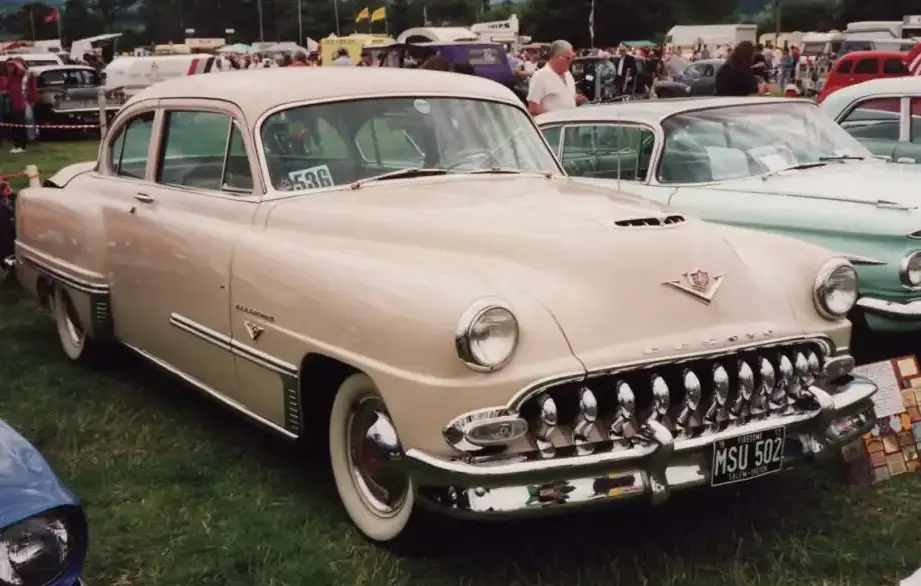
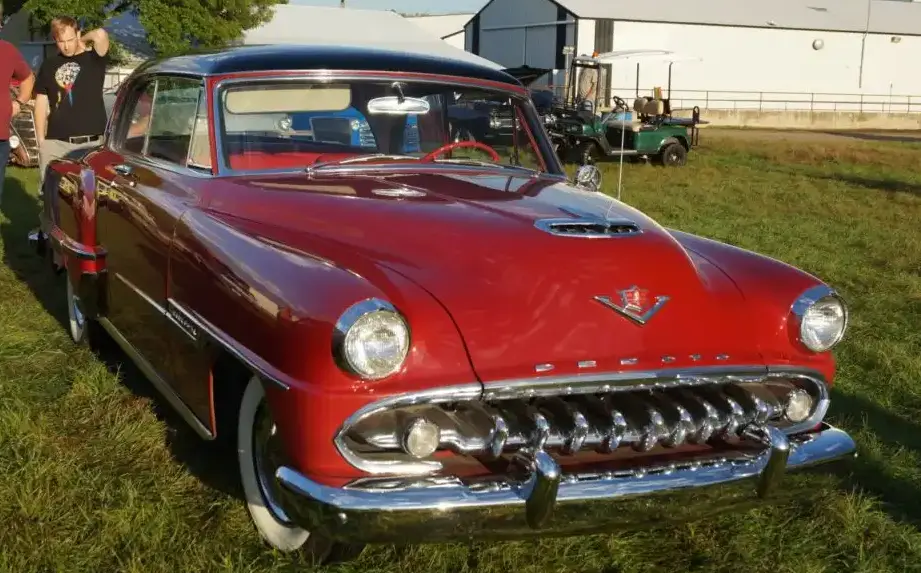
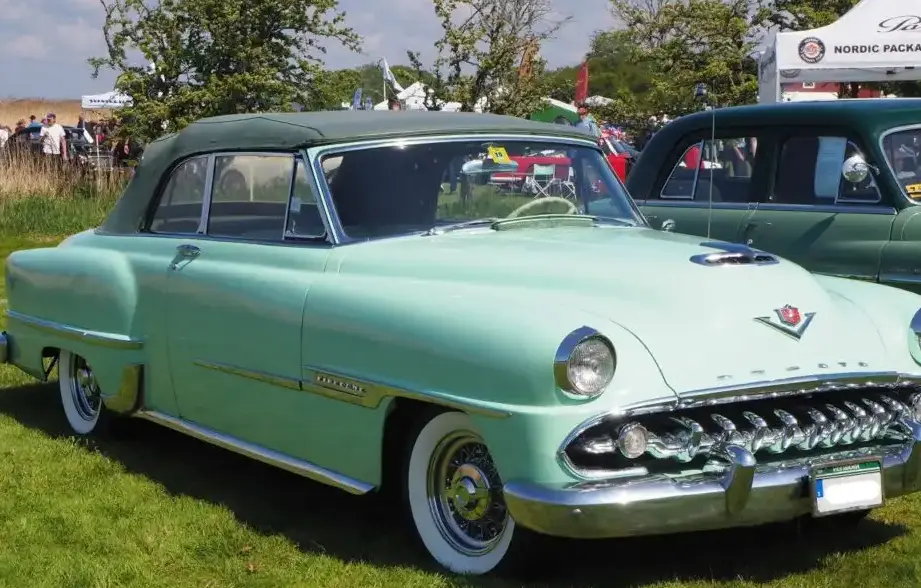
The DeSoto Firedome I Station Wagon with the 4.5-liter V8 engine, producing 160 horsepower, represents a significant offering from the 1951-1952 model years. Positioned as a family-oriented vehicle within the DeSoto lineup, it capitalized on the growing popularity of station wagons in post-war America. This variant was part of the first generation of the Firedome, built on DeSoto’s full-size platform, and aimed to provide a blend of style, space, and V8 power to the burgeoning suburban market. While not the most powerful DeSoto available, the 160 hp V8 offered a comfortable and capable driving experience for its intended purpose.
Technical Specifications
| Brand | DeSoto |
| Model | Firedome |
| Generation | Firedome I Station Wagon |
| Type (Engine) | 4.5 V8 (160 Hp) |
| Start of production | 1951 |
| End of production | 1952 |
| Powertrain Architecture | Internal Combustion engine |
| Body type | Station wagon (estate) |
| Seats | 6 |
| Doors | 5 |
| Fuel Type | Petrol (Gasoline) |
| Power | 160 Hp @ 4400 rpm |
| Power per litre | 35.4 Hp/l |
| Torque | 339 Nm @ 2000 rpm |
| Torque (lb-ft) | 250.03 lb.-ft. @ 2000 rpm |
| Engine Model/Code | S17-1001 |
| Engine displacement | 4524 cm3 |
| Engine displacement (cu. in.) | 276.07 cu. in. |
| Number of cylinders | 8 |
| Engine configuration | V-engine |
| Cylinder Bore | 92.075 mm |
| Cylinder Bore (in.) | 3.63 in. |
| Piston Stroke | 84.931 mm |
| Piston Stroke (in.) | 3.34 in. |
| Compression ratio | 7.1:1 |
| Number of valves per cylinder | 2 |
| Fuel injection system | Carburettor |
| Engine aspiration | Naturally aspirated engine |
| Engine oil capacity | 4.7 l |
| Engine oil capacity (US qt) | 4.97 US qt |
| Engine oil capacity (UK qt) | 4.14 UK qt |
| Coolant capacity | 23.6 l |
| Coolant capacity (US qt) | 24.94 US qt |
| Coolant capacity (UK qt) | 20.77 UK qt |
| Fuel tank capacity | 64 l |
| Fuel tank capacity (US gal) | 16.91 US gal |
| Fuel tank capacity (UK gal) | 14.08 UK gal |
| Length | 5293 mm |
| Length (in.) | 208.39 in. |
| Width | 1902 mm |
| Width (in.) | 74.88 in. |
| Height | 1667 mm |
| Height (in.) | 65.63 in. |
| Wheelbase | 3188 mm |
| Wheelbase (in.) | 125.51 in. |
| Front track | 1430 mm |
| Front track (in.) | 56.3 in. |
| Rear track | 1513 mm |
| Rear track (in.) | 59.57 in. |
| Ride height (ground clearance) | 229 mm |
| Ride height (in.) | 9.02 in. |
| Drag coefficient (Cd) | 0.6 |
| Minimum turning circle | 13 m |
| Minimum turning circle (ft.) | 42.65 ft. |
| Drivetrain Architecture | Rear wheel drive |
| Number of gears | 3 |
| Gearbox type | Manual transmission |
| Front suspension | Independent coil spring |
| Rear suspension | Leaf spring |
| Front brakes | Drum, 305 mm |
| Rear brakes | Drum, 305 mm |
Powertrain & Engine Architecture
The heart of the Firedome I Station Wagon was the DeSoto S17-1001 4.5-liter (276.07 cubic inch) V8 engine. This engine featured a cast iron block and cylinder heads, with a 7.1:1 compression ratio. It utilized a single carburetor for fuel delivery, a common setup for the era. The valvetrain employed two valves per cylinder, operated by a conventional pushrod system. The engine’s 160 horsepower output at 4400 rpm and 339 Nm (250.03 lb-ft) of torque at 2000 rpm provided adequate, though not exceptional, performance for the vehicle’s size and weight. The engine was paired with a standard three-speed manual transmission, delivering power to the rear wheels.
Driving Characteristics
The 1951-1952 DeSoto Firedome I Station Wagon, equipped with the 4.5L V8 and manual transmission, offered a driving experience typical of full-size American cars of the period. Acceleration was respectable, but not sporty, with the focus being on smooth cruising and comfortable transportation. The three-speed manual gearbox required deliberate shifting, and the gear ratios were optimized for relaxed highway driving rather than quick acceleration. Compared to potential higher-output DeSoto models (if available), this configuration prioritized fuel economy and ease of use over outright performance. The leaf spring rear suspension provided a relatively comfortable ride, but could be prone to some bouncing over uneven surfaces.
Equipment & Trim Levels
The Firedome I Station Wagon was generally well-equipped for its time, though options were available to enhance comfort and convenience. Standard features typically included a spacious interior with seating for six passengers, a large cargo area accessible through the rear tailgate, and a basic instrument panel. Interior upholstery was typically cloth, with vinyl trim available as an option. Dashboard configuration was relatively simple, featuring essential gauges such as speedometer, fuel level, and temperature. Popular optional extras included a radio, heater, and whitewall tires. The station wagon trim level itself was considered a step up in practicality and family-friendliness compared to the standard sedan models.
Chassis & Braking
The Firedome I Station Wagon utilized a body-on-frame construction, common for American cars of the era. The front suspension featured independent coil springs, providing a more comfortable ride compared to solid axles. The rear suspension employed leaf springs, which were robust and capable of handling the weight of passengers and cargo. Braking was accomplished via drum brakes on all four wheels, measuring 305 mm in diameter. While adequate for the time, the drum brakes lacked the stopping power of modern disc brake systems. Steering was accomplished through a conventional steering box, providing a somewhat indirect feel.
Market Reception & Comparison
The DeSoto Firedome I Station Wagon was generally well-received by the American public, particularly families seeking a versatile and spacious vehicle. Critics praised its styling, comfortable ride, and the added practicality of the station wagon body style. However, some noted that the 160 hp V8 engine was not as powerful as those offered in some competing models. Compared to other station wagons of the time, such as those from Ford and Chevrolet, the Firedome offered a distinctive look and a reputation for solid construction. Fuel economy, while not a primary concern for most buyers in the 1950s, was typical for a full-size V8-powered vehicle.
Legacy
The 1951-1952 DeSoto Firedome I Station Wagon represents a significant chapter in DeSoto’s history, showcasing the brand’s commitment to providing stylish and practical vehicles for the American family. While not produced in large numbers, surviving examples are sought after by collectors and enthusiasts. The 4.5-liter V8 engine, while not known for exceptional reliability, is generally considered durable and relatively easy to maintain. Parts availability can be a challenge, but a dedicated network of DeSoto enthusiasts and parts suppliers exists to support restoration and preservation efforts. Today, the Firedome I Station Wagon stands as a nostalgic reminder of a bygone era of American automotive design and engineering.