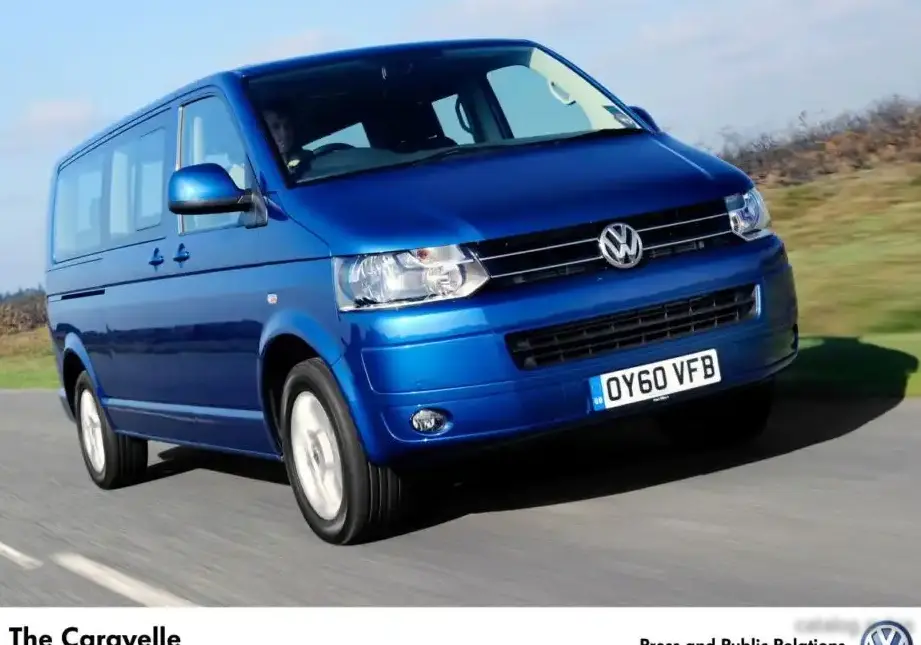
The Volkswagen Caravelle (T5, facelift 2009) Long 2.0 TDI with 180 horsepower and a Direct-Shift Gearbox (DSG) represents a significant iteration of Volkswagen’s popular multi-purpose vehicle (MPV), sold extensively throughout Europe and other international markets. Produced from 2009 to 2015, this variant occupied a mid-to-upper position within the T5 Caravelle lineup, offering a balance of performance, efficiency, and practicality for families and commercial users alike. The T5 generation, and specifically this facelifted version, aimed to modernize the Caravelle while retaining its core strengths: spaciousness, versatility, and a comfortable ride. This model was particularly popular in Europe where MPVs were a dominant force in the family vehicle segment.
Technical Specifications
| Brand | Volkswagen |
| Model | Caravelle |
| Generation | Caravelle (T5, facelift 2009) Long |
| Type (Engine) | 2.0 TDI (180 Hp) DSG |
| Start of production | 2009 |
| End of production | 2015 |
| Powertrain Architecture | Internal Combustion engine |
| Body type | Van |
| Seats | 4-9 |
| Doors | 4-5 |
| Fuel consumption (economy) – urban (NEDC) | 10.2 l/100 km (23.1 US mpg, 27.7 UK mpg, 9.8 km/l) |
| Fuel consumption (economy) – extra urban (NEDC) | 6.9 l/100 km (34.1 US mpg, 40.9 UK mpg, 14.5 km/l) |
| Fuel consumption (economy) – combined (NEDC) | 8.1 l/100 km (29 US mpg, 34.9 UK mpg, 12.3 km/l) |
| CO2 emissions (NEDC) | 214 g/km |
| Fuel Type | Diesel |
| Acceleration 0 – 100 km/h | 11.3 sec |
| Acceleration 0 – 62 mph | 11.3 sec |
| Acceleration 0 – 60 mph | 10.7 sec |
| Maximum speed | 191 km/h (118.68 mph) |
| Emission standard | Euro 5 |
| Weight-to-power ratio | 11.5 kg/Hp, 87.2 Hp/tonne |
| Weight-to-torque ratio | 5.2 kg/Nm, 193.7 Nm/tonne |
| Power | 180 Hp @ 4000 rpm |
| Power per litre | 91.5 Hp/l |
| Torque | 400 Nm @ 1500-2000 rpm (295.02 lb.-ft. @ 1500-2000 rpm) |
| Engine layout | Front, Transverse |
| Engine Model/Code | EA189 / CFCA |
| Engine displacement | 1968 cm3 (120.09 cu. in.) |
| Number of cylinders | 4 |
| Engine configuration | Inline |
| Cylinder Bore | 81 mm (3.19 in.) |
| Piston Stroke | 95.5 mm (3.76 in.) |
| Compression ratio | 16.5:1 |
| Number of valves per cylinder | 4 |
| Fuel injection system | Diesel Commonrail |
| Engine aspiration | BiTurbo, Intercooler |
| Valvetrain | DOHC |
| Engine oil capacity | 7 l (7.4 US qt | 6.16 UK qt) |
| Coolant | 11 l (11.62 US qt | 9.68 UK qt) |
| Kerb Weight | 2065-2300 kg (4552.55 – 5070.63 lbs.) |
| Max. weight | 3000-3200 kg (6613.87 – 7054.79 lbs.) |
| Max load | 900-935 kg (1984.16 – 2061.32 lbs.) |
| Trunk (boot) space – maximum | 6700 l (236.61 cu. ft.) |
| Fuel tank capacity | 80 l (21.13 US gal | 17.6 UK gal) |
| Max. roof load | 100 kg (220.46 lbs.) |
| Permitted trailer load with brakes (12%) | 2500 kg (5511.56 lbs.) |
| Permitted trailer load without brakes | 750 kg (1653.47 lbs.) |
| Permitted towbar download | 100 kg (220.46 lbs.) |
| Length | 5292 mm (208.35 in.) |
| Width | 1904 mm (74.96 in.) |
| Width including mirrors | 2283 mm (89.88 in.) |
| Height | 1990 mm (78.35 in.) |
| Wheelbase | 3400 mm (133.86 in.) |
| Front overhang | 896 mm (35.28 in.) |
| Rear overhang | 996 mm (39.21 in.) |
| Ride height (ground clearance) | 165 mm (6.5 in.) |
| Minimum turning circle (turning diameter) | 13.2 m (43.31 ft.) |
| Drivetrain Architecture | The Internal combustion engine (ICE) drives the front wheels of the vehicle. |
| Drive wheel | Front wheel drive |
| Number of gears and type of gearbox | 7 gears, automatic transmission DSG |
| Front suspension | Independent, type McPherson with coil spring and anti-roll bar |
| Rear suspension | Independent coil spring, Transverse stabilizer, Trailing arm |
| Front brakes | Ventilated discs, 340×32.5 mm |
| Rear brakes | Ventilated discs, 294×22 mm |
| Assisting systems | ABS (Anti-lock braking system) |
| Steering type | Steering rack and pinion |
| Power steering | Hydraulic Steering |
| Tires size | 235/55 R17; 255/45 R18 |
| Wheel rims size | 7J x 17; 8J x 18 |
Powertrain & Engine Architecture
At the heart of the Caravelle 2.0 TDI DSG lies the EA189 engine family, specifically the CFCA code. This 1968cc inline-four cylinder diesel engine utilizes common rail direct injection and a sophisticated bi-turbocharger system. The two-stage turbocharging – a smaller turbo for low-end response and a larger turbo for high-end power – contributes to the engine’s broad torque curve. The engine boasts a high compression ratio of 16.5:1, typical for diesel engines, and features a double overhead camshaft (DOHC) valvetrain with four valves per cylinder. The DSG (Direct-Shift Gearbox) is a seven-speed dual-clutch transmission, offering quick and smooth gear changes, enhancing both performance and fuel efficiency. This transmission allows for both fully automatic operation and manual gear selection via paddle shifters or the gear lever.
Driving Characteristics
The 180 hp 2.0 TDI engine, coupled with the DSG transmission, provides a respectable level of performance for a large MPV. Acceleration from 0-60 mph takes approximately 10.7 seconds, and the vehicle reaches a top speed of 191 km/h (118.68 mph). While not overtly sporty, the engine delivers ample torque from low RPMs, making it well-suited for carrying passengers and luggage, even when fully loaded. The DSG transmission contributes to a refined driving experience, with seamless gear changes and responsive acceleration. Compared to the lower-powered 1.9 TDI variants, the 2.0 TDI offers noticeably more power and a more relaxed cruising experience. However, it doesn’t match the outright performance of the more expensive and less common petrol-powered Caravelles.
Equipment & Trim Levels
The Caravelle 2.0 TDI DSG typically came equipped with a generous level of standard features. These included air conditioning, power windows, central locking, and an audio system with CD player. Higher trim levels offered options such as leather upholstery, navigation system, parking sensors, and a panoramic sunroof. Interior upholstery was often a durable cloth, with leather being an optional upgrade. The dashboard layout was functional and ergonomic, prioritizing practicality and ease of use. The Caravelle’s modular seating arrangement allowed for flexible configuration, accommodating up to nine passengers depending on the specific layout chosen.
Chassis & Braking
The Caravelle T5 utilizes an independent suspension setup, with McPherson struts at the front and a trailing arm arrangement at the rear. This provides a comfortable ride quality, even on uneven surfaces. The front brakes are ventilated discs, while the rear brakes are also ventilated discs, providing adequate stopping power for the vehicle’s weight. Anti-lock Braking System (ABS) is standard, enhancing safety during emergency braking situations. Stabilizer bars are fitted to both the front and rear axles to reduce body roll during cornering.
Market Reception & Comparison
The Caravelle 2.0 TDI DSG was generally well-received by automotive critics. It was praised for its spacious interior, comfortable ride, and efficient engine. Fuel economy figures of around 29 US mpg combined were considered respectable for a vehicle of its size and weight. Compared to the 1.9 TDI variants, the 2.0 TDI offered a noticeable improvement in performance, albeit at a slightly higher price point. Reliability was generally good, although some owners reported issues with the DSG transmission, particularly early units. The 2.0 TDI represented a sweet spot in the Caravelle lineup, offering a good balance of performance, economy, and practicality.
Legacy
The Volkswagen Caravelle T5 2.0 TDI DSG remains a popular choice in the used car market today. Its reputation for reliability, spaciousness, and versatility has ensured continued demand. While the DSG transmission requires regular maintenance, it is generally considered a robust unit. The EA189 engine, while subject to some emissions-related scrutiny in later years, is known for its durability and relatively low running costs. This variant of the Caravelle continues to be valued by families and businesses seeking a practical and comfortable MPV.