Technical Specifications
| Brand | Volkswagen |
| Model | Caravelle |
| Generation | Caravelle (T5, facelift 2009) Long |
| Type (Engine) | 2.0 TDI BMT (140 Hp) |
| Start of production | 2012 |
| End of production | 2015 |
| Powertrain Architecture | Internal Combustion engine |
| Body type | Van |
| Seats | 4-9 |
| Doors | 4-5 |
| Fuel consumption (economy) – urban (NEDC) | 8.9 l/100 km (26.4 US mpg, 31.7 UK mpg, 11.2 km/l) |
| Fuel consumption (economy) – extra urban (NEDC) | 5.9 l/100 km (39.9 US mpg, 47.9 UK mpg, 16.9 km/l) |
| Fuel consumption (economy) – combined (NEDC) | 7 l/100 km (33.6 US mpg, 40.4 UK mpg, 14.3 km/l) |
| CO2 emissions (NEDC) | 184 g/km |
| Fuel Type | Diesel |
| Acceleration 0 – 100 km/h | 14.2 sec |
| Acceleration 0 – 62 mph | 14.2 sec |
| Acceleration 0 – 60 mph | 13.5 sec |
| Maximum speed | 173 km/h (107.5 mph) |
| Emission standard | Euro 5 |
| Weight-to-power ratio | 14.3 kg/Hp, 70 Hp/tonne |
| Weight-to-torque ratio | 5.9 kg/Nm, 170 Nm/tonne |
| Power | 140 Hp @ 3500 rpm |
| Power per litre | 71.1 Hp/l |
| Torque | 340 Nm @ 1750-2500 rpm (250.77 lb.-ft. @ 1750-2500 rpm) |
| Engine layout | Front, Transverse |
| Engine Model/Code | EA189 / CCHA |
| Engine displacement | 1968 cm3 (120.09 cu. in.) |
| Number of cylinders | 4 |
| Engine configuration | Inline |
| Cylinder Bore | 81 mm (3.19 in.) |
| Piston Stroke | 95.5 mm (3.76 in.) |
| Compression ratio | 16.5:1 |
| Number of valves per cylinder | 4 |
| Fuel injection system | Diesel Commonrail |
| Engine aspiration | Turbocharger, Intercooler |
| Valvetrain | DOHC |
| Engine oil capacity | 7 l (7.4 US qt | 6.16 UK qt) |
| Coolant | 11 l (11.62 US qt | 9.68 UK qt) |
| Kerb Weight | 2000 kg (4409.25 lbs.) |
| Max. weight | 3000-3200 kg (6613.87 – 7054.79 lbs.) |
| Max load | 1000-1200 kg (2204.62 – 2645.55 lbs.) |
| Trunk (boot) space – maximum | 6700 l (236.61 cu. ft.) |
| Fuel tank capacity | 80 l (21.13 US gal | 17.6 UK gal) |
| Max. roof load | 100 kg (220.46 lbs.) |
| Permitted trailer load with brakes (12%) | 2500 kg (5511.56 lbs.) |
| Permitted trailer load without brakes | 750 kg (1653.47 lbs.) |
| Permitted towbar download | 100 kg (220.46 lbs.) |
| Length | 5292 mm (208.35 in.) |
| Width | 1904 mm (74.96 in.) |
| Width including mirrors | 2283 mm (89.88 in.) |
| Height | 1990 mm (78.35 in.) |
| Wheelbase | 3400 mm (133.86 in.) |
| Front overhang | 896 mm (35.28 in.) |
| Rear overhang | 996 mm (39.21 in.) |
| Ride height (ground clearance) | 201 mm (7.91 in.) |
| Minimum turning circle (turning diameter) | 13.2 m (43.31 ft.) |
| Front suspension | Independent, type McPherson with coil spring and anti-roll bar |
| Rear suspension | Independent coil spring, Transverse stabilizer, Trailing arm |
| Front brakes | Ventilated discs, 308×29.5 mm |
| Rear brakes | Ventilated discs, 294×22 mm |
| Drive wheel | Front wheel drive |
| Number of gears and type of gearbox | 6 gears, manual transmission |
| Tires size | 215/60 R16; 215/65 R16; 215/60 R17 |
| Wheel rims size | 6.5J x 16; 7J x 17 |
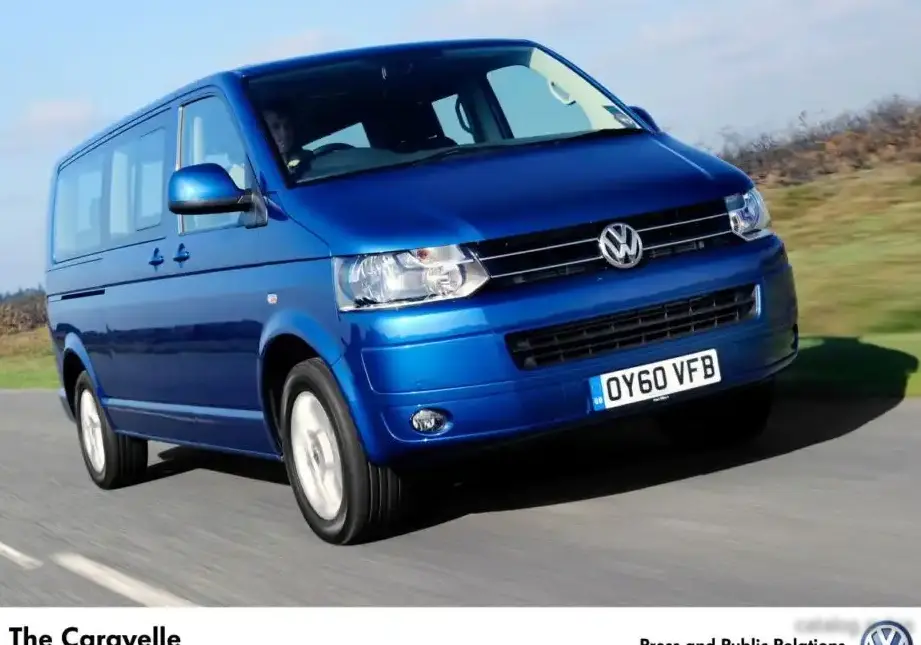
The Volkswagen Caravelle (T5, facelift 2009) Long 2.0 TDI BMT, producing 140 horsepower, was a popular configuration within the T5 generation Caravelle lineup, manufactured from 2012 to 2015. Positioned as a mid-range option, it offered a balance between fuel efficiency, practicality, and affordability for families and commercial users alike. The Caravelle, based on the Volkswagen Transporter platform, served as a more passenger-focused variant, offering increased comfort and features compared to the base Transporter van. This specific long-wheelbase version provided ample space for passengers and cargo, making it a versatile vehicle for a variety of applications.
Powertrain & Engine Architecture
The heart of this Caravelle variant is the 2.0-liter TDI engine, specifically the EA189 series, identified by the engine code CCHA. This engine is a four-cylinder, inline diesel, utilizing common rail direct injection and a turbocharger with intercooling. The common rail system, operating at high pressure, ensures precise fuel delivery for optimized combustion and reduced emissions. The DOHC (Double Overhead Camshaft) valvetrain, with four valves per cylinder, further enhances breathing and contributes to the engine’s power output. The BMT (BlueMotion Technology) designation indicates the inclusion of fuel-saving technologies, such as start-stop functionality and optimized engine mapping. The engine is transversely mounted in the front of the vehicle. A 6-speed manual transmission was the standard offering, providing a balance between fuel economy and driver control.
Driving Characteristics
The 140 horsepower and 340 Nm (250.77 lb-ft) of torque delivered by the 2.0 TDI BMT engine provided adequate, though not exhilarating, performance for the Caravelle. Acceleration from 0-60 mph took around 13.5 seconds, and top speed was limited to 173 km/h (107.5 mph). The engine’s torque peak, available from 1750-2500 rpm, meant that the Caravelle offered reasonable pulling power for highway cruising and carrying a full load of passengers. Compared to higher-output TDI variants (like the 180 hp versions), this engine felt less responsive, particularly during overtaking maneuvers. The manual transmission, while efficient, required more driver involvement than the optional DSG (Direct-Shift Gearbox) available on other trims. The gear ratios were tuned for fuel economy, resulting in a slightly less engaging driving experience.
Equipment & Trim Levels
The Caravelle 2.0 TDI BMT Long typically came equipped with a respectable level of standard features. These included air conditioning, power windows, central locking, and a basic audio system. Interior upholstery was typically cloth, with durable plastics used throughout the cabin. Higher trim levels offered upgrades such as alloy wheels, parking sensors, a more advanced infotainment system, and upgraded interior trim. Optional extras included a sunroof, navigation system, and various comfort and convenience packages. The long wheelbase configuration provided ample space for up to nine passengers, depending on the seating arrangement.
Chassis & Braking
The Caravelle T5 utilized an independent suspension setup, with McPherson struts at the front and a trailing arm arrangement at the rear. A stabilizer bar was fitted to both axles to reduce body roll during cornering. Braking duties were handled by ventilated disc brakes on all four wheels, providing adequate stopping power for the vehicle’s weight. ABS (Anti-lock Braking System) was standard. The suspension was tuned for comfort, prioritizing a smooth ride over sporty handling. The Caravelle’s relatively high center of gravity and weight meant that it wasn’t particularly agile in corners.
Market Reception & Comparison
The Caravelle 2.0 TDI BMT Long was generally well-received by critics as a practical and economical people carrier. Its fuel economy of around 7 l/100 km (33.6 US mpg) was a significant selling point, particularly in Europe where diesel fuel was often cheaper than gasoline. Compared to the more powerful TDI variants, this engine offered lower running costs but sacrificed some performance. The manual transmission was seen as a positive by some, offering greater driver control, while others preferred the convenience of the DSG gearbox. Reliability was generally good, although the EA189 engine series was later subject to scrutiny regarding emissions compliance.
Legacy
The Volkswagen Caravelle T5 2.0 TDI BMT Long remains a popular choice in the used car market today. Its reputation for reliability, practicality, and fuel efficiency continues to attract buyers. While the EA189 engine has been superseded by newer, more efficient designs, it remains a robust and dependable unit when properly maintained. Common issues include turbocharger wear and potential problems with the diesel particulate filter (DPF), particularly on vehicles that have primarily been used for short journeys. Overall, this Caravelle variant represents a solid and versatile option for families and businesses seeking a spacious and economical people carrier.