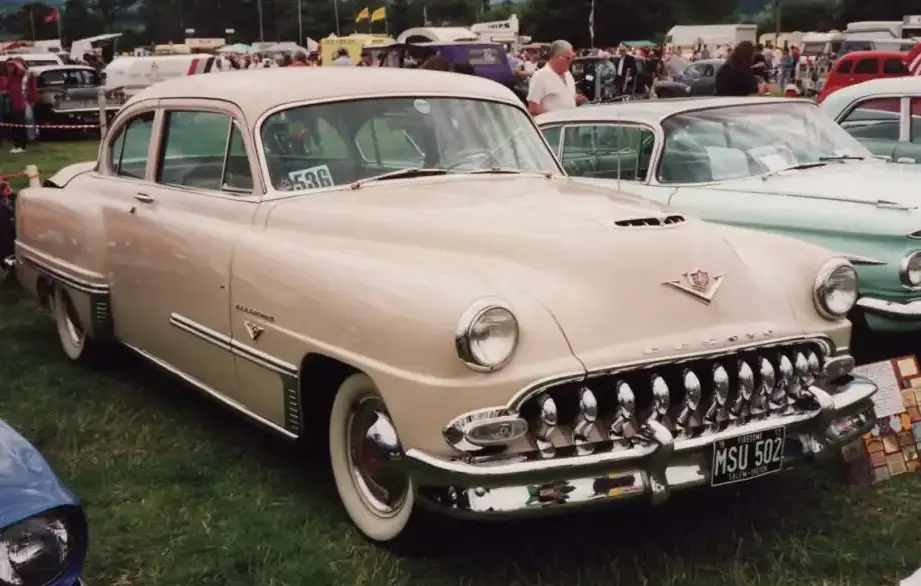
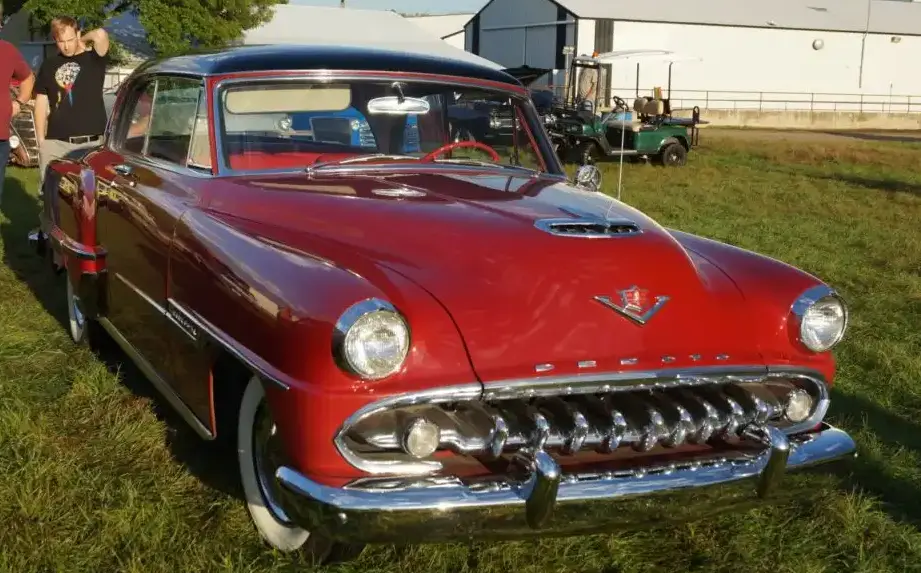
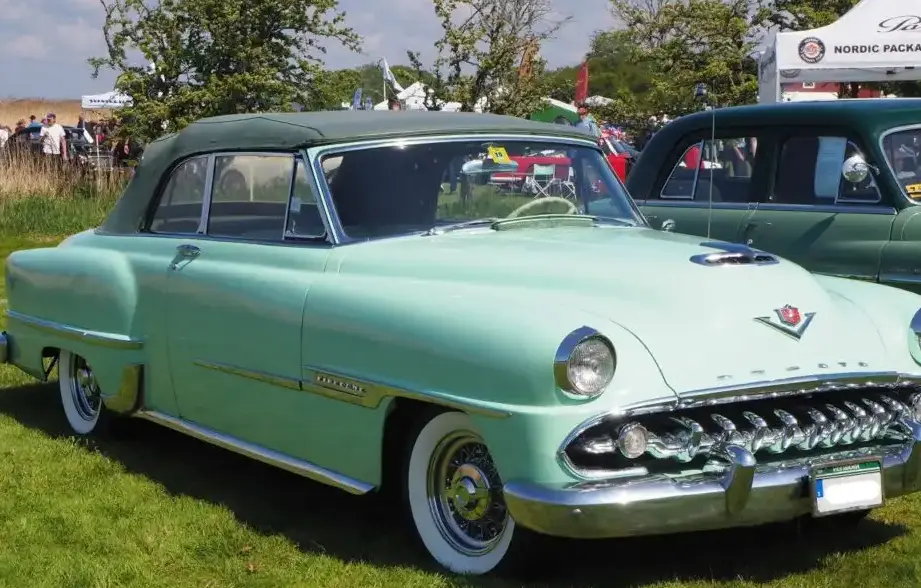
The DeSoto Firedome II Station Wagon, powered by a 4.8-liter V8 engine producing 185 horsepower and coupled with a PowerFlite automatic transmission, represented a significant offering in the American automotive landscape of the mid-1950s. Produced for the 1954 and 1955 model years, this variant occupied a middle ground within the Firedome lineup, balancing family practicality with the burgeoning desire for V8 power. It was part of the broader Firedome II generation, which aimed to modernize the DeSoto brand and compete more effectively with rivals like Ford and Chevrolet. The station wagon body style, increasingly popular with growing American families, added to the Firedome’s appeal.
Technical Specifications
| Brand | DeSoto |
| Model | Firedome |
| Generation | Firedome II Station Wagon |
| Type (Engine) | 4.8 V8 (185 Hp) PowerFlite |
| Start of production | 1954 |
| End of production | 1955 |
| Powertrain Architecture | Internal Combustion engine |
| Body type | Station wagon (estate) |
| Seats | 6 |
| Doors | 5 |
| Fuel Type | Petrol (Gasoline) |
| Power | 185 Hp @ 4400 rpm |
| Power per litre | 38.8 Hp/l |
| Torque | 332 Nm @ 2800 rpm / 244.87 lb.-ft. @ 2800 rpm |
| Engine Model/Code | S21-1001 |
| Engine displacement | 4769 cm3 / 291.02 cu. in. |
| Number of cylinders | 8 |
| Engine configuration | V-engine |
| Cylinder Bore | 94.49 mm / 3.72 in. |
| Piston Stroke | 84.931 mm / 3.34 in. |
| Compression ratio | 7.5:1 |
| Number of valves per cylinder | 2 |
| Fuel injection system | Carburettor |
| Engine aspiration | Naturally aspirated engine |
| Valvetrain | OHV |
| Engine oil capacity | 4.7 l / 4.97 US qt | 4.14 UK qt |
| Coolant | 21.8 l / 23.04 US qt | 19.18 UK qt |
| Fuel tank capacity | 70 l / 18.49 US gal | 15.4 UK gal |
| Length | 5552 mm / 218.58 in. |
| Width | 1989 mm / 78.31 in. |
| Height | 1539 mm / 60.59 in. |
| Wheelbase | 3200 mm / 125.98 in. |
| Front track | 1529 mm / 60.2 in. |
| Rear (Back) track | 1514 mm / 59.61 in. |
| Ride height (ground clearance) | 160 mm / 6.3 in. |
| Minimum turning circle (turning diameter) | 13.4 m / 43.96 ft. |
| Approach angle | 21° |
| Departure angle | 12° |
| Ramp-over (brakeover) angle | 11° |
| Drivetrain Architecture | The Internal combustion engine (ICE) drives the rear wheels of the vehicle. |
| Drive wheel | Rear wheel drive |
| Number of gears and type of gearbox | 2 gears, automatic transmission PowerFlite |
| Front suspension | Independent coil spring |
| Rear suspension | Leaf spring |
| Front brakes | Drum, 305 mm |
| Rear brakes | Drum, 305 mm |
| Steering type | Worm-reduction unit |
| Power steering | Hydraulic Steering |
Powertrain & Engine Architecture
The heart of the Firedome II Station Wagon was the DeSoto S21-1001 4.8-liter (291 cubic inch) V8 engine. This engine featured a cast iron block and cylinder heads, with an overhead valve (OHV) configuration. It utilized a single carburetor for fuel delivery, a common practice for the era. The 7.5:1 compression ratio was typical for the time, balancing performance with the fuel quality available. The engine produced 185 horsepower at 4400 rpm and 332 Nm (244.87 lb-ft) of torque at 2800 rpm. The PowerFlite automatic transmission, a two-speed unit, was the sole transmission option for this variant. The PowerFlite, while not known for its complexity, provided smooth and relatively effortless shifting, appealing to buyers prioritizing convenience over outright performance.
Driving Characteristics
The 185 hp V8, coupled with the two-speed PowerFlite automatic, delivered adequate, but not exhilarating, performance. Acceleration was respectable for the time, but the automatic transmission’s limited number of gears meant the engine often operated at higher RPMs during cruising, impacting fuel economy. Compared to the manual transmission options available on other Firedome models, the automatic version felt less responsive. The rear-wheel-drive configuration provided predictable handling, but the leaf spring rear suspension could result in a somewhat firm ride, particularly when fully loaded with passengers and cargo. The PowerFlite’s gear ratios were optimized for smooth cruising rather than rapid acceleration, making it well-suited for highway driving.
Equipment & Trim Levels
The Firedome II Station Wagon, even in its base configuration, offered a reasonable level of standard equipment for the mid-1950s. Interior appointments typically included cloth and vinyl upholstery, a basic dashboard with analog gauges, and a steering wheel. Power steering was a notable feature, making maneuvering the large station wagon easier. Optional extras included a radio, heater, and whitewall tires. The trim level of the Firedome II Station Wagon generally fell in the mid-range of the DeSoto lineup, positioned above the base models but below the more luxurious Fireflite series. The station wagon body style itself added a degree of practicality and versatility not found in the sedan or coupe versions.
Chassis & Braking
The Firedome II Station Wagon utilized a body-on-frame construction, typical of American cars of the era. The front suspension featured independent coil springs, providing a more comfortable ride compared to a solid axle. The rear suspension employed leaf springs, which were robust and capable of handling heavier loads, but less refined in terms of ride quality. Braking duties were handled by drum brakes on all four wheels, measuring 305 mm in diameter. While adequate for the time, the drum brakes lacked the stopping power and fade resistance of later disc brake systems. The steering system was a worm-reduction unit, assisted by hydraulic power steering.
Market Reception & Comparison
The DeSoto Firedome II Station Wagon was generally well-received by critics and consumers alike. It offered a compelling combination of style, space, and V8 power. However, it faced stiff competition from established rivals like the Ford Country Squire and Chevrolet Bel Air station wagons. The PowerFlite automatic transmission was praised for its smoothness, but criticized for its limited number of gears and impact on fuel economy. Compared to the manual transmission Firedome models, the automatic version was less fuel-efficient and offered slightly lower performance. Reliability was generally good, although the carburetor required periodic adjustment and maintenance.
Legacy
Today, the DeSoto Firedome II Station Wagon is a sought-after classic car, representing a bygone era of American automotive design. The 4.8-liter V8 engine and PowerFlite automatic transmission, while not particularly sophisticated by modern standards, are relatively durable and can be maintained with reasonable effort. Parts availability can be a challenge, but a dedicated community of DeSoto enthusiasts exists to provide support and resources. The Firedome II Station Wagon’s enduring appeal lies in its distinctive styling, spacious interior, and the nostalgic charm of a classic American automobile. Well-maintained examples command respectable prices in the collector car market, reflecting their rarity and historical significance.