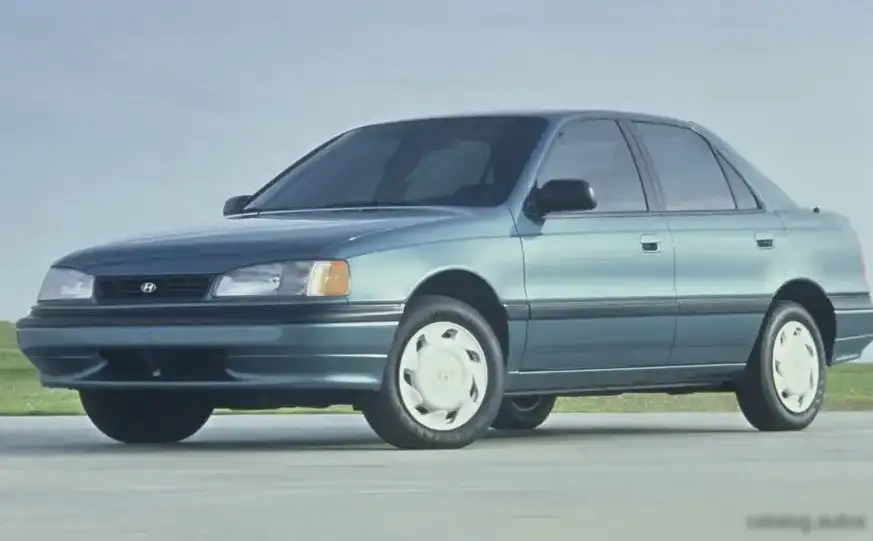
The Hyundai Elantra II Wagon 1.6 16V, produced between 1996 and 2000, represented Hyundai’s entry into the European and Asian compact wagon market. Positioned as a practical and affordable family vehicle, it was part of the larger Elantra II (XD) series, built on the Hyundai 1HX0 platform. This specific 1.6-liter, 114 horsepower variant with a five-speed manual transmission served as a core offering, balancing fuel economy with reasonable performance. It aimed to provide a versatile alternative to hatchbacks and sedans, offering increased cargo capacity without a significant price premium.
Technical Specifications
| Brand | Hyundai |
| Model | Elantra |
| Generation | Elantra II Wagon |
| Type (Engine) | 1.6 16V (114 Hp) |
| Start of production | 1996 |
| End of production | 2000 |
| Powertrain Architecture | Internal Combustion engine |
| Body type | Station wagon (estate) |
| Seats | 5 |
| Doors | 5 |
| Fuel consumption (urban) | 10.6 l/100 km (22.2 US mpg) |
| Fuel consumption (extra urban) | 6.7 l/100 km (35.1 US mpg) |
| Fuel Type | Petrol (Gasoline) |
| Acceleration 0 – 100 km/h | 11.2 sec |
| Acceleration 0 – 62 mph | 11.2 sec |
| Acceleration 0 – 60 mph | 10.6 sec |
| Maximum speed | 190 km/h (118.06 mph) |
| Weight-to-power ratio | 11.3 kg/Hp |
| Weight-to-torque ratio | 9 kg/Nm |
| Power | 114 Hp @ 6100 rpm |
| Power per litre | 71.3 Hp/l |
| Torque | 143 Nm @ 3000 rpm (105.47 lb.-ft. @ 3000 rpm) |
| Engine layout | Front, Transverse |
| Engine Model/Code | Beta / G4GR |
| Engine displacement | 1599 cm3 (97.58 cu. in.) |
| Number of cylinders | 4 |
| Engine configuration | Inline |
| Cylinder Bore | 77.4 mm (3.05 in.) |
| Piston Stroke | 85 mm (3.35 in.) |
| Compression ratio | 9.9:1 |
| Number of valves per cylinder | 4 |
| Fuel injection system | Multi-port manifold injection |
| Engine aspiration | Naturally aspirated engine |
| Valvetrain | DOHC |
| Engine oil capacity | 4 l (4.23 US qt | 3.52 UK qt) |
| Coolant capacity | 6 l (6.34 US qt | 5.28 UK qt) |
| Kerb Weight | 1283 kg (2828.53 lbs.) |
| Max. weight | 1715 kg (3780.93 lbs.) |
| Max load | 432 kg (952.4 lbs.) |
| Trunk (boot) space – minimum | 362 l (12.78 cu. ft.) |
| Trunk (boot) space – maximum | 607 l (21.44 cu. ft.) |
| Fuel tank capacity | 55 l (14.53 US gal | 12.1 UK gal) |
| Length | 4450 mm (175.2 in.) |
| Width | 1700 mm (66.93 in.) |
| Height | 1457 mm (57.36 in.) |
| Wheelbase | 2550 mm (100.39 in.) |
| Front track | 1465 mm (57.68 in.) |
| Rear track | 1450 mm (57.09 in.) |
| Drivetrain Architecture | Front wheel drive |
| Number of gears | 5 |
| Gearbox type | Manual transmission |
| Front suspension | Wishbone |
| Rear suspension | Spring Strut |
| Front brakes | Ventilated discs |
| Rear brakes | Drum |
| Assisting systems | ABS (Anti-lock braking system) |
| Steering type | Steering rack and pinion |
| Power steering | Hydraulic Steering |
| Tires size | 175/65 R14 |
Introduction
The Hyundai Elantra II Wagon 1.6 16V, launched in 1996 and continuing through 2000, was a key model in Hyundai’s expansion into the European and Asian markets. Building upon the success of the initial Elantra, the wagon body style offered increased practicality for families and those requiring additional cargo space. This variant, equipped with the 1.6-liter Beta engine and a five-speed manual transmission, was positioned as the entry-level offering within the Elantra II Wagon range, prioritizing affordability and fuel efficiency. It competed with vehicles like the Ford Escort Estate, Opel/Vauxhall Astra Estate, and Toyota Corolla Wagon.
Powertrain & Engine Architecture
The heart of the Elantra II Wagon 1.6 16V is the Hyundai Beta engine, specifically the G4GR code. This 1.6-liter inline-four cylinder engine utilizes a multi-port fuel injection (MPI) system, delivering fuel directly into the intake ports. The engine features a double overhead camshaft (DOHC) valvetrain, operating 16 valves (four per cylinder) to optimize airflow and enhance performance. The 16-valve configuration, compared to earlier 8-valve designs, contributed to improved power output and responsiveness. The engine’s 9.9:1 compression ratio was a compromise between performance and the ability to run on readily available fuel grades. The five-speed manual transmission provided a relatively direct connection between the engine and the front wheels, offering drivers more control over gear selection and engine speed. Gear ratios were tuned for a balance of acceleration and fuel economy, with a taller fifth gear for efficient highway cruising.
Driving Characteristics
The 1.6-liter engine, producing 114 horsepower, provided adequate, though not exhilarating, performance for the Elantra II Wagon. Acceleration from 0 to 60 mph took approximately 10.6 seconds, and top speed was around 118 mph. Compared to higher-spec Elantra II Wagons equipped with larger engines (like the 1.8L), the 1.6L felt noticeably less powerful, particularly when fully loaded with passengers and cargo. The manual transmission allowed drivers to maximize the available power, but required more frequent gear changes, especially when climbing hills or overtaking. The steering was light and easy to use, making it well-suited for urban driving, but lacked the precision and feedback found in some European competitors. The suspension provided a comfortable ride, absorbing bumps and imperfections in the road surface effectively, but leaned noticeably during cornering.
Equipment & Trim Levels
The 1.6-liter Elantra II Wagon typically came with a fairly basic level of equipment, reflecting its position as the entry-level trim. Standard features generally included power steering, central locking, and a basic audio system. Interior upholstery was typically cloth, and the dashboard featured a functional, if somewhat plain, design. Optional extras included air conditioning, power windows, and an upgraded audio system. Higher trim levels offered features like alloy wheels, a sunroof, and more luxurious interior appointments. The focus of this trim was on providing essential features at an affordable price point.
Chassis & Braking
The Elantra II Wagon utilized a front-wheel-drive layout with a MacPherson strut front suspension and a spring strut rear suspension. This configuration provided a good balance of ride comfort and handling. The front brakes were ventilated discs, offering good stopping power, while the rear brakes were drums, a cost-saving measure common in this class of vehicle. Anti-lock braking system (ABS) was often included as standard equipment, enhancing safety by preventing wheel lockup during hard braking. The chassis was relatively lightweight, contributing to the car’s fuel efficiency and handling agility.
Market Reception & Comparison
The Elantra II Wagon 1.6 16V was generally well-received by critics as a practical and affordable family vehicle. It was praised for its spacious interior, generous cargo capacity, and competitive price. However, some reviewers noted that the 1.6-liter engine felt underpowered, particularly when compared to rivals with larger engines. Fuel economy was a strong point, and the car proved to be relatively reliable. Compared to the higher-spec 1.8L Elantra Wagon, the 1.6L offered a lower purchase price but sacrificed performance. The 1.8L provided a more refined driving experience and was better suited for long-distance journeys or carrying heavy loads.
Legacy
The Hyundai Elantra II Wagon 1.6 16V has proven to be a relatively durable and reliable vehicle. The Beta engine, while not known for being particularly high-performance, is generally considered to be robust and long-lasting, provided it receives regular maintenance. Today, these wagons are becoming increasingly rare, but well-maintained examples can still be found on the used car market. They represent an affordable and practical option for those seeking a classic compact wagon. Parts availability is generally good, although some specific trim pieces may be difficult to source. The Elantra II Wagon helped establish Hyundai as a credible competitor in the European and Asian compact car segments, paving the way for the brand’s continued growth and success.