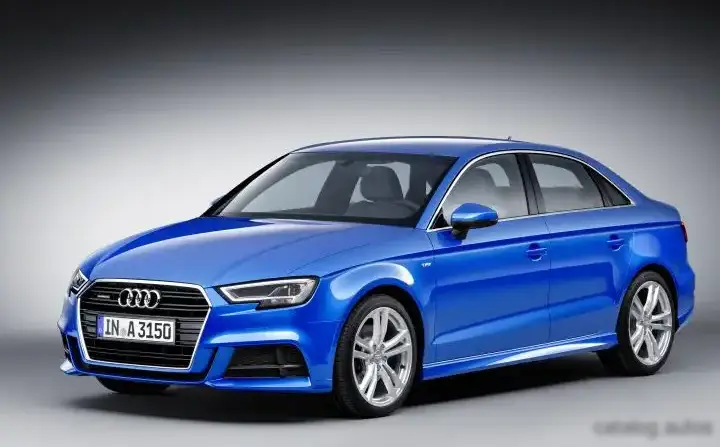
The Audi A3 Sedan 35 TFSI (150 hp) represents a significant iteration within the 8V generation of Audi’s compact executive car, specifically the facelifted model introduced in 2016 and produced through March 2020. Positioned as a mid-range offering, this variant balanced performance, fuel efficiency, and affordability within the A3 sedan lineup. It served as a key model in Audi’s strategy to attract a broader customer base in the North American and European markets, offering a premium experience with a more accessible price point than the higher-performance S3 or the diesel-powered TDI models. This version was particularly popular in Europe where fuel economy and emissions regulations heavily influence purchasing decisions.
Technical Specifications
| Brand | Audi |
| Model | A3 |
| Generation | A3 Sedan (8V, facelift 2016) |
| Type (Engine) | 35 TFSI (150 Hp) |
| Start of production | 2018 |
| End of production | March, 2020 |
| Powertrain Architecture | Internal Combustion engine |
| Body type | Sedan |
| Seats | 5 |
| Doors | 4 |
| Combined fuel consumption (WLTP) | 6.2-6.5 l/100 km (37.9 – 36.2 US mpg, 45.6 – 43.5 UK mpg, 16.1 – 15.4 km/l) |
| CO2 emissions (WLTP) | 144-148 g/km |
| Fuel consumption (urban) | 5.8-6.9 l/100 km (40.6 – 34.1 US mpg, 48.7 – 40.9 UK mpg, 17.2 – 14.5 km/l) |
| Fuel consumption (extra urban) | 4.4-4.6 l/100 km (53.5 – 51.1 US mpg, 64.2 – 61.4 UK mpg, 22.7 – 21.7 km/l) |
| Fuel consumption (combined) | 5.2-5.5 l/100 km (45.2 – 42.8 US mpg, 54.3 – 51.4 UK mpg, 19.2 – 18.2 km/l) |
| CO2 emissions | 119-124 g/km |
| Fuel Type | Petrol (Gasoline) |
| Acceleration 0 – 100 km/h | 8.2 sec |
| Acceleration 0 – 62 mph | 8.2 sec |
| Acceleration 0 – 60 mph | 7.8 sec |
| Maximum speed | 224 km/h (139.19 mph) |
| Emission standard | Euro 6d – TEMP |
| Weight-to-power ratio | 8.4 kg/Hp, 119 Hp/tonne |
| Weight-to-torque ratio | 5 kg/Nm, 198.4 Nm/tonne |
| Power | 150 Hp @ 5000-6000 rpm |
| Power per litre | 100.1 Hp/l |
| Torque | 250 Nm @ 1500-3500 rpm (184.39 lb.-ft. @ 1500-3500 rpm) |
| Engine layout | Front, Transverse |
| Engine Model/Code | DPCA |
| Engine displacement | 1498 cm3 (91.41 cu. in.) |
| Number of cylinders | 4 |
| Engine configuration | Inline |
| Cylinder Bore | 74.5 mm (2.93 in.) |
| Piston Stroke | 85.9 mm (3.38 in.) |
| Compression ratio | 10.5:1 |
| Number of valves per cylinder | 4 |
| Fuel injection system | Direct injection |
| Engine aspiration | Turbocharger, Intercooler |
| Engine oil capacity | 4.3 l (4.54 US qt | 3.78 UK qt) |
| Coolant | 10.8 l (11.41 US qt | 9.5 UK qt) |
| Kerb Weight | 1260 kg (2777.82 lbs.) |
| Max. weight | 1835 kg (4045.48 lbs.) |
| Max load | 575 kg (1267.66 lbs.) |
| Trunk (boot) space – minimum | 425 l (15.01 cu. ft.) |
| Fuel tank capacity | 50 l (13.21 US gal | 11 UK gal) |
| Max. roof load | 75 kg (165.35 lbs.) |
| Permitted trailer load with brakes (8%) | 1700 kg (3747.86 lbs.) |
| Permitted trailer load with brakes (12%) | 1500 kg (3306.93 lbs.) |
| Permitted trailer load without brakes | 660 kg (1455.05 lbs.) |
| Permitted towbar download | 75 kg (165.35 lbs.) |
| Length | 4458 mm (175.51 in.) |
| Width | 1796 mm (70.71 in.) |
| Width including mirrors | 1960 mm (77.17 in.) |
| Height | 1416 mm (55.75 in.) |
| Wheelbase | 2637 mm (103.82 in.) |
| Front track | 1555 mm (61.22 in.) |
| Rear (Back) track | 1526 mm (60.08 in.) |
| Drag coefficient (Cd) | 0.29 |
| Minimum turning circle (turning diameter) | 10.9 m (35.76 ft.) |
| Drivetrain Architecture | The Internal combustion engine (ICE) drives the front wheels of the vehicle. |
| Drive wheel | Front wheel drive |
| Number of gears and type of gearbox | 6 gears, manual transmission |
| Front suspension | Independent type McPherson |
| Rear suspension | Independent multi-link suspension |
| Front brakes | Ventilated discs |
| Rear brakes | Disc |
| Assisting systems | ABS (Anti-lock braking system) |
| Steering type | Steering rack and pinion |
| Power steering | Electric Steering |
| Tires size | 205/55 R16 |
| Wheel rims size | 7.0J x 16 |
INTRODUCTION
The Audi A3 Sedan 35 TFSI (150 hp) is a front-wheel-drive compact executive car that formed part of Audi’s 8V A3 range, which spanned from 2013 to 2020. The 2016 facelift brought styling updates, improved technology, and refined engine options. This 35 TFSI variant, introduced in 2018, occupied a crucial middle ground in the A3 sedan lineup, offering a balance between performance and economy. It was designed to appeal to buyers seeking a premium sedan experience without the higher price tag of the S3 or the specialized nature of the diesel models. The A3 sedan, in general, aimed to attract a younger demographic to the Audi brand, offering a more accessible entry point into the world of luxury automobiles.
Powertrain & Engine Architecture
At the heart of the A3 35 TFSI lies the 1.5-liter, four-cylinder, turbocharged gasoline engine, designated as the DPCA engine code. This engine is a member of Audi’s EA211 family, known for its compact design and efficiency. The engine utilizes direct fuel injection, delivering fuel directly into the combustion chamber for improved combustion efficiency and reduced emissions. A single turbocharger with an intercooler provides forced induction, boosting power output. The engine features variable valve timing on both the intake and exhaust sides, optimizing performance across the rev range. The 150 hp and 250 Nm (184 lb-ft) of torque are delivered between 1500 and 3500 rpm, providing a broad torque band for everyday driving. The engine is paired with a six-speed manual transmission, contributing to its fuel efficiency and driver engagement. While a seven-speed S tronic dual-clutch transmission was available as an option, the manual was a popular choice for those prioritizing cost and a more traditional driving experience.
Driving Characteristics
The A3 35 TFSI with the manual transmission delivers a respectable, if not exhilarating, driving experience. Acceleration from 0-60 mph takes approximately 7.8 seconds, and the car reaches a top speed of 139.19 mph. The engine feels responsive in the mid-range, making overtaking maneuvers relatively easy. The six-speed manual gearbox is well-matched to the engine’s characteristics, offering precise shifts and a satisfying mechanical feel. Compared to the more powerful S3, the 35 TFSI lacks the outright punch, but it provides ample power for daily commuting and longer journeys. Compared to the diesel TDI variants, the 35 TFSI offers a more linear power delivery and a more engaging driving experience, albeit with slightly higher fuel consumption. The front-wheel-drive configuration provides good traction in most conditions, but can exhibit some torque steer under hard acceleration.
Equipment & Trim Levels
The A3 35 TFSI typically came equipped with a generous array of standard features. These included Audi’s Multi Media Interface (MMI) infotainment system with a 7-inch display, Bluetooth connectivity, automatic climate control, and a leather-wrapped steering wheel. Safety features such as ABS, electronic stability control, and multiple airbags were standard. Higher trim levels offered options such as a larger MMI display, navigation system, a panoramic sunroof, leather upholstery, and advanced driver-assistance systems like adaptive cruise control and lane departure warning. Interior upholstery typically consisted of cloth seats in the base trim, with optional leather upgrades available. The dashboard layout was clean and modern, reflecting Audi’s minimalist design philosophy.
Chassis & Braking
The A3 35 TFSI utilizes a McPherson strut front suspension and a multi-link rear suspension, providing a comfortable and controlled ride. The suspension is tuned to balance handling and comfort, making it suitable for both city driving and highway cruising. The car is equipped with ventilated front disc brakes and solid rear disc brakes, providing adequate stopping power. ABS (Anti-lock Braking System) is standard, enhancing braking performance and stability. The steering is electric power-assisted, offering a light and precise feel. The chassis is relatively lightweight, contributing to the car’s agility and fuel efficiency.
Market Reception & Comparison
The Audi A3 Sedan 35 TFSI was generally well-received by automotive critics. It was praised for its stylish design, comfortable interior, and refined driving experience. The 1.5-liter engine was considered a good compromise between performance and fuel economy. However, some critics noted that the engine could feel strained at higher speeds or when fully loaded. Compared to its rivals, such as the BMW 2 Series Gran Coupe and the Mercedes-Benz A-Class Sedan, the A3 35 TFSI offered a competitive package in terms of price, features, and driving dynamics. Fuel economy figures of 37.9 – 36.2 US mpg (combined) were considered respectable for its class. Reliability reports generally indicated good reliability, with few major issues reported.
Legacy
The Audi A3 Sedan 35 TFSI (150 hp) has proven to be a reliable and durable vehicle in the used car market. The 1.5-liter engine, while not known for being exceptionally powerful, has demonstrated good long-term reliability. Regular maintenance, including oil changes and timing belt replacements, is crucial for ensuring its longevity. The A3 8V generation, as a whole, has established a reputation for build quality and refinement, making it a popular choice among used car buyers seeking a premium compact sedan. Today, these models represent a good value proposition, offering a blend of German engineering, modern features, and reasonable running costs.