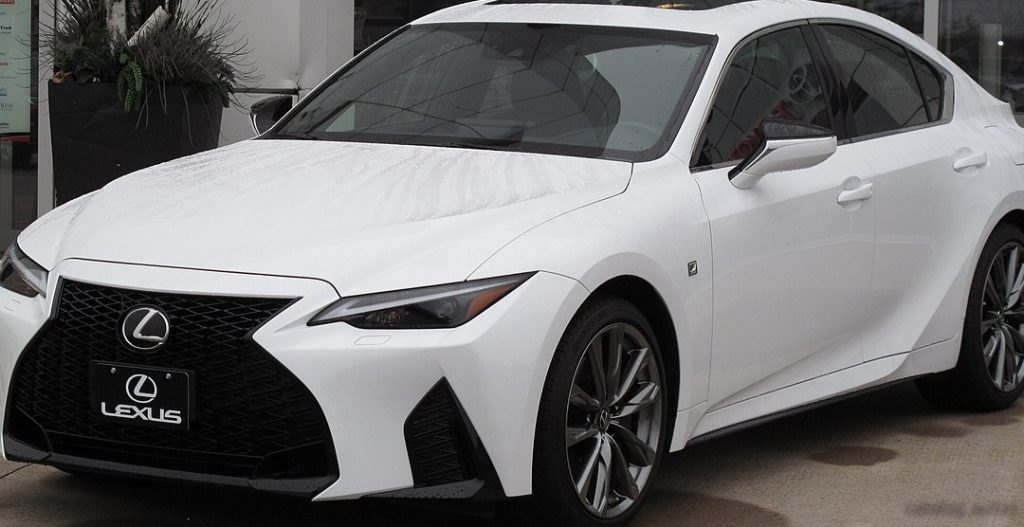
The Lexus IS 350, specifically the XE30 facelift model produced from 2017 to 2020, represents the performance-oriented variant of the third-generation IS (XE30) luxury sedan. Positioned as the top-tier engine option within the IS lineup, it offered a significant step up in power and driving experience compared to the IS 200t/300 models. This configuration, featuring a 3.5-liter V6 engine paired with a six-speed automatic transmission and all-wheel drive (AWD), aimed to deliver a blend of luxury, performance, and all-weather capability to the North American market, where AWD is highly valued. The facelift brought revised styling cues, updated technology, and refinements to the driving experience, solidifying the IS 350’s position as a competitor to established European sports sedans.
Technical Specifications
| Brand | Lexus |
| Model | IS |
| Generation | IS III (XE30, facelift 2016) |
| Type (Engine) | 350 V6 (311 Hp) AWD ECT |
| Start of production | August, 2017 |
| End of production | 2020 |
| Powertrain Architecture | Internal Combustion engine |
| Body type | Sedan |
| Seats | 5 |
| Doors | 4 |
| Fuel consumption (economy) – urban (EPA) | 12.4 l/100 km (19 US mpg, 22.8 UK mpg, 8.1 km/l) |
| Fuel consumption (economy) – extra urban (EPA) | 9 l/100 km (26.1 US mpg, 31.4 UK mpg, 11.1 km/l) |
| Fuel consumption (economy) – combined (EPA) | 10.7-11.2 l/100 km (22 – 21 US mpg, 26.4 – 25.2 UK mpg, 9.3 – 8.9 km/l) |
| Fuel Type | Petrol (Gasoline) |
| Acceleration 0 – 60 mph | 5.7 sec |
| Maximum speed | 210 km/h (130.49 mph), Electronically limited |
| Emission standard | LEV III ULEV |
| Weight-to-power ratio | 5.5 kg/Hp, 183.5 Hp/tonne |
| Weight-to-torque ratio | 4.5 kg/Nm, 221.8 Nm/tonne |
| Power | 311 Hp @ 6400 rpm |
| Power per litre | 90 Hp/l |
| Torque | 376 Nm @ 4800 rpm (277.32 lb.-ft. @ 4800 rpm) |
| Engine layout | Front, Longitudinal |
| Engine Model/Code | 2GR-FKS |
| Engine displacement | 3456 cm3 (210.9 cu. in.) |
| Number of cylinders | 6 |
| Engine configuration | V-engine |
| Cylinder Bore | 94 mm (3.7 in.) |
| Piston Stroke | 83 mm (3.27 in.) |
| Compression ratio | 11.8:1 |
| Number of valves per cylinder | 4 |
| Fuel injection system | Direct injection and Multi-port manifold injection |
| Engine aspiration | Naturally aspirated engine |
| Valvetrain | DOHC, D-VVT-i |
| Engine oil capacity | 6.4 l (6.76 US qt | 5.63 UK qt) |
| Coolant | 9.4 l (9.93 US qt | 8.27 UK qt) |
| Kerb Weight | 1695 kg (3736.84 lbs.) |
| Max. weight | 2126-2148 kg (4687.03 – 4735.53 lbs.) |
| Max load | 431-453 kg (950.19 – 998.69 lbs.) |
| Trunk (boot) space – minimum | 306 l (10.81 cu. ft.) |
| Fuel tank capacity | 66 l (17.44 US gal | 14.52 UK gal) |
| Length | 4680 mm (184.25 in.) |
| Width | 1810 mm (71.26 in.) |
| Width including mirrors | 2027 mm (79.8 in.) |
| Height | 1430 mm (56.3 in.) |
| Wheelbase | 2800 mm (110.24 in.) |
| Front track | 1535 mm (60.43 in.) |
| Rear (Back) track | 1540-1550 mm (60.63 – 61.02 in.) |
| Front overhang | 845 mm (33.27 in.) |
| Rear overhang | 1035 mm (40.75 in.) |
| Ride height (ground clearance) | 130 mm (5.12 in.) |
| Drag coefficient (Cd) | 0.29 |
| Minimum turning circle (turning diameter) | 10.8 m (35.43 ft.) |
| Drivetrain Architecture | The Internal combustion engine (ICE) drives permanently the four wheels of the vehicle. |
| Drive wheel | All wheel drive (4×4) |
| Number of gears and type of gearbox | 6 gears, automatic transmission ECT |
| Front suspension | Coil spring, Double wishbone, Transverse stabilizer |
| Rear suspension | Independent multi-link spring suspension with stabilizer |
| Front brakes | Ventilated discs, 334 mm |
| Rear brakes | Ventilated discs, 310 mm |
| Assisting systems | ABS (Anti-lock braking system) |
| Steering type | Steering rack and pinion |
| Power steering | Electric Steering |
| Tires size | Front wheel tires: 225/35 R18; 225/40 R18 Rear wheel tires: 225/35 R18; 225/40 R18; 255/35 R18 |
| Wheel rims size | Front wheel rims: 8J x 18 Rear wheel rims: 8J x 18; 8.5J x 18 |
Powertrain & Engine Architecture
The heart of the IS 350 AWD is the 2GR-FKS 3.5-liter naturally aspirated V6 engine. This engine utilizes both direct injection (D-4S) and port injection to optimize combustion efficiency and power delivery. The direct injection system injects fuel directly into the combustion chamber, while the port injection system provides supplemental fuel during high-load conditions. The engine features a dual overhead camshaft (DOHC) design with intelligent variable valve timing (D-VVT-i) on both intake and exhaust valves, further enhancing performance and fuel economy. The 2GR-FKS produces 311 horsepower at 6,400 rpm and 277 lb-ft of torque at 4,800 rpm. This engine is paired with a six-speed automatic transmission (ECT – Electronically Controlled Transmission) specifically tuned for smooth and responsive shifting. The AWD system employs a viscous coupling center differential, distributing torque between the front and rear axles as needed to maintain optimal traction.
Driving Characteristics
The IS 350 AWD delivers a noticeably more engaging driving experience than its turbocharged four-cylinder counterparts. The naturally aspirated V6 provides a linear power delivery, offering strong acceleration throughout the rev range. While not as fuel-efficient as the smaller engine options, the IS 350’s performance is rewarding. The six-speed automatic transmission is well-matched to the engine’s characteristics, providing quick and precise shifts. The AWD system enhances stability and grip, particularly in inclement weather conditions. The gear ratios are tuned for a balance of acceleration and highway cruising, with a focus on providing responsive power for overtaking maneuvers. Compared to the IS 200t/300, the IS 350 feels significantly more powerful and refined.
Equipment & Trim Levels
The IS 350 typically came well-equipped with standard features including leather upholstery, heated and ventilated front seats, a premium audio system, a navigation system, and a suite of advanced safety technologies such as Lexus Safety System+. Optional extras included a Mark Levinson premium sound system, adaptive variable suspension, and a power rear sunshade. Interior trim options included various wood and metallic accents. The IS 350 was generally offered in a single, fully-equipped trim level, with options primarily focused on enhancing the luxury and convenience features.
Chassis & Braking
The IS 350 utilizes a robust chassis with a double-wishbone front suspension and an independent multi-link rear suspension. Stabilizer bars are fitted to both axles to reduce body roll during cornering. The braking system consists of ventilated disc brakes on all four wheels, providing ample stopping power. The front brakes measure 334mm in diameter, while the rear brakes are 310mm. An Anti-lock Braking System (ABS) is standard, along with Electronic Brake-force Distribution (EBD) and Brake Assist.
Market Reception & Comparison
Critics generally praised the IS 350 for its powerful engine, comfortable ride, and luxurious interior. However, some noted that the six-speed automatic transmission felt dated compared to the eight or nine-speed automatics offered by competitors. Fuel economy was also a point of criticism, as the IS 350’s consumption was higher than that of its turbocharged rivals. Compared to the IS 200t/300, the IS 350 offered a significant performance upgrade, but at a higher price point. The IS 350 competed primarily with the BMW 335i/340i, Audi A4 3.0T, and Mercedes-Benz C350.
Legacy
The 2GR-FKS engine has proven to be a reliable and durable powerplant, with relatively few widespread issues reported. The IS 350’s AWD system is also generally considered to be robust and dependable. On the used car market, the IS 350 holds its value relatively well, particularly well-maintained examples with low mileage. Its combination of luxury, performance, and all-weather capability continues to appeal to buyers seeking a refined and capable sports sedan. Regular maintenance, including oil changes and fluid checks, is crucial for ensuring the long-term reliability of this powertrain.