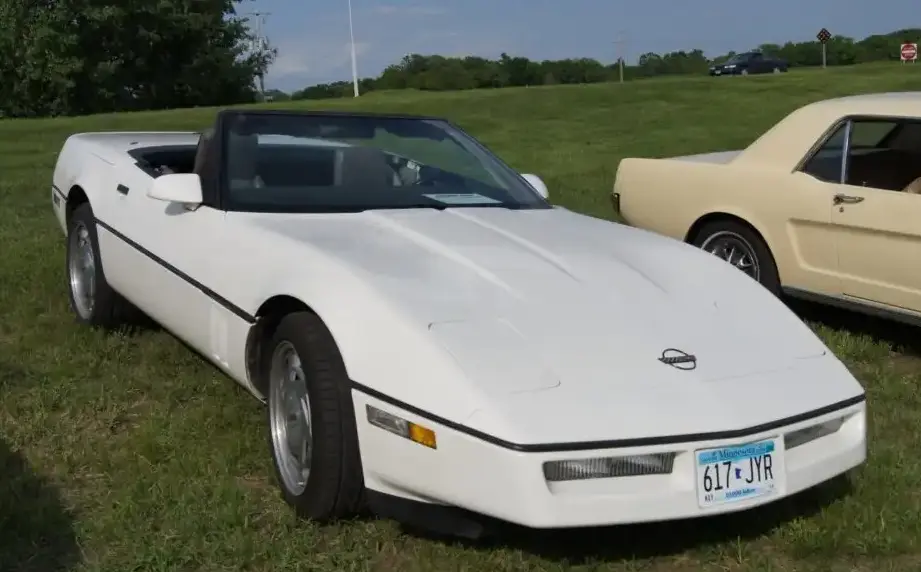
The Chevrolet Corvette Coupe (C4) 5.7 V8 Automatic, produced from 1983 to 1984, represents a pivotal moment in the Corvette lineage. This variant, powered by the L83 5.7-liter V8 engine paired with a four-speed automatic transmission, was positioned as a comfortable and capable grand tourer within the C4 generation, which spanned from 1984 to 1996. It marked the initial offering of the C4 platform, following a one-year hiatus of the Corvette model in 1983. The C4 aimed to modernize the Corvette, moving away from the previous generation’s more traditional styling and focusing on improved aerodynamics and handling. This particular configuration offered a balance between performance and ease of use, appealing to buyers who desired the Corvette experience without the demands of a manual transmission.
Technical Specifications
| Brand | Chevrolet |
| Model | Corvette |
| Generation | Corvette Coupe (C4) |
| Type (Engine) | 5.7 V8 (205 Hp) Automatic |
| Start of production | January, 1983 |
| End of production | 1984 |
| Powertrain Architecture | Internal Combustion engine |
| Body type | Targa |
| Seats | 2 |
| Doors | 2 |
| Fuel consumption (economy) – urban (EPA) | 14.7 l/100 km (16 US mpg, 19.2 UK mpg, 6.8 km/l) |
| Fuel consumption (economy) – extra urban (EPA) | 8.4 l/100 km (28 US mpg, 33.6 UK mpg, 11.9 km/l) |
| Fuel consumption (economy) – combined (EPA) | 11.8 l/100 km (19.9 US mpg, 23.9 UK mpg, 8.5 km/l) |
| Fuel Type | Petrol (Gasoline) |
| Weight-to-power ratio | 7.1 kg/Hp, 141.7 Hp/tonne |
| Weight-to-torque ratio | 3.7 kg/Nm, 271.6 Nm/tonne |
| Power | 205 Hp @ 4300 rpm |
| Power per litre | 35.8 Hp/l |
| Torque | 393 Nm @ 2800 rpm (289.86 lb.-ft. @ 2800 rpm) |
| Engine layout | Front, Longitudinal |
| Engine Model/Code | L83 |
| Engine displacement | 5733 cm3 (349.85 cu. in.) |
| Number of cylinders | 8 |
| Engine configuration | V-engine |
| Cylinder Bore | 101.6 mm (4 in.) |
| Piston Stroke | 88.4 mm (3.48 in.) |
| Number of valves per cylinder | 2 |
| Fuel injection system | Multi-port manifold injection |
| Engine aspiration | Naturally aspirated engine |
| Valvetrain | OHV |
| Engine oil capacity | 4.7 l (4.97 US qt | 4.14 UK qt) |
| Coolant | 13.7 l (14.48 US qt | 12.05 UK qt) |
| Kerb Weight | 1447 kg (3190.09 lbs.) |
| Trunk (boot) space – minimum | 508 l (17.94 cu. ft.) |
| Fuel tank capacity | 75.7 l (20 US gal | 16.65 UK gal) |
| Length | 4483 mm (176.5 in.) |
| Width | 1804 mm (71.02 in.) |
| Height | 1186 mm (46.69 in.) |
| Wheelbase | 2444 mm (96.22 in.) |
| Front track | 1513 mm (59.57 in.) |
| Rear (Back) track | 1534 mm (60.39 in.) |
| Front overhang | 1030 mm (40.55 in.) |
| Rear overhang | 1009 mm (39.72 in.) |
| Ride height (ground clearance) | 127 mm (5 in.) |
| Drag coefficient (Cd) | 0.341 |
| Approach angle | 11.4° |
| Departure angle | 34.8° |
| Ramp-over (brakeover) angle | 12.4° |
| Drivetrain Architecture | The Internal combustion engine (ICE) drives the rear wheels of the vehicle. |
| Drive wheel | Rear wheel drive |
| Number of gears and type of gearbox | 4 gears, automatic transmission |
| Front suspension | Double wishbone, Transverse stabilizer, Leaf spring |
| Rear suspension | Independent multi-link suspension, Transverse stabilizer, Leaf spring |
| Front brakes | Ventilated discs |
| Rear brakes | Ventilated discs |
| Assisting systems | ABS (Anti-lock braking system) |
| Steering type | Steering rack and pinion |
| Power steering | Hydraulic Steering |
| Tires size | 215/65 R15; 255/50 VR16 |
| Wheel rims size | Front wheel rims: 7J x 15; 8.5J x 16Rear wheel rims: 7.5J x 15; 8.5J x 16; 9.5J x 16 |
Powertrain & Engine Architecture
The heart of this Corvette variant is the L83 5.7-liter (349.85 cubic inch) small-block V8 engine. This engine, a staple of Chevrolet performance for decades, featured a cast iron block and aluminum cylinder heads. It utilized a multi-port fuel injection system, a significant upgrade over the carburetor-equipped engines of earlier Corvettes, contributing to improved fuel efficiency and throttle response. The engine employed an overhead valve (OHV) valvetrain with two valves per cylinder. The 5.7L L83 produced 205 horsepower at 4300 rpm and 290 lb-ft of torque at 2800 rpm. The automatic transmission was a four-speed unit, designed to provide smooth and relatively quick shifts. While not as performance-oriented as the available manual transmission, it offered a more relaxed driving experience, particularly suited for long-distance cruising.
Driving Characteristics
The 1983-1984 Corvette 5.7L Automatic delivered a comfortable and refined driving experience. The automatic transmission, while not offering the direct control of a manual, provided smooth acceleration and effortless cruising. The gear ratios were optimized for both highway efficiency and reasonable acceleration. Compared to the later, more powerful versions of the C4 Corvette, this variant felt less aggressively tuned. The 205 horsepower was adequate for spirited driving, but it lacked the outright punch of the later LT1 or ZR-1 engines. However, the torque output of 290 lb-ft provided good off-the-line acceleration and passing power. The suspension, tuned for a balance of comfort and handling, offered a relatively compliant ride, absorbing bumps and imperfections in the road surface effectively.
Equipment & Trim Levels
The base Corvette Coupe came standard with features like air conditioning, power windows and locks, and a tilt steering wheel. The interior featured cloth upholstery, although leather was available as an optional upgrade. The dashboard layout was relatively simple and functional, with clearly marked gauges. Optional extras included a Bose stereo system, power seats, and a glass Targa top. The 1983 model year saw a significant redesign of the interior, with a more modern and driver-focused layout. The automatic transmission models typically attracted buyers who prioritized comfort and convenience over outright performance, and as such, were often equipped with more luxury-oriented options.
Chassis & Braking
The C4 Corvette utilized a space frame chassis, constructed from steel, which provided a rigid and lightweight platform. The suspension system consisted of independent front and rear suspension, with transverse stabilizer bars to reduce body roll. The front suspension employed a double wishbone design, while the rear utilized a multi-link setup. Braking duties were handled by ventilated disc brakes on all four wheels, providing ample stopping power. An anti-lock braking system (ABS) was also standard, enhancing safety and control during hard braking maneuvers. The rear suspension utilized leaf springs, a cost-saving measure compared to the fully independent setups found in some competing sports cars.
Market Reception & Comparison
The 1983-1984 Corvette 5.7L Automatic was generally well-received by critics, who praised its improved styling, handling, and overall refinement compared to the previous generation. However, some reviewers noted that the engine’s performance was not as impressive as some of its European rivals. Compared to other C4 variants, such as the later L98-equipped models, the 5.7L Automatic offered a more affordable entry point into Corvette ownership. The manual transmission versions provided a more engaging driving experience, while the higher-output engines delivered significantly more performance. Fuel economy was reasonable for a V8-powered sports car, averaging around 19.9 US mpg in combined driving.
Legacy
The 1983-1984 Corvette 5.7L Automatic holds a significant place in Corvette history as the first iteration of the C4 generation. While not the most powerful or technologically advanced Corvette ever produced, it laid the foundation for the improvements that would follow throughout the C4’s production run. The L83 engine, while not known for being particularly high-strung, proved to be relatively reliable and durable. Today, these early C4 Corvettes are becoming increasingly collectible, appealing to enthusiasts who appreciate their classic styling and relatively simple mechanicals. The automatic transmission models, while not as sought after as the manual versions, offer a comfortable and accessible way to experience the Corvette legacy.