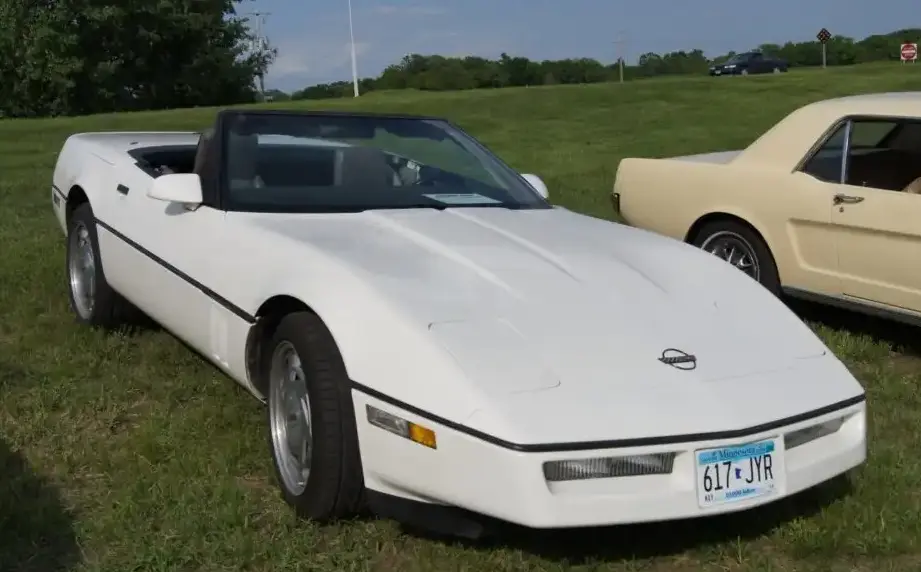
The Chevrolet Corvette Coupe (C4) 5.7 V8, produced from 1986 to 1988, represented a significant evolution for the iconic American sports car. Falling within the early years of the fourth generation (C4) Corvette, which spanned from 1984 to 1996, this variant utilized the L98 5.7-liter V8 engine, delivering 240 horsepower. It was primarily offered as a Targa top model, becoming a popular choice for enthusiasts seeking a blend of performance and open-air driving. This particular configuration occupied a mid-range position within the C4 lineup, offering a substantial power upgrade over the base 230 hp engine while remaining more accessible than the later, higher-performance ZR-1 model.
Technical Specifications
| Brand | Chevrolet |
| Model | Corvette |
| Generation | Corvette Coupe (C4) |
| Type (Engine) | 5.7 V8 (240 Hp) |
| Start of production | June, 1986 |
| End of production | 1988 |
| Powertrain Architecture | Internal Combustion engine |
| Body type | Targa |
| Seats | 2 |
| Doors | 2 |
| Fuel consumption (economy) – urban (EPA) | 13.8 l/100 km (17 US mpg, 20.5 UK mpg, 7.2 km/l) |
| Fuel consumption (economy) – extra urban (EPA) | 9.8 l/100 km (24 US mpg, 28.8 UK mpg, 10.2 km/l) |
| Fuel consumption (economy) – combined (EPA) | 12.4 l/100 km (19 US mpg, 22.8 UK mpg, 8.1 km/l) |
| Fuel Type | Petrol (Gasoline) |
| Acceleration 0 – 60 mph | 5.6 sec |
| Weight-to-power ratio | 6.1 kg/Hp, 164.5 Hp/tonne |
| Weight-to-torque ratio | 3.1 kg/Nm, 320.8 Nm/tonne |
| Power | 240 Hp @ 4000 rpm |
| Power per litre | 41.9 Hp/l |
| Torque | 468 Nm @ 3200 rpm (345.18 lb.-ft. @ 3200 rpm) |
| Engine layout | Front, Longitudinal |
| Engine Model/Code | L98 |
| Engine displacement | 5733 cm3 (349.85 cu. in.) |
| Number of cylinders | 8 |
| Engine configuration | V-engine |
| Cylinder Bore | 101.6 mm (4 in.) |
| Piston Stroke | 88.4 mm (3.48 in.) |
| Compression ratio | 9.5:1 |
| Number of valves per cylinder | 2 |
| Fuel injection system | Multi-port manifold injection |
| Engine aspiration | Naturally aspirated engine |
| Valvetrain | OHV |
| Engine oil capacity | 4.7 l (4.97 US qt | 4.14 UK qt) |
| Coolant | 13.9 l (14.69 US qt | 12.23 UK qt) |
| Kerb Weight | 1459-1466 kg (3216.54 – 3231.98 lbs.) |
| Trunk (boot) space – minimum | 508 l (17.94 cu. ft.) |
| Fuel tank capacity | 75.7 l (20 US gal | 16.65 UK gal) |
| Length | 4483 mm (176.5 in.) |
| Width | 1804 mm (71.02 in.) |
| Height | 1186 mm (46.69 in.) |
| Wheelbase | 2444 mm (96.22 in.) |
| Front track | 1513 mm (59.57 in.) |
| Rear (Back) track | 1534 mm (60.39 in.) |
| Front overhang | 1030 mm (40.55 in.) |
| Rear overhang | 1009 mm (39.72 in.) |
| Ride height (ground clearance) | 120 mm (4.72 in.) |
| Drag coefficient (Cd) | 0.34 |
| Minimum turning circle (turning diameter) | 12.3 m (40.35 ft.) |
| Approach angle | 10.6° |
| Departure angle | 20.2° |
| Ramp-over (brakeover) angle | 12.3° |
| Drivetrain Architecture | The Internal combustion engine (ICE) drives the rear wheels of the vehicle. |
| Drive wheel | Rear wheel drive |
| Number of gears and type of gearbox | 4 gears, manual transmission |
| Front suspension | Double wishbone, Transverse stabilizer, Leaf spring |
| Rear suspension | Independent multi-link suspension, Transverse stabilizer, Leaf spring |
| Front brakes | Ventilated discs |
| Rear brakes | Ventilated discs |
| Assisting systems | ABS (Anti-lock braking system) |
| Steering type | Steering rack and pinion |
| Power steering | Hydraulic Steering |
| Tires size | 255/50 R16; 275/40 ZR17 |
| Wheel rims size | 8.5J x 16; 9.5J x 16; 9.5J x 17 |
INTRODUCTION
The 1986-1988 Chevrolet Corvette Coupe (C4) with the 5.7-liter V8 engine marked a pivotal point in the Corvette’s evolution. The C4 generation, launched in 1984, aimed to modernize the Corvette, moving away from the traditional Coke-bottle styling and embracing a more aerodynamic and technologically advanced design. This iteration, utilizing the L98 engine, offered a significant performance boost over the earlier C4 models, solidifying the Corvette’s position as a formidable American sports car. The Targa top configuration, a defining feature of the Corvette for decades, remained popular, providing an open-air experience without sacrificing structural rigidity.
Powertrain & Engine Architecture
The heart of this Corvette variant is the L98 5.7-liter (349.85 cubic inch) small-block V8 engine. This engine represented a return to a larger displacement after the initial C4 models featured a smaller 5.7L engine. The L98 featured a cast iron block with aluminum cylinder heads, and utilized a cross-fire injection system. It produced 240 horsepower at 4000 rpm and 345 lb-ft of torque at 3200 rpm. The engine employed a two-bolt main bearing cap design for increased strength and durability. The fuel system consisted of multi-port fuel injection, improving fuel efficiency and throttle response compared to earlier carbureted or throttle-body injected systems. The engine was paired with a standard 4-speed manual transmission, although an optional 4-speed automatic transmission was also available. The automatic transmission was a Turbo-Hydramatic 400, known for its durability and smooth shifting characteristics.
Driving Characteristics
The 1986-1988 Corvette 5.7L offered a noticeably more engaging driving experience than its predecessors. The increased horsepower and torque provided brisk acceleration, with 0-60 mph times consistently in the 5.6-second range. The automatic transmission, while offering convenience, did slightly diminish acceleration compared to the manual version due to inherent transmission losses. The suspension, featuring independent front and rear suspension, provided a comfortable ride while maintaining good handling characteristics. The steering was precise and responsive, offering good feedback to the driver. The car felt planted and stable at highway speeds, making it a capable grand tourer. However, the relatively soft suspension setup meant that it wasn’t as sharp or agile as some European sports cars of the era.
Equipment & Trim Levels
The Corvette Coupe (C4) 5.7L came standard with a range of features, including air conditioning, power windows and locks, and a Delco Bose sound system. The interior featured sport seats upholstered in cloth or leather, depending on the options selected. The dashboard was designed with a driver-focused layout, featuring analog gauges for speed, RPM, oil pressure, and coolant temperature. Optional extras included leather upholstery, power seats, a glass Targa top, and a performance handling package. The exterior featured a sleek, aerodynamic design with pop-up headlights and a distinctive rear spoiler.
Chassis & Braking
The C4 Corvette utilized a unibody construction, providing a rigid and lightweight chassis. The suspension system consisted of an independent front suspension with double wishbones and a transverse stabilizer, and an independent rear suspension with a multi-link design and a transverse stabilizer. Braking duties were handled by ventilated disc brakes on all four wheels, providing ample stopping power. An Anti-lock Braking System (ABS) was standard, enhancing safety and control during hard braking. The car rode on 16 or 17-inch wheels, depending on the options selected, with tire sizes ranging from 255/50R16 to 275/40ZR17.
Market Reception & Comparison
The 1986-1988 Corvette 5.7L was generally well-received by automotive critics. It was praised for its improved performance, comfortable ride, and modern features. Compared to the base 230 hp Corvette, the 5.7L offered a significant power upgrade, making it a more desirable option for enthusiasts. However, some critics noted that the car’s handling wasn’t as sharp as some European sports cars, and that the interior quality could be improved. Fuel economy was reasonable for a V8 sports car, averaging around 19 mpg in combined driving. Reliability was generally good, although some owners reported issues with the early electronic components.
Legacy
The 1986-1988 Corvette 5.7L remains a popular choice among Corvette enthusiasts today. The L98 engine is known for its durability and relatively simple maintenance requirements. These cars are readily available on the used car market at affordable prices, making them an accessible entry point into Corvette ownership. While not as collectible as the later ZR-1 model, the 5.7L Corvette offers a compelling combination of performance, style, and value. Its enduring appeal is a testament to the Corvette’s legacy as America’s iconic sports car.