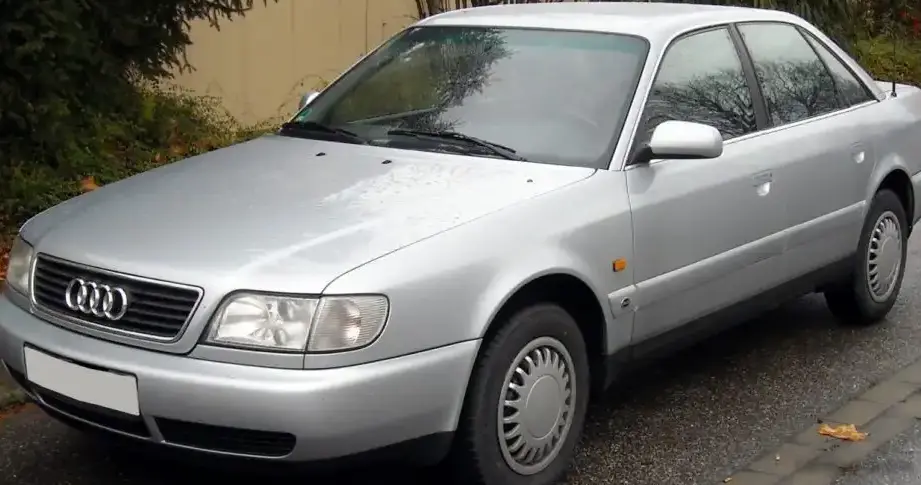
Technical Specifications
| Brand | Audi |
| Model | A6 |
| Generation | A6 Avant (4A,C4) |
| Type (Engine) | 2.8 V6 (174 Hp) quattro |
| Start of production | June, 1994 |
| End of production | October, 1997 |
| Powertrain Architecture | Internal Combustion engine |
| Body type | Station wagon (estate) |
| Seats | 5 |
| Doors | 5 |
| Fuel consumption (urban) | 14 l/100 km (16.8 US mpg, 20.2 UK mpg, 7.1 km/l) |
| Fuel consumption (extra urban) | 8.2 l/100 km (28.7 US mpg, 34.4 UK mpg, 12.2 km/l) |
| Fuel consumption (combined) | 10.8 l/100 km (21.8 US mpg, 26.2 UK mpg, 9.3 km/l) |
| Fuel Type | Petrol (Gasoline) |
| Acceleration 0 – 100 km/h | 9.3 sec |
| Acceleration 0 – 62 mph | 9.3 sec |
| Acceleration 0 – 60 mph | 8.8 sec |
| Maximum speed | 213 km/h (132.35 mph) |
| Weight-to-power ratio | 9.1 kg/Hp, 109.4 Hp/tonne |
| Weight-to-torque ratio | 6.4 kg/Nm, 157.2 Nm/tonne |
| Power | 174 Hp @ 5500 rpm |
| Power per litre | 62.8 Hp/l |
| Torque | 250 Nm @ 3000 rpm (184.39 lb.-ft. @ 3000 rpm) |
| Engine layout | Front, Longitudinal |
| Engine Model/Code | AAH |
| Engine displacement | 2771 cm3 (169.1 cu. in.) |
| Number of cylinders | 6 |
| Engine configuration | V-engine |
| Cylinder Bore | 82.5 mm (3.25 in.) |
| Piston Stroke | 86.4 mm (3.4 in.) |
| Compression ratio | 10.3:1 |
| Number of valves per cylinder | 2 |
| Fuel injection system | Multi-port manifold injection |
| Engine aspiration | Naturally aspirated engine |
| Valvetrain | OHC |
| Engine oil capacity | 5 l (5.28 US qt | 4.4 UK qt) |
| Coolant | 11 l (11.62 US qt | 9.68 UK qt) |
| Kerb Weight | 1590 kg (3505.35 lbs.) |
| Max. weight | 2140 kg (4717.89 lbs.) |
| Max load | 550 kg (1212.54 lbs.) |
| Trunk (boot) space – minimum | 390 l (13.77 cu. ft.) |
| Trunk (boot) space – maximum | 1310 l (46.26 cu. ft.) |
| Fuel tank capacity | 80 l (21.13 US gal | 17.6 UK gal) |
| Max. roof load | 100 kg (220.46 lbs.) |
| Permitted trailer load with brakes (8%) | 2100 kg (4629.71 lbs.) |
| Permitted trailer load with brakes (12%) | 1650 kg (3637.63 lbs.) |
| Permitted trailer load without brakes | 750 kg (1653.47 lbs.) |
| Permitted towbar download | 75 kg (165.35 lbs.) |
| Length | 4797 mm (188.86 in.) |
| Width | 1783 mm (70.2 in.) |
| Height | 1440 mm (56.69 in.) |
| Wheelbase | 2692 mm (105.98 in.) |
| Front track | 1520 mm (59.84 in.) |
| Rear (Back) track | 1524 mm (60 in.) |
| Drag coefficient (Cd) | 0.34 |
| Minimum turning circle (turning diameter) | 11.4 m (37.4 ft.) |
| Drive wheel | All wheel drive (4×4) |
| Number of gears and type of gearbox | 5 gears, manual transmission |
| Front suspension | Independent, type McPherson with coil spring and anti-roll bar |
| Rear suspension | Semi-independent, coil spring |
| Front brakes | Ventilated discs |
| Rear brakes | Disc |
| Assisting systems | ABS (Anti-lock braking system) |
| Steering type | Steering rack and pinion |
| Power steering | Hydraulic Steering |
| Tires size | 195/65 R15 |
| Wheel rims size | 6J x 15 |
The Audi A6 Avant (4A, C4) 2.8 V6 quattro, produced between June 1994 and October 1997, represents a significant iteration of Audi’s mid-size executive wagon. Positioned as a premium offering within the C4 A6 range, this variant combined a potent V6 engine with Audi’s renowned quattro all-wheel-drive system, offering a blend of performance, practicality, and all-weather capability. It was part of the broader C4 A6 generation, which itself was a substantial evolution of the 80/90 platform, moving towards a more sophisticated and luxurious experience. The Avant body style, Audi’s designation for a station wagon or estate, was particularly popular in Europe, offering a compelling alternative to traditional sedans.
Powertrain & Engine Architecture
The heart of the A6 Avant 2.8 quattro was the AAH engine, a 2.8-liter naturally aspirated V6. This engine, a member of Audi’s long-running V6 family, featured a 90-degree V-angle for inherent smoothness. It utilized a cast iron block with an aluminum cylinder head, a common construction for the era balancing durability and weight. Fuel delivery was handled by a Bosch Motronic multi-port fuel injection system, optimizing fuel atomization and combustion efficiency. The engine produced 174 horsepower at 5500 rpm and 250 Nm (184 lb-ft) of torque at 3000 rpm. The engine’s valvetrain employed a single overhead camshaft (OHC) per cylinder bank, operating two valves per cylinder. The engine was mounted longitudinally in the chassis, driving all four wheels through Audi’s Torsen-based quattro all-wheel-drive system. The standard transmission was a 5-speed manual, though a 4-speed automatic transmission was also available, impacting performance and fuel economy.
Driving Characteristics
The 2.8 V6 quattro Avant offered a refined and capable driving experience. While not overtly sporty, the engine provided ample power for everyday driving and comfortable highway cruising. Acceleration to 60 mph took around 8.8 seconds, respectable for the mid-1990s. The quattro system provided excellent traction in all weather conditions, enhancing stability and confidence. The automatic transmission, while offering convenience, did slightly diminish acceleration compared to the manual version. Gear ratios were tuned for a balance of fuel efficiency and responsiveness. The suspension, while comfortable, offered a degree of body roll during aggressive cornering, typical of grand touring vehicles of the period.
Equipment & Trim Levels
The A6 Avant 2.8 quattro typically came well-equipped, reflecting its premium positioning. Standard features included power windows, power locks, central locking, air conditioning, and an upgraded audio system. Interior upholstery was typically cloth, with leather options available. Dashboard design was functional and elegant, featuring wood trim accents. Optional extras included a sunroof, heated front seats, automatic climate control, and upgraded audio systems. The Avant also benefited from the wagon’s inherent practicality, offering a generous cargo area that could be expanded by folding down the rear seats.
Chassis & Braking
The C4 A6 Avant featured an independent front suspension with McPherson struts and coil springs, along with an anti-roll bar. The rear suspension was a semi-independent torsion beam setup, also with coil springs. This configuration provided a good balance of ride comfort and handling. Braking duties were handled by ventilated discs at the front and solid discs at the rear, with ABS (Anti-lock Braking System) standard. The braking system was generally considered effective for the vehicle’s weight and performance.
Market Reception & Comparison
The A6 Avant 2.8 quattro was generally well-received by automotive critics. It was praised for its refined engine, comfortable ride, and all-weather capability. Compared to the base 1.8L and 2.0L A6 variants, the 2.8 offered a significant performance upgrade. It also provided a more luxurious experience than the diesel-powered TDI models. However, some critics noted that the automatic transmission could feel sluggish at times. Fuel economy, while acceptable, was not a strong point, particularly compared to the more economical four-cylinder and diesel options.
Legacy
The A6 Avant 2.8 quattro remains a sought-after classic among Audi enthusiasts. The AAH engine is known for its durability, although regular maintenance is crucial to prevent oil leaks and other age-related issues. The quattro all-wheel-drive system continues to be highly regarded for its effectiveness. Well-maintained examples command a premium in the used car market. The C4 A6 Avant, particularly the 2.8 quattro variant, represents a high point in Audi’s wagon history, offering a compelling blend of performance, practicality, and luxury. Finding original, unmolested examples is becoming increasingly difficult, as many have been modified or neglected over the years. However, the enduring appeal of the C4 A6 Avant ensures its continued presence in the classic car community.