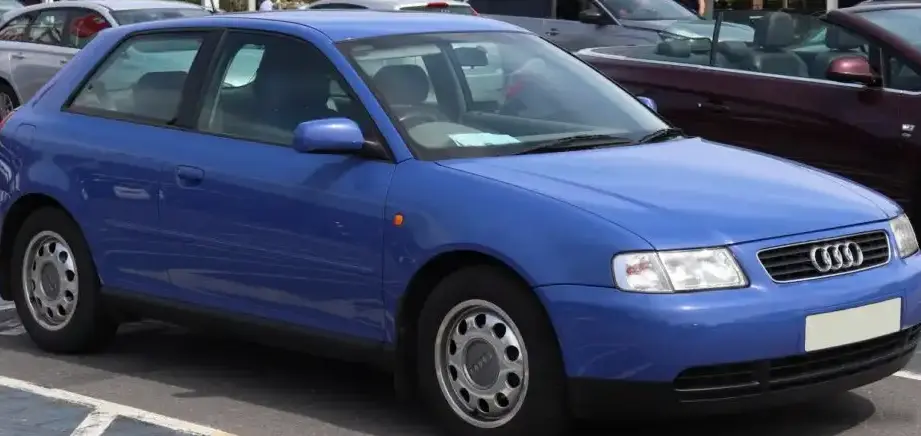
The Audi A3 Sportback (8PA) 2.0 TDI 16V, producing 140 horsepower, was a key variant in Audi’s first-generation A3 Sportback lineup, manufactured from 2004 to 2008. Positioned as a practical and efficient option within the A3 range, it aimed to balance performance with fuel economy, appealing to buyers seeking a premium hatchback experience. This model was particularly significant in the European market, where compact hatchbacks are highly popular, offering a more versatile alternative to the three-door A3. It utilized the Volkswagen Group’s A platform (8P), shared with models like the Volkswagen Golf Mk5 and SEAT León.
Technical Specifications
| Brand | Audi |
| Model | A3 |
| Generation | A3 Sportback (8PA) |
| Type (Engine) | 2.0 TDI 16V (140 Hp) |
| Start of production | 2004 |
| End of production | 2008 |
| Powertrain Architecture | Internal Combustion engine |
| Body type | Hatchback |
| Seats | 5 |
| Doors | 5 |
| Fuel consumption (urban) | 7.2 l/100 km (32.7 US mpg, 39.2 UK mpg, 13.9 km/l) |
| Fuel consumption (extra urban) | 4.6 l/100 km (51.1 US mpg, 61.4 UK mpg, 21.7 km/l) |
| Fuel consumption (combined) | 5.5 l/100 km (42.8 US mpg, 51.4 UK mpg, 18.2 km/l) |
| Fuel Type | Diesel |
| Acceleration 0 – 100 km/h | 9.7 sec |
| Acceleration 0 – 62 mph | 9.7 sec |
| Acceleration 0 – 60 mph | 9.2 sec |
| Maximum speed | 207 km/h (128.62 mph) |
| Emission standard | Euro 4 |
| Weight-to-power ratio | 9.8 kg/Hp, 102.2 Hp/tonne |
| Weight-to-torque ratio | 4.3 kg/Nm, 233.6 Nm/tonne |
| Power | 140 Hp @ 4000 rpm |
| Power per litre | 71.1 Hp/l |
| Torque | 320 Nm @ 1750-2500 rpm (236.02 lb.-ft. @ 1750-2500 rpm) |
| Engine layout | Front, Transverse |
| Engine Model/Code | EA188 / BKD |
| Engine displacement | 1968 cm3 (120.09 cu. in.) |
| Number of cylinders | 4 |
| Engine configuration | Inline |
| Cylinder Bore | 81 mm (3.19 in.) |
| Piston Stroke | 95.5 mm (3.76 in.) |
| Compression ratio | 18:1 |
| Number of valves per cylinder | 4 |
| Fuel injection system | Pump-nozzle (Unit Injector) |
| Engine aspiration | Turbocharger, Intercooler |
| Valvetrain | DOHC |
| Engine oil capacity | 3.8 l (4.02 US qt | 3.34 UK qt) |
| Kerb Weight | 1370 kg (3020.33 lbs.) |
| Max. weight | 1930 kg (4254.92 lbs.) |
| Max load | 560 kg (1234.59 lbs.) |
| Trunk (boot) space – minimum | 370 l (13.07 cu. ft.) |
| Trunk (boot) space – maximum | 1120 l (39.55 cu. ft.) |
| Fuel tank capacity | 55 l (14.53 US gal | 12.1 UK gal) |
| Length | 4286 mm (168.74 in.) |
| Width | 1765 mm (69.49 in.) |
| Height | 1423 mm (56.02 in.) |
| Wheelbase | 2578 mm (101.5 in.) |
| Front track | 1534 mm (60.39 in.) |
| Rear (Back) track | 1507 mm (59.33 in.) |
| Drag coefficient (Cd) | 0.33 |
| Minimum turning circle | 10.7 m (35.1 ft.) |
| Drivetrain Architecture | Front wheel drive |
| Number of gears | 6 gears, manual transmission |
| Front suspension | Independent type McPherson, Transverse stabilizer |
| Rear suspension | Independent multi-link suspension, Transverse stabilizer |
| Front brakes | Ventilated discs |
| Rear brakes | Disc |
| Assisting systems | ABS (Anti-lock braking system) |
| Steering type | Steering rack and pinion |
| Power steering | Hydraulic Steering |
| Tires size | 205/55 R16 |
| Wheel rims size | 6.5J x 16 |
Powertrain & Engine Architecture
The heart of the A3 2.0 TDI 16V was the EA188 engine family, specifically the BKD code. This 1968cc, four-cylinder diesel engine featured a cast iron block and aluminum cylinder head. It employed common rail direct injection, delivering fuel directly into the combustion chamber at extremely high pressure. The 16-valve configuration (four valves per cylinder) and a turbocharger with intercooler contributed to its respectable power output. The BKD engine was known for its robust build quality and relatively straightforward maintenance. The engine utilized a pump-nozzle (unit injector) system, a technology that was gradually superseded by common rail in later iterations of the EA188. This system, while effective, could be more sensitive to fuel quality than later common rail designs. The engine’s transverse mounting and front-wheel-drive configuration were standard for this class of vehicle.
Driving Characteristics
The 140 hp 2.0 TDI offered a good balance between performance and economy. Acceleration from 0-60 mph took around 9.2 seconds, and it had a top speed of 128.62 mph. While not a sports car, it provided sufficient power for everyday driving and overtaking maneuvers. The engine’s torque peak of 320 Nm (236 lb-ft) available from 1750-2500 rpm meant that it felt responsive in most driving situations. Compared to the more powerful 2.0 TDI variants (often exceeding 170 hp), the 140 hp version felt less strained at higher speeds and generally offered better fuel economy. The manual transmission, with its six forward gears, allowed for efficient cruising and helped to keep the engine within its optimal operating range. The gear ratios were tuned for a blend of acceleration and fuel efficiency, rather than outright performance.
Equipment & Trim Levels
The A3 Sportback 2.0 TDI 16V typically came with a reasonable level of standard equipment. This included air conditioning, power windows, central locking, and an integrated audio system. Interior upholstery was usually cloth, although leather options were available. Trim levels varied depending on the market, but common options included alloy wheels, a multi-function steering wheel, and a trip computer. More upscale trims might add features like automatic climate control, parking sensors, and upgraded audio systems. The A3 Sportback offered a relatively minimalist interior design, typical of Audi at the time, focusing on functionality and build quality.
Chassis & Braking
The A3 Sportback featured independent suspension all around – McPherson struts at the front and a multi-link setup at the rear. This provided a comfortable ride and good handling characteristics. Stabilizer bars were fitted to both axles to reduce body roll during cornering. Braking was handled by ventilated discs at the front and solid discs at the rear, with ABS (Anti-lock Braking System) as standard. The suspension was tuned to prioritize comfort and stability, making it a pleasant vehicle for long journeys. The chassis was relatively lightweight, contributing to the car’s agility.
Market Reception & Comparison
The Audi A3 Sportback 2.0 TDI 16V was generally well-received by automotive critics. It was praised for its fuel efficiency, comfortable ride, and refined interior. However, some reviewers noted that the engine could be a little noisy compared to some of its competitors. Compared to other trims in the A3 lineup, the 2.0 TDI 16V offered a compelling value proposition. It provided a good balance of performance and economy, making it a popular choice for buyers who didn’t need the extra power of the higher-output models. Its fuel economy was notably better than the petrol-powered A3 variants, and its torque delivery made it more effortless to drive in everyday conditions.
Legacy
The EA188 2.0 TDI engine, including the BKD variant, proved to be a durable and reliable powertrain when properly maintained. However, it’s known to be susceptible to issues with the dual-mass flywheel and the turbocharger over time. The A3 Sportback 2.0 TDI 16V remains a relatively common sight on used car markets today. Its reputation for reliability and fuel efficiency continues to make it an attractive option for buyers seeking a practical and affordable premium hatchback. Parts availability is generally good, and the car’s relatively simple mechanical design makes it relatively easy to maintain for those with some mechanical aptitude.