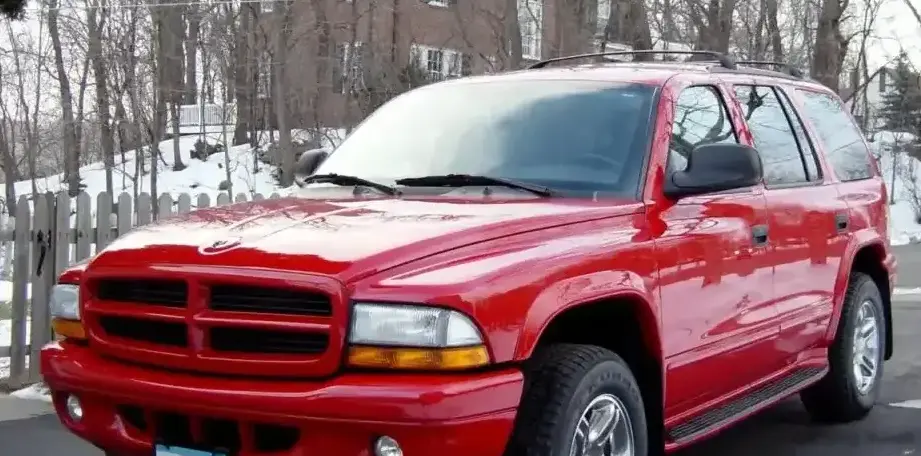
The Dodge Durango first generation (DN) with the 4.7-liter V8 engine, producing 238 horsepower, was a significant entry into the mid-size SUV market for Dodge. Produced from 2000 to 2004, this Durango represented Dodge’s attempt to capture a share of the growing SUV segment, offering a blend of truck-based durability and family-friendly space. This particular variant, equipped with the 42RE four-speed automatic transmission, occupied a middle ground in the Durango lineup, positioned above the base 3.9L V6 models but below the higher-performance trims. It aimed to provide a balance of power, capability, and affordability for buyers seeking a versatile SUV.
Technical Specifications
| Brand | Dodge |
| Model | Durango |
| Generation | Durango I (DN) |
| Type (Engine) | 4.7 i V8 (238 Hp) |
| Start of production | 2000 |
| End of production | 2004 |
| Powertrain Architecture | Internal Combustion engine |
| Body type | SUV |
| Seats | 8 |
| Doors | 5 |
| Fuel consumption (urban) | 16.8 l/100 km (14 US mpg, 16.8 UK mpg) |
| Fuel consumption (extra urban) | 13.8 l/100 km (17 US mpg, 20.5 UK mpg) |
| Fuel Type | Petrol (Gasoline) |
| Maximum speed | 180 km/h (111.85 mph) |
| Weight-to-power ratio | 8.5 kg/Hp, 118.1 Hp/tonne |
| Weight-to-torque ratio | 5 kg/Nm, 198.5 Nm/tonne |
| Power | 238 Hp @ 4800 rpm |
| Power per litre | 50.6 Hp/l |
| Torque | 400 Nm @ 3200 rpm (295.02 lb.-ft. @ 3200 rpm) |
| Engine layout | Front, Longitudinal |
| Engine Model/Code | EVA |
| Engine displacement | 4701 cm3 (286.87 cu. in.) |
| Number of cylinders | 8 |
| Engine configuration | V-engine |
| Cylinder Bore | 93 mm (3.66 in.) |
| Piston Stroke | 86.5 mm (3.41 in.) |
| Compression ratio | 9.3:1 |
| Number of valves per cylinder | 2 |
| Fuel injection system | Multi-port manifold injection |
| Engine aspiration | Naturally aspirated engine |
| Engine oil capacity | 5.7 l (6.02 US qt | 5.02 UK qt) |
| Coolant | 16 l (16.91 US qt | 14.08 UK qt) |
| Kerb Weight | 2015 kg (4442.31 lbs.) |
| Max. weight | 2744 kg (6049.48 lbs.) |
| Max load | 729 kg (1607.17 lbs.) |
| Trunk (boot) space – minimum | 532 l (18.79 cu. ft.) |
| Trunk (boot) space – maximum | 2482 l (87.65 cu. ft.) |
| Fuel tank capacity | 95 l (25.1 US gal | 20.9 UK gal) |
| Length | 4910 mm (193.31 in.) |
| Width | 1810 mm (71.26 in.) |
| Height | 1804 mm (71.02 in.) |
| Wheelbase | 2944 mm (115.91 in.) |
| Front track | 1537 mm (60.51 in.) |
| Rear (Back) track | 1562 mm (61.5 in.) |
| Drivetrain Architecture | The Internal combustion engine (ICE) drives the rear wheels of the vehicle. |
| Drive wheel | Rear wheel drive |
| Number of gears and type of gearbox | 4 gears, automatic transmission |
| Front suspension | Torsion |
| Rear suspension | Leaf spring |
| Front brakes | Ventilated discs |
| Rear brakes | Drum |
| Assisting systems | ABS (Anti-lock braking system) |
| Steering type | Cone worm with recirculation balls |
| Power steering | Hydraulic Steering |
| Tires size | 235/75 R15 |
Powertrain & Engine Architecture
The heart of this Durango variant is the 4.7-liter (4701 cc) EVA V8 engine. This engine, part of Chrysler’s second-generation small-block V8 family, featured a cast iron block with aluminum cylinder heads. It utilized a multi-port fuel injection system, delivering fuel directly to each cylinder for optimized combustion. The engine produced 238 horsepower at 4800 rpm and 295 lb-ft of torque at 3200 rpm. The 9.3:1 compression ratio was a compromise between performance and the ability to run on readily available gasoline. The 42RE four-speed automatic transmission was the standard pairing for this engine. While not known for its sophistication, the 42RE was a robust unit designed for durability and towing capability. It featured a torque converter lock-up clutch to improve fuel efficiency at highway speeds.
Driving Characteristics
The 4.7L V8 and 42RE automatic combination provided adequate, but not exhilarating, performance. Acceleration from 0 to 60 mph was typically in the 8-9 second range. The transmission’s gear ratios were geared towards providing sufficient torque for towing and hauling, rather than maximizing acceleration. Compared to the base 3.9L V6, the 4.7L offered a noticeable improvement in power and responsiveness, especially when fully loaded or towing a trailer. However, it lacked the sporty feel of the higher-output versions of the 4.7L available with more advanced transmissions. The rear-wheel-drive configuration provided a traditional truck-like driving experience, with a focus on stability and control.
Equipment & Trim Levels
The 4.7L Durango typically came standard with features like air conditioning, power windows and locks, and an AM/FM stereo. Higher trim levels, such as the SLT, added features like leather upholstery, upgraded sound systems, and alloy wheels. Optional extras included a sunroof, rear entertainment system, and a towing package. Interior upholstery was typically cloth on the base models, with leather available as an upgrade. The dashboard layout was functional and straightforward, prioritizing ease of use over aesthetic flair.
Chassis & Braking
The Durango’s chassis was based on a body-on-frame construction, providing a robust and durable platform. The front suspension utilized a torsion bar setup, while the rear suspension employed leaf springs. This configuration was chosen for its load-carrying capacity and durability. Braking duties were handled by ventilated discs in the front and drum brakes in the rear. Anti-lock brakes (ABS) were standard, enhancing safety and control during emergency braking situations. The steering system was a recirculating ball setup, providing a direct but somewhat heavy steering feel.
Market Reception & Comparison
The 4.7L Durango was generally well-received by critics as a capable and versatile SUV. It offered a good balance of power, space, and affordability. However, some reviewers criticized the transmission for its lack of smoothness and the relatively basic interior compared to some competitors. Fuel economy was also a concern, with the 4.7L engine averaging around 14-17 mpg in real-world driving. Compared to the 3.9L V6, the 4.7L offered a significant performance upgrade, but at the cost of increased fuel consumption. The higher-output 4.7L versions, paired with more advanced transmissions, provided even better performance but came at a higher price point.
Legacy
The first-generation Dodge Durango, particularly the 4.7L V8 models, have developed a reputation for being relatively reliable vehicles. The 4.7L engine, while not without its quirks, is generally considered to be a durable powerplant. Common issues include oil leaks and occasional sensor failures. The 42RE transmission is also known for its robustness, but can be prone to wear and tear with heavy use. Today, these Durangos are often found as affordable used SUVs, appealing to buyers seeking a capable and spacious vehicle for family transportation or light-duty work. Their body-on-frame construction and rear-wheel-drive layout make them suitable for towing and off-road adventures, while their relatively simple mechanicals make them easier to maintain and repair compared to more modern SUVs.