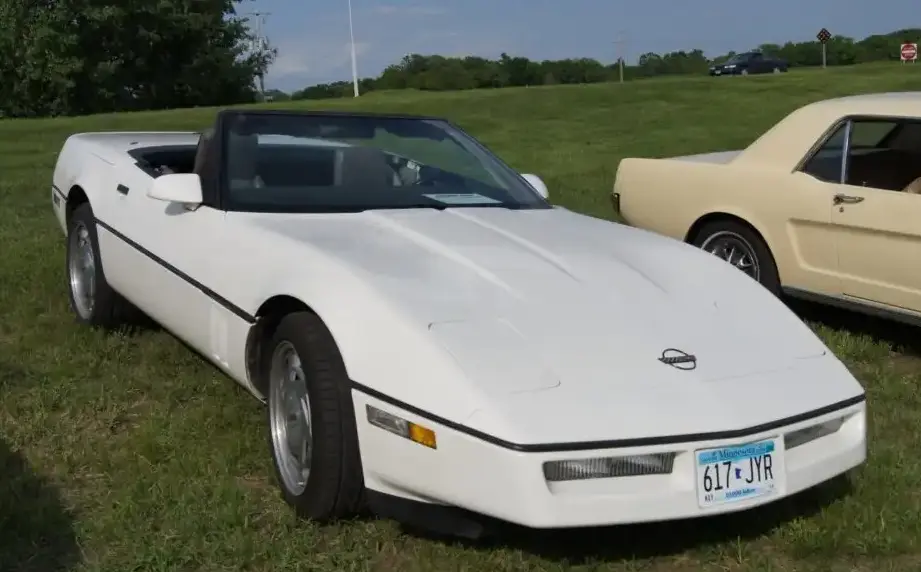
The Chevrolet Corvette Coupe (C4) facelift of 1990, specifically the 5.7 V8 (300 hp) automatic variant, represents a significant evolution in the fourth generation of Chevrolet’s iconic sports car. Produced from 1992 through 1995, this model year marked a pivotal shift with the introduction of the LT1 engine, replacing the L98. This iteration of the C4 aimed to blend performance with improved refinement, appealing to a broader audience while maintaining the Corvette’s core identity. The C4 chassis, introduced in 1984, underwent continuous improvements throughout its lifecycle, and the 1992-1995 models benefited from these enhancements, offering a more modern driving experience compared to earlier C4s. This particular trim level, combining the potent LT1 V8 with a four-speed automatic transmission, positioned itself as a comfortable and capable grand tourer within the Corvette lineup.
Technical Specifications
| Brand | Chevrolet |
| Model | Corvette |
| Generation | Corvette Coupe (C4, facelift 1990) |
| Type (Engine) | 5.7 V8 (300 Hp) Automatic |
| Start of production | 1992 |
| End of production | 1995 |
| Powertrain Architecture | Internal Combustion engine |
| Body type | Targa |
| Seats | 2 |
| Doors | 2 |
| Fuel consumption (economy) – urban (EPA) | 13.8 l/100 km (17 US mpg, 20.5 UK mpg) |
| Fuel consumption (economy) – extra urban (EPA) | 9.8 l/100 km (24 US mpg, 28.8 UK mpg) |
| Fuel consumption (economy) – combined (EPA) | 11.8-12.4 l/100 km (19.9 – 19 US mpg, 23.9 – 22.8 UK mpg) |
| Fuel Type | Petrol (Gasoline) |
| Power | 300 Hp @ 5000 rpm |
| Power per litre | 52.3 Hp/l |
| Torque | 461 Nm @ 3600 rpm (340.02 lb.-ft. @ 3600 rpm) |
| Maximum engine speed | 5700 rpm |
| Engine layout | Front, Longitudinal |
| Engine Model/Code | LT1 |
| Engine displacement | 5733 cm3 (349.85 cu. in.) |
| Number of cylinders | 8 |
| Engine configuration | V-engine |
| Cylinder Bore | 101.6 mm (4 in.) |
| Piston Stroke | 88.4 mm (3.48 in.) |
| Compression ratio | 10.5:1 |
| Number of valves per cylinder | 2 |
| Fuel injection system | Multi-port manifold injection |
| Engine aspiration | Naturally aspirated engine |
| Valvetrain | OHV |
| Engine oil capacity | 4.3 l (4.54 US qt, 3.78 UK qt) |
| Coolant | 16.9 l (17.86 US qt, 14.87 UK qt) |
| Trunk (boot) space – minimum | 357 l (12.61 cu. ft.) |
| Fuel tank capacity | 76 l (20.08 US gal, 16.72 UK gal) |
| Length | 4535 mm (178.54 in.) |
| Width | 1796 mm (70.71 in.) |
| Height | 1177 mm (46.34 in.) |
| Wheelbase | 2444 mm (96.22 in.) |
| Front track | 1466 mm (57.72 in.) |
| Rear (Back) track | 1500 mm (59.06 in.) |
| Drivetrain Architecture | Rear wheel drive, Internal Combustion engine |
| Drive wheel | Rear wheel drive |
| Number of gears and type of gearbox | 4 gears, automatic transmission |
| Front suspension | Double wishbone, Transverse stabilizer, Leaf spring |
| Rear suspension | Independent multi-link suspension, Transverse stabilizer, Leaf spring |
| Front brakes | Ventilated discs |
| Rear brakes | Ventilated discs |
| Assisting systems | ABS (Anti-lock braking system) |
| Steering type | Steering rack and pinion |
| Power steering | Hydraulic Steering |
| Tires size | Front: 255/45 ZR17; 275/40 ZR17, Rear: 275/40 ZR17; 285/40 ZR17 |
| Wheel rims size | Front: 8.5J x 17; 9.5J x 17, Rear: 9.5J x 17 |
Powertrain & Engine Architecture
The heart of this Corvette variant is the 5.7-liter (349.85 cubic inch) LT1 small-block V8 engine. This engine represented a significant departure from the previous L98, featuring reverse-flow cooling, a higher compression ratio of 10.5:1, and a more efficient intake manifold design. The LT1 utilized multi-port fuel injection, delivering precise fuel metering for improved performance and emissions. The overhead valve (OHV) valvetrain, while traditional, was optimized for the engine’s characteristics. Coupled with the LT1 was a 4L60E four-speed automatic transmission. This transmission was chosen for its smoothness and ease of use, making it an ideal pairing for drivers seeking a more relaxed grand touring experience. The transmission featured electronic control, allowing for optimized shift points based on throttle position and vehicle speed.
Driving Characteristics
The 300 horsepower and 340 lb-ft of torque delivered by the LT1 engine, combined with the four-speed automatic, provided brisk acceleration. While not as immediately responsive as the manual transmission equipped models, the automatic offered smooth and predictable power delivery. The automatic’s gear ratios were tuned for a balance between acceleration and fuel efficiency. In real-world driving, the 0-60 mph sprint was typically achieved in around 5.8-6.2 seconds, respectable for the early 1990s. Compared to the manual transmission version, the automatic traded some outright performance for increased comfort and convenience. The automatic also offered a less demanding driving experience, particularly in city traffic.
Equipment & Trim Levels
The 1992-1995 Corvette with the 5.7L/automatic combination typically came standard with leather upholstery, air conditioning, power windows and locks, and a Delco Bose sound system. The interior featured a driver-focused cockpit with analog gauges and a center console. Optional extras included a removable roof panel (Targa top), sport seats, and various cosmetic enhancements. The C4 Corvette offered a relatively streamlined trim structure, with the LT1/automatic combination representing a mid-range offering. It sat above the base model with the earlier L98 engine but below the higher-performance ZR-1 variant.
Chassis & Braking
The C4 Corvette utilized a lightweight aluminum chassis, contributing to its relatively low curb weight. The suspension consisted of independent front and rear suspension systems, employing transverse stabilizers and leaf springs. The front suspension featured a double wishbone design, while the rear utilized a multi-link setup. Braking duties were handled by ventilated disc brakes on all four wheels, augmented by an anti-lock braking system (ABS) for enhanced safety. The braking system provided ample stopping power, although earlier C4s were sometimes criticized for a slightly soft pedal feel.
Market Reception & Comparison
The 1992-1995 Corvette with the LT1 engine and automatic transmission was generally well-received by automotive critics. The LT1 engine was praised for its increased power and improved efficiency compared to the L98. The automatic transmission was appreciated for its smoothness and ease of use, making the Corvette more accessible to a wider range of drivers. Fuel economy figures averaged around 19-20 mpg combined, which was competitive for a sports car of its era. Compared to the manual transmission version, the automatic offered a more relaxed driving experience but sacrificed some performance. The LT1/automatic combination proved to be a popular choice among Corvette buyers, offering a compelling blend of performance, comfort, and convenience.
Legacy
The LT1 engine proved to be a durable and reliable powerplant, and the 4L60E automatic transmission, while occasionally requiring maintenance, generally held up well over time. Today, the 1992-1995 Corvette C4 with the 5.7L/automatic combination represents an affordable entry point into Corvette ownership. These cars are readily available on the used car market and offer a classic American sports car experience. While not as highly sought after as the ZR-1 variant, the LT1/automatic C4 remains a popular choice among enthusiasts seeking a capable and stylish grand tourer. Its relative simplicity and readily available parts make it a relatively easy car to maintain and enjoy.