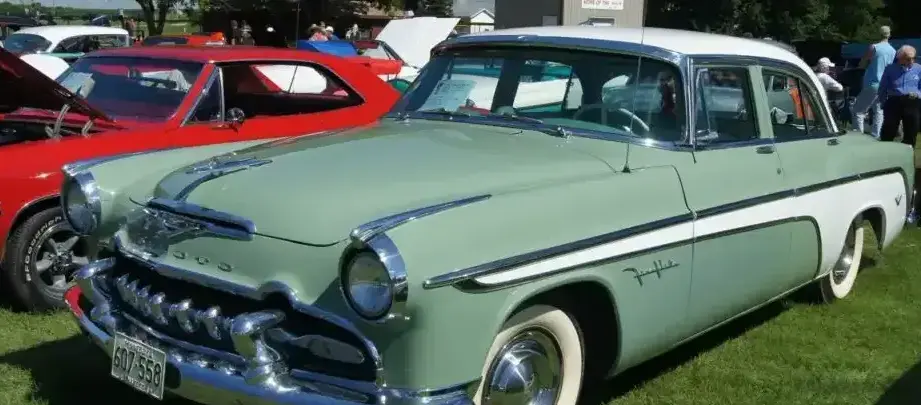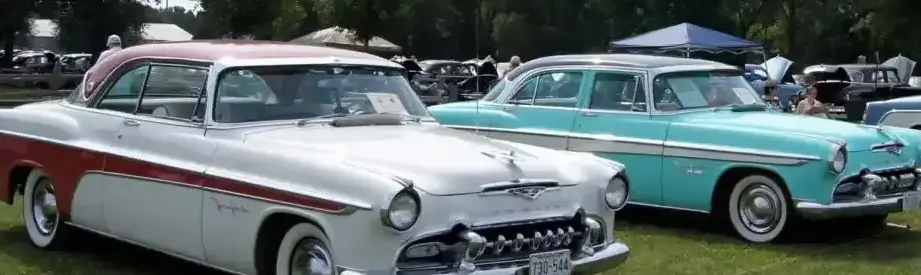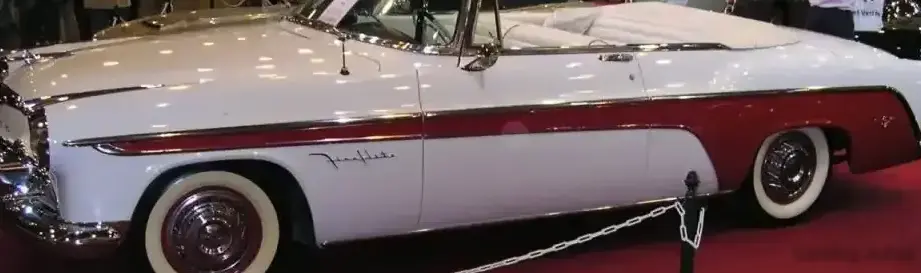
The DeSoto Fireflite I Convertible, powered by a 4.8-liter V8 engine producing 200 horsepower, represented a significant offering from the DeSoto division of Chrysler Corporation during the 1954 and 1955 model years. Positioned as a premium offering within the DeSoto lineup, the Fireflite Convertible aimed to capture the burgeoning post-war American desire for stylish, powerful, and comfortable automobiles. It was a key model in DeSoto’s attempt to establish itself as a distinct brand, separate from its parent company, and compete with other mid-range luxury brands like Buick and Oldsmobile. The Fireflite name itself evoked a sense of speed and modern technology, aligning with the era’s optimistic outlook.
Technical Specifications
| Brand | DeSoto |
| Model | Fireflite |
| Generation | Fireflite I Convertible |
| Type (Engine) | 4.8 V8 (200 Hp) |
| Start of production | 1954 |
| End of production | 1955 |
| Powertrain Architecture | Internal Combustion engine |
| Body type | Cabriolet |
| Seats | 6 |
| Doors | 2 |
| Fuel Type | Petrol (Gasoline) |
| Power | 200 Hp @ 4400 rpm |
| Power per litre | 41.9 Hp/l |
| Torque | 371 Nm @ 2800 rpm |
| Torque (lb-ft) | 273.64 lb.-ft. @ 2800 rpm |
| Engine Model/Code | S22-1001 |
| Engine displacement | 4769 cm3 |
| Engine displacement (cu. in.) | 291.02 cu. in. |
| Number of cylinders | 8 |
| Engine configuration | V-engine |
| Cylinder Bore | 94.49 mm |
| Cylinder Bore (in.) | 3.72 in. |
| Piston Stroke | 84.931 mm |
| Piston Stroke (in.) | 3.34 in. |
| Compression ratio | 7.5:1 |
| Number of valves per cylinder | 2 |
| Fuel injection system | Carburettor |
| Engine aspiration | Naturally aspirated engine |
| Valvetrain | OHV |
| Engine oil capacity | 4.7 l |
| Engine oil capacity (US qt) | 4.97 US qt |
| Engine oil capacity (UK qt) | 4.14 UK qt |
| Coolant capacity | 22.7 l |
| Coolant capacity (US qt) | 23.99 US qt |
| Coolant capacity (UK qt) | 19.97 UK qt |
| Fuel tank capacity | 76 l |
| Fuel tank capacity (US gal) | 20.08 US gal |
| Fuel tank capacity (UK gal) | 16.72 UK gal |
| Length | 5535 mm |
| Length (in.) | 217.91 in. |
| Width | 1989 mm |
| Width (in.) | 78.31 in. |
| Height | 1539 mm |
| Height (in.) | 60.59 in. |
| Wheelbase | 3200 mm |
| Wheelbase (in.) | 125.98 in. |
| Front track | 1529 mm |
| Front track (in.) | 60.2 in. |
| Rear track | 1514 mm |
| Rear track (in.) | 59.61 in. |
| Front overhang | 930 mm |
| Front overhang (in.) | 36.61 in. |
| Rear overhang | 1405 mm |
| Rear overhang (in.) | 55.31 in. |
| Ride height (ground clearance) | 160 mm |
| Ride height (ground clearance) (in.) | 6.3 in. |
| Minimum turning circle | 13.4 m |
| Minimum turning circle (ft.) | 43.96 ft. |
| Approach angle | 21° |
| Departure angle | 12° |
| Ramp-over angle | 11° |
| Drivetrain Architecture | Rear wheel drive |
| Drive wheel | Rear wheel drive |
| Number of gears | 3 |
| Gearbox type | Manual transmission |
| Front suspension | Independent coil spring |
| Rear suspension | Leaf spring |
| Front brakes | Drum, 305 mm |
| Rear brakes | Drum, 305 mm |
| Steering type | Worm-reduction unit |
| Power steering | Hydraulic Steering |
Powertrain & Engine Architecture
The heart of the Fireflite I Convertible was the DeSoto S22-1001 4.8-liter (291.02 cubic inch) V8 engine. This engine featured a cast iron block and aluminum cylinder heads, a relatively modern design for the time. It utilized a conventional overhead valve (OHV) valvetrain with two valves per cylinder. Fuel delivery was managed by a Carter carburetor, typical for American V8s of the era. The 7.5:1 compression ratio was a compromise between performance and the fuel quality available in the mid-1950s. The engine’s design prioritized low-end torque, making it well-suited for comfortable cruising and effortless acceleration. The three-speed manual transmission was the standard offering, providing a direct connection between the engine and the rear wheels.
Driving Characteristics
The 200 horsepower and 273.64 lb-ft of torque provided by the Fireflite’s V8 engine delivered respectable performance for the time. While not a sports car, the Fireflite offered brisk acceleration and the ability to comfortably maintain highway speeds. The three-speed manual transmission required deliberate shifting, but provided the driver with a good degree of control. The car’s substantial weight (approximately 3,700 lbs) meant that handling was best described as comfortable rather than sporty. The independent coil spring front suspension offered a smoother ride than the solid rear axle with leaf springs, but body roll was noticeable in corners. The hydraulic steering, while a welcome feature, lacked the precision of more modern systems.
Equipment & Trim Levels
The Fireflite I Convertible was well-equipped for its time, reflecting its positioning as a premium model. Standard features included a full-wheel cover, whitewall tires, a deluxe steering wheel, and a heater. The interior was typically upholstered in cloth and vinyl, with a focus on comfort and spaciousness. Optional extras included power steering (a popular choice), power windows, a radio, and a continental kit. The convertible top was manually operated, and available in a range of colors to complement the exterior paint options. The dashboard featured a straightforward layout with clearly marked gauges, including a speedometer, fuel gauge, and temperature gauge.
Chassis & Braking
The Fireflite I Convertible utilized a body-on-frame construction, typical of American cars of the 1950s. The chassis was robust and designed to provide a comfortable ride. The front suspension featured independent coil springs, while the rear suspension employed a traditional leaf spring setup. Braking was accomplished via drum brakes on all four wheels, measuring 305mm in diameter. While adequate for the car’s weight and performance, the drum brakes lacked the stopping power and fade resistance of disc brakes. The steering system was a worm-reduction unit with hydraulic power assist, providing relatively easy maneuverability.
Market Reception & Comparison
The DeSoto Fireflite I Convertible was generally well-received by critics and consumers. It was praised for its stylish design, comfortable ride, and powerful engine. However, some reviewers noted that the car’s handling was not as sharp as some of its competitors. Compared to other DeSoto models, the Fireflite Convertible represented the top of the range, offering a more luxurious and refined experience than the lower-priced models. Compared to competitors like the Buick Special and Oldsmobile 88, the Fireflite offered a similar level of performance and features, but often at a slightly lower price point. Fuel economy, while not a primary concern for buyers in the 1950s, was typical for a large American V8, averaging around 14-16 miles per gallon.
Legacy
The DeSoto Fireflite I Convertible, while not a long-lived model, remains a desirable classic car today. The 4.8-liter V8 engine is known for its reliability and relative simplicity, making it a relatively easy engine to maintain and repair. However, parts availability can be a challenge, as DeSoto ceased production in 1961. The Fireflite Convertible’s iconic styling and association with the optimistic post-war era continue to attract collectors and enthusiasts. Well-maintained examples command significant prices in the used car market, reflecting their rarity and historical significance. The Fireflite helped solidify DeSoto’s image as a stylish and powerful American automobile, even if the brand ultimately struggled to compete with the larger and more established manufacturers.