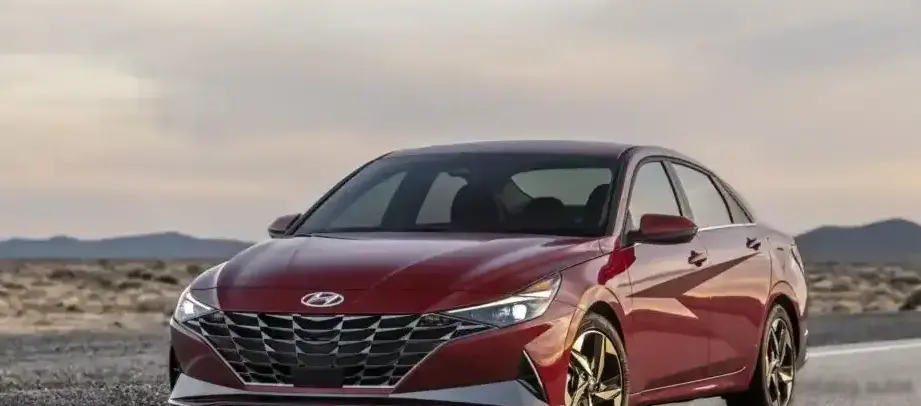
The Hyundai Elantra VII (CN7), produced from 2020 to 2023, represents the seventh generation of Hyundai’s popular compact sedan. Within this generation, the 2.0 MPI (147 Hp) IVT variant occupied a significant position as a mainstream offering, bridging the gap between the base engine and more performance-oriented trims. Built on the CN7 platform, this Elantra aimed to deliver a balance of fuel efficiency, comfort, and modern features to the North American and global markets. It was a key model in Hyundai’s strategy to gain market share in the highly competitive compact car segment.
Technical Specifications
| Brand | Hyundai |
| Model | Elantra |
| Generation | Elantra VII (CN7) |
| Type (Engine) | 2.0 MPI (147 Hp) IVT |
| Start of production | 2020 |
| End of production | 2023 |
| Powertrain Architecture | Internal Combustion engine |
| Body type | Sedan |
| Seats | 5 |
| Doors | 4 |
| Fuel consumption (urban) | 7.1-7.6 l/100 km (33.1 – 30.9 US mpg) |
| Fuel consumption (extra urban) | 5.5-5.7 l/100 km (42.8 – 41.3 US mpg) |
| Fuel consumption (combined) | 6.4-6.7 l/100 km (36.8 – 35.1 US mpg) |
| Fuel Type | Petrol (Gasoline) |
| Emission standard | ULEV70 SULEV30 |
| Weight-to-power ratio | 8.4 kg/Hp, 118.9 Hp/tonne |
| Weight-to-torque ratio | 6.9 kg/Nm, 144.8 Nm/tonne |
| Power | 147 Hp @ 6200 rpm |
| Power per litre | 73.5 Hp/l |
| Torque | 179 Nm @ 4500 rpm (132.02 lb.-ft. @ 4500 rpm) |
| Engine layout | Front, Transverse |
| Engine Model/Code | Smartstream / G4NS |
| Engine displacement | 1999 cm3 (121.99 cu. in.) |
| Number of cylinders | 4 |
| Engine configuration | Inline |
| Cylinder Bore | 81 mm (3.19 in.) |
| Piston Stroke | 97 mm (3.82 in.) |
| Compression ratio | 12.5:1 |
| Number of valves per cylinder | 4 |
| Fuel injection system | Multi-port manifold injection |
| Valvetrain | DOHC, D-CVVT |
| Engine oil capacity | 4.3 l (4.54 US qt | 3.78 UK qt) |
| Coolant capacity | 7.4 l (7.82 US qt | 6.51 UK qt) |
| Kerb Weight | 1236-1301 kg (2724.91 – 2868.21 lbs.) |
| Max. weight | 1750 kg (3858.09 lbs.) |
| Max load | 449-514 kg (989.88 – 1133.18 lbs.) |
| Trunk (boot) space | 402 l (14.2 cu. ft.) |
| Fuel tank capacity | 47 l (12.42 US gal | 10.34 UK gal) |
| Length | 4676 mm (184.09 in.) |
| Width | 1826 mm (71.89 in.) |
| Height | 1415 mm (55.71 in.) |
| Wheelbase | 2720 mm (107.09 in.) |
| Front track | 1580-1593 mm (62.2 – 62.72 in.) |
| Rear track | 1590-1603 mm (62.6 – 63.11 in.) |
| Front overhang | 894 mm (35.2 in.) |
| Rear overhang | 1059 mm (41.69 in.) |
| Ride height (ground clearance) | 135 mm (5.31 in.) |
| Drag coefficient (Cd) | 0.28 |
| Drivetrain Architecture | Front wheel drive |
| Number of gears and type of gearbox | automatic transmission IVT |
| Front suspension | Independent, type McPherson with coil spring and anti-roll bar |
| Rear suspension | Torsion |
| Front brakes | Ventilated discs, 279.4 mm |
| Rear brakes | Disc, 254 mm |
| Assisting systems | ABS (Anti-lock braking system) |
| Steering type | Steering rack and pinion |
| Power steering | Electric Steering |
| Tires size | 205/55 R16 91H; 205/50 R17 89V; 225/45 R17 91W |
| Wheel rims size | 6J x 16; 6.5J x 17; 7J x 17 |
Powertrain & Engine Architecture
The heart of this Elantra variant is the Hyundai Smartstream G4NS 2.0-liter inline-four cylinder engine. This engine utilizes multi-point fuel injection and a double overhead camshaft (DOHC) valvetrain with Hyundai’s Dual Continuous Variable Valve Timing (D-CVVT) technology. D-CVVT optimizes valve timing based on driving conditions, improving both fuel efficiency and power output. The engine produces 147 horsepower at 6,200 rpm and 179 Nm (132 lb-ft) of torque at 4,500 rpm. The engine’s relatively high 12.5:1 compression ratio contributes to its efficiency. Paired with the engine is Hyundai’s Intelligent Variable Transmission (IVT), which is a type of continuously variable transmission (CVT). The IVT is designed to simulate traditional automatic gear changes while offering smoother acceleration and improved fuel economy compared to a conventional automatic.
Driving Characteristics
The 2.0 MPI IVT Elantra delivers a comfortable and predictable driving experience. While not particularly sporty, the powertrain provides adequate acceleration for everyday driving situations. The IVT effectively keeps the engine in its optimal power band, resulting in smooth and linear acceleration. Compared to the base 2.0L engine with a manual transmission, the IVT offers a more relaxed driving experience, particularly in city traffic. However, the IVT lacks the responsiveness and engagement of a traditional automatic or manual gearbox. The gear ratios are tuned for fuel efficiency, meaning that quick overtaking maneuvers require a bit more planning. The weight of the vehicle, ranging from 1236 to 1301 kg (2724.91 to 2868.21 lbs), is reasonably well-managed by the 147 hp output, providing a decent power-to-weight ratio.
Equipment & Trim Levels
The 2.0 MPI IVT trim typically served as a mid-range offering in the Elantra VII lineup. Standard features generally included air conditioning, power windows and locks, a touchscreen infotainment system with Apple CarPlay and Android Auto compatibility, a rearview camera, and a suite of safety features such as automatic emergency braking, lane keeping assist, and driver attention warning. Interior upholstery was typically cloth, with options for upgraded materials available on higher trims. Optional extras included a sunroof, heated front seats, a premium audio system, and blind-spot monitoring. The dashboard layout was modern and user-friendly, with a focus on intuitive controls and a clean aesthetic.
Chassis & Braking
The Elantra VII utilizes a front-wheel-drive layout with an independent McPherson strut suspension in the front and a torsion beam suspension in the rear. This suspension setup provides a comfortable ride quality, absorbing bumps and imperfections in the road surface effectively. The front brakes are ventilated discs measuring 279.4 mm, while the rear brakes are solid discs measuring 254 mm. Anti-lock Braking System (ABS) is standard. The steering is electrically assisted, providing light and precise steering feel. Stabilizer bars are included both front and rear to reduce body roll during cornering.
Market Reception & Comparison
The 2.0 MPI IVT Elantra was generally well-received by critics and consumers alike. It was praised for its fuel efficiency, comfortable ride, and generous list of standard features. Compared to other trims in the Elantra lineup, such as the turbocharged 1.6L engine, the 2.0 MPI offered a more affordable price point and simpler mechanicals. However, it lacked the performance and excitement of the turbocharged engine. Fuel economy figures of 6.4-6.7 l/100 km (36.8 – 35.1 US mpg) were competitive within the compact sedan segment. Reliability reports generally indicated good long-term dependability, with the Smartstream engine proving to be a robust and durable unit.
Legacy
The Hyundai Elantra VII 2.0 MPI IVT has established itself as a reliable and affordable used car option. The Smartstream engine and IVT transmission have proven to be relatively trouble-free, requiring routine maintenance rather than major repairs. The availability of parts and service is excellent, thanks to Hyundai’s growing dealer network. As a result, this Elantra variant continues to hold its value well in the used car market, appealing to buyers seeking a practical and economical compact sedan.