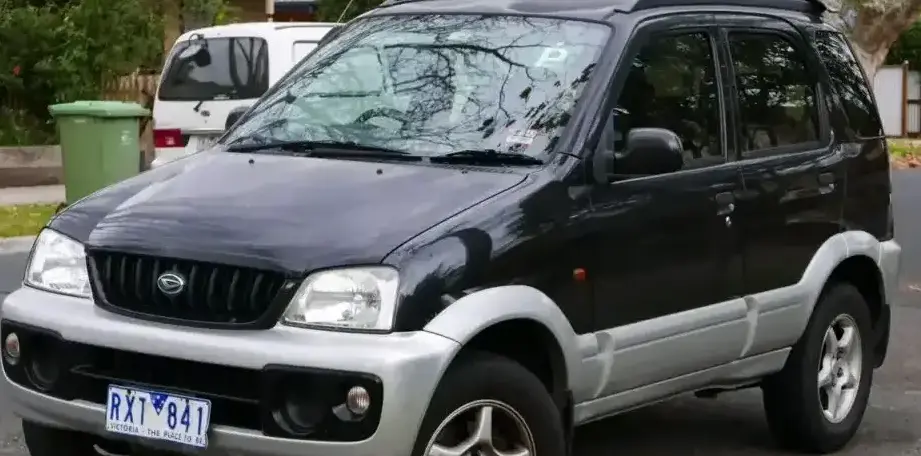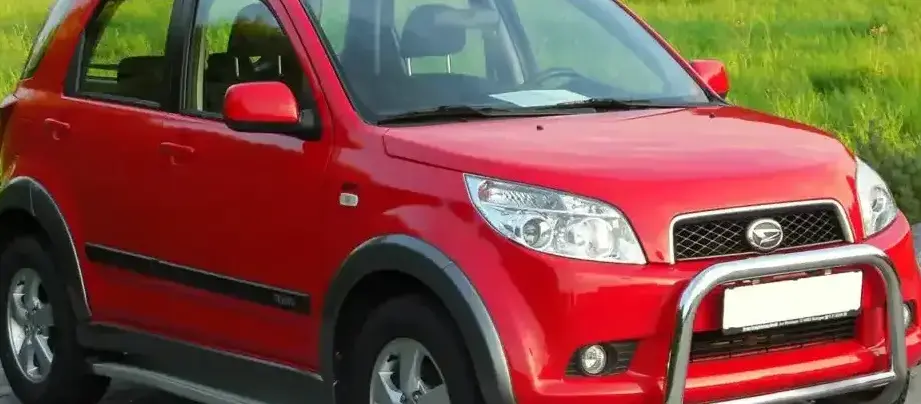
The Daihatsu Terios III (F800) 1.5, produced from 2018 to 2023, represents the third generation of Daihatsu’s popular compact SUV. This variant, powered by the 2NR-VE 1.5-liter engine producing 104 horsepower, was primarily aimed at the Indonesian and broader Southeast Asian markets, where affordable, practical, and spacious seven-seater vehicles are in high demand. The F800 series marked a significant shift for the Terios, moving to a rear-wheel-drive layout and adopting a more robust, body-on-frame construction, differentiating it from its predecessors and competitors.
Technical Specifications
| Brand | Daihatsu |
| Model | Terios |
| Generation | Terios III (F800) |
| Type (Engine) | 1.5 (104 Hp) |
| Start of production | 2018 year |
| End of production | 2023 year |
| Powertrain Architecture | Internal Combustion engine |
| Body type | SUV |
| Seats | 7 |
| Doors | 5 |
| Fuel Type | Petrol (Gasoline) |
| Weight-to-power ratio | 12 kg/Hp, 83.5 Hp/tonne |
| Weight-to-torque ratio | 9.2 kg/Nm, 109.2 Nm/tonne |
| Power | 104 Hp @ 6000 rpm |
| Power per litre | 69.5 Hp/l |
| Torque | 136 Nm @ 4200 rpm, 100.31 lb.-ft. @ 4200 rpm |
| Engine layout | Front, Longitudinal |
| Engine Model/Code | 2NR-VE |
| Engine displacement | 1496 cm3, 91.29 cu. in. |
| Number of cylinders | 4 |
| Engine configuration | Inline |
| Cylinder Bore | 72.5 mm, 2.85 in. |
| Piston Stroke | 90.6 mm, 3.57 in. |
| Number of valves per cylinder | 4 |
| Fuel injection system | Multi-port manifold injection |
| Engine aspiration | Naturally aspirated engine |
| Valvetrain | DOHC, D-VVT-i |
| Engine oil capacity | 3.5 l, 3.7 US qt | 3.08 UK qt |
| Coolant | 6 l, 6.34 US qt | 5.28 UK qt |
| Kerb Weight | 1245-1260 kg, 2744.76 – 2777.82 lbs. |
| Max. weight | 1870 kg, 4122.64 lbs. |
| Max load | 610-625 kg, 1344.82 – 1377.89 lbs. |
| Fuel tank capacity | 45 l, 11.89 US gal | 9.9 UK gal |
| Length | 4435 mm, 174.61 in. |
| Width | 1695 mm, 66.73 in. |
| Height | 1705 mm, 67.13 in. |
| Wheelbase | 2685 mm, 105.71 in. |
| Front track | 1445 mm, 56.89 in. |
| Rear (Back) track | 1460 mm, 57.48 in. |
| Ride height (ground clearance) | 220 mm, 8.66 in. |
| Drivetrain Architecture | The Internal combustion engine (ICE) drives the rear wheels of the vehicle. |
| Drive wheel | Rear wheel drive |
| Number of gears and type of gearbox | 5 gears, manual transmission |
| Front suspension | Independent, type McPherson with coil spring and anti-roll bar |
| Rear suspension | Independent multi-link spring suspension with stabilizer |
| Front brakes | Ventilated discs |
| Rear brakes | Drum |
| Assisting systems | ABS (Anti-lock braking system) |
| Steering type | Steering rack and pinion |
| Power steering | Electric Steering |
| Tires size | 215/65 R16; 215/60 R17 |
| Wheel rims size | 16; 17 |
INTRODUCTION
The Daihatsu Terios III (F800) 1.5 represents a significant departure from earlier Terios models. Introduced in 2018, it was designed to cater to the growing demand for affordable, seven-seater SUVs in Southeast Asia, particularly Indonesia. Built on a body-on-frame chassis, the F800 prioritized durability and practicality over outright performance. The 1.5-liter variant, producing 104 horsepower, served as the entry point to the Terios lineup, offering a balance between fuel efficiency and usability for families. It competed directly with models like the Toyota Rush, which shares many of its underpinnings, and other budget-friendly SUVs in the region.
Powertrain & Engine Architecture
At the heart of the Terios III 1.5 lies the 2NR-VE 1.5-liter inline-four cylinder engine. This engine is part of Daihatsu’s NR engine family, known for its reliability and fuel efficiency. The 2NR-VE utilizes a dual overhead camshaft (DOHC) configuration with Daihatsu’s Variable Valve Timing-intelligent (D-VVT-i) system, optimizing valve timing for improved performance and fuel economy across a wider range of engine speeds. Fuel delivery is managed by a multi-port fuel injection system. The engine’s longitudinal mounting allows for a rear-wheel-drive configuration, a key characteristic of the F800. This 1.5L engine is paired with a 5-speed manual transmission in this specific variant. The transmission is chosen for its simplicity and cost-effectiveness, contributing to the vehicle’s overall affordability.
Driving Characteristics
The Terios III 1.5, with its 104 horsepower and 136 Nm of torque, isn’t designed for sporty driving. Acceleration is modest, and the rear-wheel-drive setup, while providing decent traction, doesn’t offer the dynamic handling of more modern, car-based SUVs. The 5-speed manual transmission requires frequent shifting, especially when fully loaded or tackling inclines. However, the engine delivers adequate power for everyday driving conditions, and the rear-wheel-drive layout provides a stable feel, particularly when carrying passengers or cargo. Compared to higher-spec Terios models with more powerful engines, the 1.5L feels noticeably less responsive, but it compensates with improved fuel economy. The gear ratios are tuned for practicality, prioritizing fuel efficiency over rapid acceleration.
Equipment & Trim Levels
The Terios III 1.5 typically came with a relatively basic level of equipment, reflecting its position as the entry-level trim. Standard features generally included air conditioning, power windows, and a basic audio system. Interior upholstery was typically cloth, and the dashboard featured a functional, if somewhat spartan, design. Safety features included ABS (Anti-lock Braking System) and dual airbags. Optional extras, depending on the market, could include alloy wheels, a touchscreen infotainment system, and rear parking sensors. The focus was on providing essential features at an affordable price point.
Chassis & Braking
The Terios III’s body-on-frame construction contributes to its robust feel and durability. The front suspension utilizes an independent McPherson strut setup with coil springs and an anti-roll bar, while the rear employs an independent multi-link suspension with a stabilizer bar. This suspension configuration provides a reasonably comfortable ride, although it can feel somewhat bouncy when unladen. Braking duties are handled by ventilated discs at the front and drum brakes at the rear. The rear drum brakes were a cost-saving measure, common in this segment. The steering is rack and pinion, with electric power assistance, providing adequate feedback and maneuverability.
Market Reception & Comparison
The Terios III 1.5 was well-received in its target markets, particularly Indonesia, where it quickly became a popular choice for families seeking an affordable and spacious SUV. Critics praised its practicality, durability, and value for money. However, some reviewers noted its lack of refinement and modest performance compared to more expensive competitors. Compared to the higher-spec Terios variants, the 1.5L offered significantly better fuel economy, making it an attractive option for budget-conscious buyers. Its reliability was also a key selling point, as Daihatsu has a strong reputation for building dependable vehicles.
Legacy
The Daihatsu Terios III 1.5 has established itself as a reliable and affordable option in the used car market. The 2NR-VE engine is known for its longevity, and the simple mechanical design makes it relatively easy and inexpensive to maintain. While it may not offer the latest technology or the most exciting driving experience, its practicality and durability continue to appeal to buyers seeking a dependable family vehicle. The F800 generation, and specifically the 1.5L variant, represents a significant chapter in Daihatsu’s history, demonstrating their ability to produce affordable and functional vehicles for emerging markets.