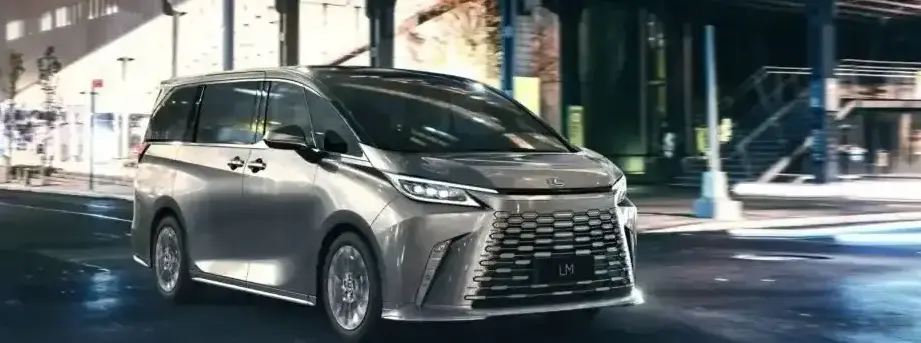
The Lexus LM II 500h, launched in 2023, represents Lexus’s entry into the luxury minivan segment, initially targeted towards the Asian market with limited availability elsewhere. This variant, specifically the 371 horsepower hybrid model with DIRECT4 all-wheel drive and a six-speed Direct Shift automatic transmission, is positioned as the flagship offering within the LM II lineup. It aims to provide a first-class travel experience, blending Lexus’s renowned refinement with the practicality of a multi-purpose vehicle. The LM II is built upon a stretched version of the Toyota Alphard/Vellfire platform, signifying a departure from Lexus’s traditional sedan and SUV focus.
Technical Specifications
| Brand | Lexus |
| Model | LM |
| Generation | LM II |
| Type (Engine) | 500h (371 Hp) Hybrid DIRECT4 Direct Shift 4 Seat |
| Start of production | 2023 |
| Powertrain Architecture | FHEV (Full Hybrid Electric Vehicle) |
| Body type | Minivan, MPV |
| Seats | 4 |
| Doors | 5 |
| Fuel consumption (economy) – urban (WLTC) | 8.6 l/100 km (27.4 US mpg, 32.8 UK mpg, 11.6 km/l) |
| Fuel consumption (economy) – extra urban (WLTC) | 6.8 l/100 km (34.6 US mpg, 41.5 UK mpg, 14.7 km/l) |
| Fuel consumption (economy) – combined (WLTC) | 7.4 l/100 km (31.8 US mpg, 38.2 UK mpg, 13.5 km/l) |
| Fuel Type | Petrol (Gasoline) |
| Acceleration 0 – 100 km/h | 6.9 sec |
| Acceleration 0 – 62 mph | 6.9 sec |
| Acceleration 0 – 60 mph | 6.6 sec |
| Maximum speed | 185 km/h (114.95 mph) |
| Weight-to-power ratio | 6.6 kg/Hp, 150.8 Hp/tonne |
| Weight-to-torque ratio | 5.3 kg/Nm, 187 Nm/tonne |
| Battery voltage | 288 V |
| Battery technology | Nickel-metal hydride (NiMH) |
| Battery location | Under the front seats |
| Electric motor power (1) | 87 Hp |
| Electric motor Torque (1) | 292 Nm (215.37 lb.-ft.) |
| Electric motor model/code (1) | 1ZM |
| Electric motor location (1) | Between the combustion engine and the transmission |
| Electric motor type (1) | Synchronous |
| Electric motor power (2) | 103 Hp |
| Electric motor Torque (2) | 169 Nm (124.65 lb.-ft.) |
| Electric motor model/code (2) | 1YM |
| Electric motor location (2) | Rear axle, Transverse |
| Electric motor type (2) | Synchronous |
| System power | 371 Hp |
| Power | 275 Hp @ 6000 rpm |
| Torque | 460 Nm @ 2000-3000 rpm (339.28 lb.-ft. @ 2000-3000 rpm) |
| Engine layout | Front, Transverse |
| Engine Model/Code | T24A-FTS |
| Engine displacement | 2393 cm3 (146.03 cu. in.) |
| Number of cylinders | 4 |
| Engine configuration | Inline |
| Cylinder Bore | 87.5 mm (3.44 in.) |
| Piston Stroke | 99.5 mm (3.92 in.) |
| Compression ratio | 11:1 |
| Number of valves per cylinder | 4 |
| Fuel injection system | Direct injection and Multi-port manifold injection |
| Engine aspiration | Twin-scroll turbo, Intercooler |
| Valvetrain | Dual VVT-i |
| Engine oil capacity | 5.3 l (5.6 US qt | 4.66 UK qt) |
| Coolant capacity | 11.2 l (11.83 US qt | 9.85 UK qt) |
| Kerb Weight | 2460 kg (5423.37 lbs.) |
| Trunk (boot) space – maximum | 752 l (26.56 cu. ft.) |
| Fuel tank capacity | 60 l (15.85 US gal | 13.2 UK gal) |
| Length | 5125 mm (201.77 in.) |
| Width | 1890 mm (74.41 in.) |
| Height | 1955 mm (76.97 in.) |
| Wheelbase | 3000 mm (118.11 in.) |
| Front track | 1615 mm (63.58 in.) |
| Rear (Back) track | 1620 mm (63.78 in.) |
| Front overhang | 1015 mm (39.96 in.) |
| Rear overhang | 1110 mm (43.7 in.) |
| Ride height (ground clearance) | 130-140 mm (5.12 – 5.51 in.) |
| Drag coefficient (Cd) | 0.33 |
| Minimum turning circle (turning diameter) | 11.8 m (38.71 ft.) |
| Approach angle | 14° |
| Drivetrain Architecture | ICE drives front wheels, electric motors drive front and rear wheels. Full Hybrid Electric Vehicle (FHEV). |
| Drive wheel | All wheel drive (4×4) |
| Number of gears and type of gearbox | 6 gears, automatic transmission Direct Shift |
| Front suspension | Independent, type McPherson with coil spring and anti-roll bar |
| Rear suspension | Double wishbone, Independent coil spring, Transverse stabilizer |
| Front brakes | Ventilated discs, 328 mm |
| Rear brakes | Ventilated discs, 317 mm |
| Assisting systems | ABS (Anti-lock braking system) |
| Steering type | Steering rack and pinion |
| Power steering | Electric Steering |
| Tires size | 225/65 R17; 225/55 R19 |
| Wheel rims size | 6.5J x 17; 7J x 19 |
Powertrain & Engine Architecture
The Lexus LM II 500h utilizes a sophisticated full hybrid electric vehicle (FHEV) powertrain. At its heart lies the T24A-FTS 2.4-liter turbocharged inline-four cylinder gasoline engine. This engine produces 275 horsepower and 460 Nm (339.28 lb-ft) of torque. It features direct injection and multi-port fuel injection, along with a twin-scroll turbocharger and intercooler for enhanced performance. The engine is paired with two electric motors – a 87 hp motor integrated between the engine and the transmission, and a 103 hp motor driving the rear axle. This configuration enables DIRECT4 all-wheel drive, allowing for variable torque distribution between the front and rear wheels for optimal traction and stability. The combined system output is 371 horsepower. The transmission is a six-speed Direct Shift automatic, chosen for its smooth operation and responsiveness. The battery pack, utilizing Nickel-metal hydride (NiMH) technology, is located under the front seats, minimizing intrusion into the passenger compartment.
Driving Characteristics
The 500h variant delivers a refined and comfortable driving experience. The electric motors provide instant torque, resulting in brisk acceleration – 0 to 60 mph in approximately 6.6 seconds. The DIRECT4 system intelligently manages power delivery, providing confident handling in various conditions. While not overtly sporty, the LM II 500h offers ample power for highway merging and overtaking. The automatic transmission shifts smoothly and efficiently, contributing to a relaxed driving experience. Compared to potential lower-powered variants (not currently offered in most markets), the 500h provides a noticeable performance advantage, making it well-suited for long journeys and carrying a full passenger load. The hybrid system also allows for short periods of electric-only driving, further enhancing fuel efficiency.
Equipment & Trim Levels
The LM II 500h is generously equipped, reflecting its luxury positioning. Standard features include premium leather upholstery, power-adjustable and heated front and second-row seats, a large touchscreen infotainment system with navigation, a premium sound system, and a comprehensive suite of safety features including Lexus Safety System+. The four-seat configuration emphasizes rear passenger comfort, with individual seats offering ample legroom and recline. Optional extras include a rear-seat entertainment system, a refrigerator, and bespoke interior trim options. The interior design prioritizes a sense of calm and spaciousness, with high-quality materials and meticulous attention to detail.
Chassis & Braking
The LM II utilizes an independent suspension system, with McPherson struts at the front and a double wishbone setup at the rear. This configuration provides a comfortable ride, effectively absorbing bumps and irregularities in the road surface. Ventilated disc brakes are fitted on all four wheels, ensuring strong and consistent stopping power. The electronic braking system incorporates ABS (Anti-lock Braking System) and other advanced safety features. The chassis is reinforced to accommodate the added weight of the hybrid powertrain and battery pack, maintaining a stable and controlled driving experience.
Market Reception & Comparison
The Lexus LM II 500h has been well-received in markets where it’s available, particularly in Asia, where luxury minivans are highly sought after. Critics have praised its refined interior, comfortable ride, and advanced technology. Fuel economy is competitive for its class, with combined WLTC figures of 7.4 l/100 km (31.8 US mpg). Compared to other luxury minivans, the LM II stands out with its Lexus-specific design language and emphasis on craftsmanship. While pricing is premium, it aligns with its positioning as a flagship luxury vehicle.
Legacy
It is still early to assess the long-term reliability of the LM II 500h powertrain. However, Lexus has a strong reputation for reliability, and the hybrid technology has been proven in other Lexus and Toyota models. The use of a well-established gasoline engine and robust electric motors suggests a durable and dependable powertrain. As the LM II enters the used car market, its value will likely be influenced by its condition, mileage, and the demand for luxury minivans. The DIRECT4 system and advanced hybrid technology may make it a desirable option for buyers seeking a sophisticated and efficient people mover.