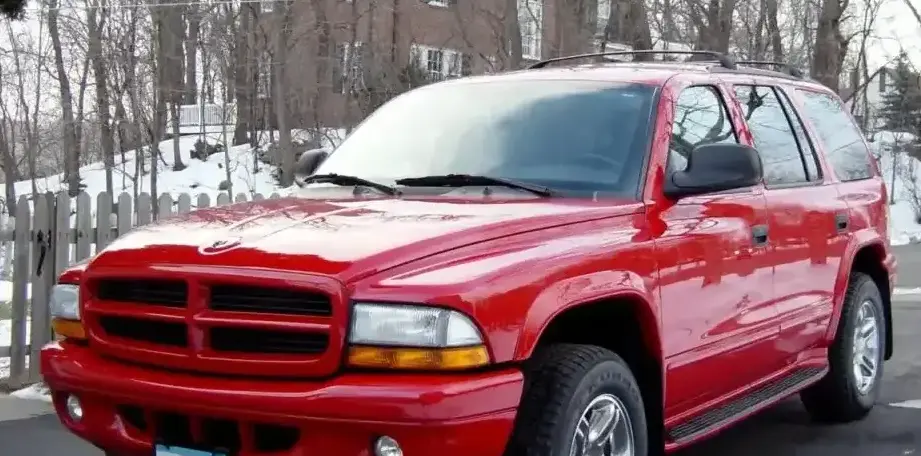
The Dodge Durango II (HB) 5.7i V8 AWD, produced from 2004 to 2006, represented the second generation of Dodge’s full-size SUV. Built on the Chrysler/Dodge Dakota platform, the HB Durango aimed to offer a blend of truck-based durability with more refined on-road manners. This particular variant, equipped with the 5.7-liter V8 engine and an automatic transmission, occupied the upper echelon of the Durango lineup, positioned as a performance-oriented option for buyers needing substantial towing capacity and all-weather capability. It served as a direct competitor to vehicles like the Chevrolet TrailBlazer, Ford Explorer, and Jeep Grand Cherokee.
Technical Specifications
| Brand | Dodge |
| Model | Durango |
| Generation | Durango II (HB) |
| Type (Engine) | 5.7 i V8 AWD (350 Hp) |
| Start of production | 2004 |
| End of production | 2006 |
| Powertrain Architecture | Internal Combustion engine |
| Body type | SUV |
| Seats | 5 |
| Doors | 5 |
| Fuel consumption (urban) | 18 l/100 km (13.1 US mpg) |
| Fuel consumption (extra urban) | 13 l/100 km (18.1 US mpg) |
| Fuel Type | Petrol (Gasoline) |
| Maximum speed | 180 km/h (111.85 mph) |
| Weight-to-power ratio | 6.6 kg/Hp |
| Weight-to-torque ratio | 4.6 kg/Nm |
| Power | 350 Hp @ 5400 rpm |
| Power per litre | 61.9 Hp/l |
| Torque | 502 Nm @ 4200 rpm (370.26 lb.-ft. @ 4200 rpm) |
| Engine layout | Front, Longitudinal |
| Engine Model/Code | EZA |
| Engine displacement | 5654 cm3 (345.03 cu. in.) |
| Number of cylinders | 8 |
| Engine configuration | V-engine |
| Cylinder Bore | 99.5 mm (3.92 in.) |
| Piston Stroke | 90.9 mm (3.58 in.) |
| Compression ratio | 9.6:1 |
| Number of valves per cylinder | 2 |
| Fuel injection system | Multi-port manifold injection |
| Engine aspiration | Naturally aspirated engine |
| Engine oil capacity | 6.6 l (6.97 US qt | 5.81 UK qt) |
| Coolant capacity | 15.8 l (16.7 US qt | 13.9 UK qt) |
| Kerb Weight | 2305 kg (5081.66 lbs.) |
| Trunk (boot) space – minimum | 532 l (18.79 cu. ft.) |
| Trunk (boot) space – maximum | 2492 l (88 cu. ft.) |
| Fuel tank capacity | 95 l (25.1 US gal | 20.9 UK gal) |
| Length | 4915 mm (193.5 in.) |
| Width | 1811 mm (71.3 in.) |
| Height | 1791 mm (70.51 in.) |
| Wheelbase | 2946 mm (115.98 in.) |
| Front track | 1546 mm (60.87 in.) |
| Rear track | 1572 mm (61.89 in.) |
| Drive wheel | All wheel drive (4×4) |
| Number of gears | 5 |
| Gearbox type | Automatic transmission |
| Front suspension | Spring Strut |
| Rear suspension | Torsion |
| Front brakes | Ventilated discs |
| Rear brakes | Disc |
| Assisting systems | ABS (Anti-lock braking system) |
| Steering type | Steering rack and pinion |
| Tires size | 255/65 R16 |
Powertrain & Engine Architecture
The heart of the Durango 5.7i AWD was the EZA engine, a 5.7-liter (345 cubic inch) V8. This engine was a member of Chrysler’s third-generation small-block V8 family, known for its robust construction and relatively simple design. It featured a cast iron block with aluminum cylinder heads, a two-valve per cylinder configuration, and a multi-port fuel injection system. The engine produced 350 horsepower at 5400 rpm and 502 Nm (370 lb-ft) of torque at 4200 rpm. The automatic transmission paired with this engine was a 5-speed unit, providing smooth shifts and adequate gear ratios for both highway cruising and towing. This transmission was designed to handle the substantial torque output of the 5.7L V8.
Driving Characteristics
The 5.7L V8 and automatic transmission combination delivered brisk acceleration for a full-size SUV. While not as quick as some of the lighter, sportier SUVs on the market, the Durango offered ample power for merging onto highways, passing other vehicles, and towing trailers. The automatic transmission, while smooth, wasn’t particularly sporty, prioritizing comfort and ease of use over aggressive shifting. The all-wheel-drive system provided enhanced traction in inclement weather and on slippery surfaces, making it a capable vehicle year-round. The weight of the Durango was noticeable, particularly in cornering, but the suspension did a reasonable job of controlling body roll.
Equipment & Trim Levels
The Durango 5.7i AWD typically came standard with features like air conditioning, power windows and locks, a CD player, and cloth upholstery. Higher trim levels, such as the SLT, added features like leather upholstery, heated seats, a premium sound system, and alloy wheels. Optional extras included a sunroof, a navigation system, and a rear entertainment system. The interior design was functional and straightforward, prioritizing practicality over luxury.
Chassis & Braking
The Durango II (HB) utilized a body-on-frame construction, providing a robust and durable chassis. The front suspension consisted of an independent spring strut setup, while the rear suspension employed a torsion bar arrangement. This suspension configuration offered a comfortable ride, but wasn’t particularly sophisticated in terms of handling. The braking system featured ventilated discs at the front and solid discs at the rear. Anti-lock brakes (ABS) were standard, enhancing safety and control during emergency braking situations.
Market Reception & Comparison
Critics generally praised the Durango 5.7i AWD for its powerful engine, spacious interior, and towing capacity. However, some reviewers noted its relatively poor fuel economy and somewhat dated interior design. Compared to the 3.7L V6 and 4.7L V8 versions of the Durango, the 5.7L offered significantly more power and torque, making it the preferred choice for buyers who needed to tow heavy loads or wanted more responsive acceleration. The 5.7L also commanded a higher price tag and consumed more fuel than the smaller engine options.
Legacy
The Dodge Durango II (HB) 5.7i V8 AWD, while not a groundbreaking vehicle, remains a popular choice among enthusiasts and those seeking a capable and affordable full-size SUV. The 5.7L V8 engine is known for its reliability, although regular maintenance is crucial. Parts availability is generally good, and the Durango’s relatively simple design makes it relatively easy to repair. Today, well-maintained examples of the 5.7L Durango can be found on the used car market, offering a compelling combination of power, space, and affordability.