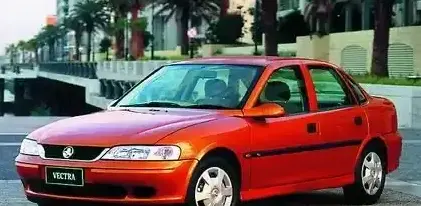
The Holden Vectra (B) 2.0i 16V, produced between 1999 and 2000, represented a significant offering in the Australian mid-size car market. Part of the globally developed Opel/Vauxhall Vectra B (XH) series, the Holden version was adapted for Australian tastes and road conditions. This particular variant, powered by a 2.0-liter 16-valve engine producing 136 horsepower, occupied a middle ground in the Vectra lineup, offering a balance between performance and affordability. It was positioned above the base models and below the more powerful V6 options, targeting buyers seeking a comfortable and reasonably efficient family sedan.
Technical Specifications
| Brand | Holden |
| Model | Vectra |
| Generation | Vectra (B) |
| Type (Engine) | 2.0i 16V (136 Hp) |
| Start of production | 1999 |
| End of production | 2000 |
| Powertrain Architecture | Internal Combustion engine |
| Body type | Sedan |
| Seats | 5 |
| Doors | 4 |
| Fuel consumption (combined) | 10 l/100 km |
| Fuel consumption (US mpg) | 23.5 |
| Fuel consumption (UK mpg) | 28.2 |
| Fuel Type | Petrol (Gasoline) |
| Acceleration 0 – 100 km/h | 7.6 sec |
| Acceleration 0 – 62 mph | 7.6 sec |
| Acceleration 0 – 60 mph | 7.2 sec |
| Maximum speed | 215 km/h (133.59 mph) |
| Weight-to-power ratio | 9.4 kg/Hp |
| Weight-to-torque ratio | 6.8 kg/Nm |
| Power | 136 Hp @ 5600 rpm |
| Power per litre | 68.1 Hp/l |
| Torque | 188 Nm @ 3200 rpm (138.66 lb.-ft. @ 3200 rpm) |
| Engine layout | Front, Transverse |
| Engine displacement | 1998 cm3 (121.93 cu. in.) |
| Number of cylinders | 4 |
| Engine configuration | Inline |
| Number of valves per cylinder | 4 |
| Fuel injection system | Multi-port manifold injection |
| Engine aspiration | Naturally aspirated |
| Valvetrain | DOHC |
| Kerb Weight | 1285 kg (2832.94 lbs) |
| Trunk (boot) space – minimum | 500 l (17.66 cu. ft.) |
| Fuel tank capacity | 60 l (15.85 US gal | 13.2 UK gal) |
| Length | 4477 mm (176.26 in) |
| Width | 1707 mm (67.2 in) |
| Height | 1428 mm (56.22 in) |
| Wheelbase | 2640 mm (103.94 in) |
| Front track | 1484 mm (58.43 in) |
| Rear track | 1470 mm (57.87 in) |
| Drivetrain Architecture | Front wheel drive |
| Drive wheel | Front wheel drive |
| Number of gears | 5 gears, manual transmission |
| Front suspension | Coil spring |
| Rear suspension | Coil spring |
| Front brakes | Ventilated discs |
| Rear brakes | Disc |
| Assisting systems | ABS (Anti-lock braking system) |
| Steering type | Steering rack and pinion |
| Power steering | Hydraulic Steering |
| Tires size | 195/65 R15 V |
Powertrain & Engine Architecture
The heart of the Vectra 2.0i 16V was the X20XEL engine, a member of Opel’s Ecotec family. This 1998cc, inline-four cylinder engine featured a dual overhead camshaft (DOHC) valvetrain with four valves per cylinder, contributing to its relatively high output for its displacement. The engine utilized multi-port fuel injection, delivering fuel directly into the intake ports for improved combustion efficiency. The X20XEL was known for its robust construction and relatively simple design, making it easier to maintain compared to some of its more technologically advanced contemporaries. The five-speed manual transmission was the standard offering, providing drivers with direct control over the engine’s power. The transmission was chosen for its durability and relatively smooth shifting characteristics.
Driving Characteristics
The 136 horsepower and 188 Nm (138.66 lb-ft) of torque provided by the 2.0i 16V engine delivered adequate performance for everyday driving. Acceleration from 0 to 100 km/h (0-62 mph) took approximately 7.6 seconds, making it competitive with other mid-size sedans of the era. Compared to the higher-output V6 models, the 2.0i felt less eager to rev, with peak power arriving at 5600 rpm. However, the engine offered a broader torque curve, providing usable power throughout the rev range. The manual transmission allowed for precise gear selection, enhancing the driving experience. The gear ratios were well-matched to the engine’s characteristics, providing good acceleration in lower gears and comfortable cruising at highway speeds. While not a sports sedan, the 2.0i offered a balanced and enjoyable driving experience.
Equipment & Trim Levels
The Holden Vectra 2.0i 16V typically came equipped with a reasonable level of standard features. These included power windows and mirrors, central locking, air conditioning, and an AM/FM radio. Interior upholstery was typically cloth, with a relatively simple and functional dashboard layout. Optional extras included a sunroof, upgraded audio system, and alloy wheels. The trim level was generally considered mid-range, offering a step up in comfort and features compared to the base models, but lacking the luxury appointments of the V6 variants.
Chassis & Braking
The Vectra (B) utilized a MacPherson strut front suspension and a multi-link rear suspension, providing a comfortable ride and decent handling characteristics. The front brakes were ventilated discs, offering good stopping power, while the rear brakes were solid discs. Anti-lock Braking System (ABS) was standard, enhancing safety by preventing wheel lockup during hard braking. The suspension was tuned for comfort, prioritizing ride quality over outright sportiness. Stabilizer bars were fitted to both the front and rear axles to reduce body roll during cornering.
Market Reception & Comparison
The Holden Vectra 2.0i 16V was generally well-received by Australian motoring journalists. It was praised for its comfortable ride, spacious interior, and reasonable performance. However, some critics noted that the engine lacked the refinement and power of the V6 options. In terms of fuel economy, the 2.0i offered a noticeable improvement over the V6 models, achieving around 10 liters per 100 kilometers (23.5 US mpg). Compared to competitors like the Ford Falcon and Holden Commodore, the Vectra offered a more European driving experience, with a focus on comfort and handling rather than outright power. The Toyota Camry was a key competitor, offering a reputation for reliability and value.
Legacy
The Holden Vectra 2.0i 16V, while not the most iconic model in Holden’s history, remains a reasonably popular choice in the used car market. The X20XEL engine is known for its durability and relatively low maintenance costs, provided it is properly serviced. Common issues include oil leaks and occasional sensor failures, but these are generally straightforward to address. Today, these vehicles are often sought after by enthusiasts looking for a comfortable and affordable European-inspired sedan. The Vectra B, in general, represents a transitional period for Holden, showcasing the influence of its European parent company, General Motors, and offering a different alternative to the traditional Australian-made large sedans.