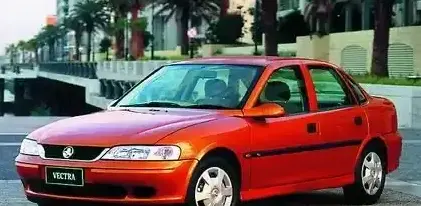
The Holden Vectra (B) 2.2 i 16V, produced between 2000 and 2002, represented a significant offering in the Australian mid-size car market. Part of the globally developed Opel/Vauxhall Vectra B range (designated 38B), the Holden version was adapted for Australian conditions and preferences. This 2.2-liter variant occupied a middle ground in the Vectra lineup, positioned above the base 1.8-liter models and below the more performance-oriented V6 options. It aimed to provide a balance of fuel efficiency, respectable performance, and a comfortable driving experience for families and commuters.
Technical Specifications
| Brand | Holden |
| Model | Vectra |
| Generation | Vectra (B) |
| Type (Engine) | 2.2 i 16V (141 Hp) |
| Start of production | 2000 year |
| End of production | 2002 year |
| Powertrain Architecture | Internal Combustion engine |
| Body type | Sedan |
| Seats | 5 |
| Doors | 4 |
| Fuel consumption (economy) – combined | 8.7 l/100 km |
| Fuel consumption (economy) – combined | 27 US mpg |
| Fuel consumption (economy) – combined | 32.5 UK mpg |
| Fuel consumption (economy) – combined | 11.5 km/l |
| Fuel Type | Petrol (Gasoline) |
| Acceleration 0 – 100 km/h | 9.7 sec |
| Acceleration 0 – 62 mph | 9.7 sec |
| Acceleration 0 – 60 mph | 9.2 sec |
| Maximum speed | 200 km/h |
| Maximum speed | 124.27 mph |
| Weight-to-power ratio | 9.6 kg/Hp |
| Weight-to-power ratio | 103.8 Hp/tonne |
| Weight-to-torque ratio | 6.8 kg/Nm |
| Weight-to-torque ratio | 147.2 Nm/tonne |
| Power | 141 Hp @ 5200 rpm |
| Power per litre | 64.1 Hp/l |
| Torque | 200 Nm @ 4000 rpm |
| Torque | 147.51 lb.-ft. @ 4000 rpm |
| Engine layout | Front, Transverse |
| Engine displacement | 2198 cm3 |
| Engine displacement | 134.13 cu. in. |
| Number of cylinders | 4 |
| Engine configuration | Inline |
| Number of valves per cylinder | 4 |
| Fuel injection system | Multi-port manifold injection |
| Engine aspiration | Naturally aspirated engine |
| Valvetrain | DOHC |
| Kerb Weight | 1359 kg |
| Kerb Weight | 2996.08 lbs |
| Trunk (boot) space – minimum | 500 l |
| Trunk (boot) space – minimum | 17.66 cu. ft. |
| Fuel tank capacity | 60 l |
| Fuel tank capacity | 15.85 US gal |
| Fuel tank capacity | 13.2 UK gal |
| Length | 4477 mm |
| Length | 176.26 in. |
| Width | 1707 mm |
| Width | 67.2 in. |
| Height | 1425 mm |
| Height | 56.1 in. |
| Wheelbase | 2637 mm |
| Wheelbase | 103.82 in. |
| Front track | 1464 mm |
| Front track | 57.64 in. |
| Rear (Back) track | 1458 mm |
| Rear (Back) track | 57.4 in. |
| Drivetrain Architecture | The Internal combustion engine (ICE) drives the front wheels of the vehicle. |
| Drive wheel | Front wheel drive |
| Number of gears and type of gearbox | 4 gears, automatic transmission |
| Front suspension | Coil spring |
| Rear suspension | Coil spring |
| Front brakes | Ventilated discs |
| Rear brakes | Disc |
| Assisting systems | ABS (Anti-lock braking system) |
| Steering type | Steering rack and pinion |
| Power steering | Hydraulic Steering |
| Tires size | 195/65 R15 V |
Powertrain & Engine Architecture
The heart of the Vectra 2.2 i 16V is the X22XE engine, a 2.2-liter inline-four cylinder powerplant. This engine, part of the GM Ecotec family, featured a dual overhead camshaft (DOHC) design with four valves per cylinder, contributing to its relatively high specific output. Fuel delivery was managed by a multi-port fuel injection system, ensuring precise fuel metering for optimal combustion. The X22XE was known for its smooth operation and reasonable reliability. Paired with this engine was a four-speed automatic transmission, offering convenient shifting for everyday driving. This transmission, while not particularly advanced by modern standards, was durable and well-suited to the engine’s torque characteristics. The engine code is crucial for identifying specific parts and maintenance requirements.
Driving Characteristics
The 2.2-liter automatic Vectra offered a comfortable and predictable driving experience. With 141 horsepower and 200 Nm (147.5 lb-ft) of torque, acceleration was adequate for most situations, achieving 0-60 mph in around 9.2 seconds. However, it wasn’t a particularly sporty vehicle. The four-speed automatic transmission, while smooth, lacked the responsiveness of a manual gearbox or a more modern automatic with additional gears. Gear ratios were tuned for fuel efficiency and comfort rather than outright performance. Compared to the 1.8-liter models, the 2.2 i 16V provided noticeably more power, making overtaking and highway cruising less strained. However, it didn’t possess the punch of the V6 variants, which offered significantly quicker acceleration.
Equipment & Trim Levels
The Holden Vectra 2.2 i 16V typically came equipped with a reasonable level of standard features. These included air conditioning, power windows and mirrors, central locking, and an AM/FM radio with a CD player. Interior upholstery was generally cloth, with options for upgraded materials available. Higher trim levels might have included features like alloy wheels, a sunroof, and upgraded audio systems. Safety features such as ABS (Anti-lock Braking System) were standard, contributing to improved braking performance. The dashboard layout was functional and straightforward, prioritizing ease of use over stylistic flair.
Chassis & Braking
The Vectra B utilized a front-wheel-drive layout with independent coil spring suspension at all four corners. The front suspension featured MacPherson struts, while the rear employed a multi-link setup. This configuration provided a good balance of ride comfort and handling. Braking duties were handled by ventilated discs at the front and solid discs at the rear. The ABS system helped to prevent wheel lockup during hard braking, enhancing stability and control. Stabilizer bars were fitted to both the front and rear axles to reduce body roll during cornering.
Market Reception & Comparison
The Holden Vectra 2.2 i 16V was generally well-received by Australian motoring journalists. It was praised for its comfortable ride, spacious interior, and reasonable fuel economy (around 8.7 l/100km). However, some critics noted that the automatic transmission could feel sluggish at times, and the overall driving experience lacked the engagement of some of its rivals. Compared to the 1.8-liter Vectra, the 2.2 i 16V offered a worthwhile performance upgrade, justifying the higher price tag for drivers who frequently carried passengers or drove on highways. The V6 models, while more powerful, were significantly more expensive and consumed more fuel.
Legacy
The Holden Vectra B, including the 2.2 i 16V variant, has developed a reputation for reasonable reliability, although age and mileage are now significant factors. The X22XE engine is generally considered durable, but regular maintenance is crucial to prevent issues such as oil leaks and timing chain wear. The automatic transmission, if properly serviced, can also provide years of reliable operation. Today, well-maintained examples of the Vectra 2.2 i 16V are becoming increasingly sought after by enthusiasts and collectors, representing a relatively affordable entry point into classic Australian motoring. Parts availability can be a challenge, but a dedicated network of Holden enthusiasts and specialist parts suppliers exists to support these vehicles.