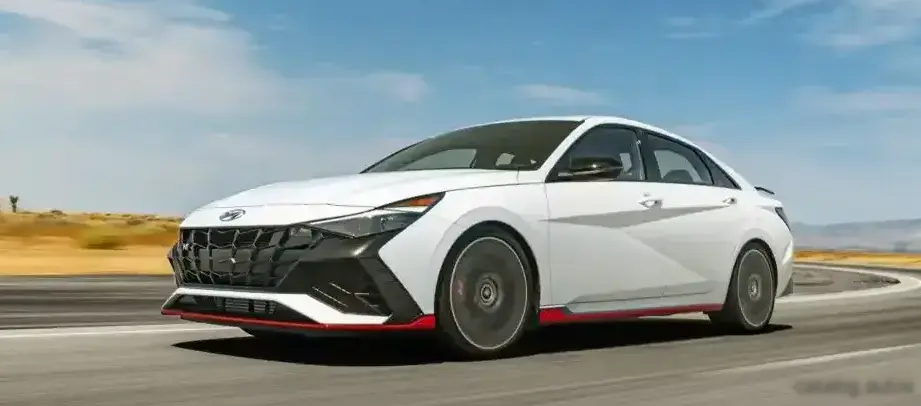
The Hyundai Elantra N 2.0 Turbo GDI (276 Hp) N DCT, produced from 2021 to 2023, represents the high-performance variant of the seventh-generation Elantra (CN7). Positioned as the flagship model within the CN7 lineup, the Elantra N was designed to compete directly with established hot sedans like the Volkswagen GTI and Honda Civic Si. It marked Hyundai’s significant push into the performance car segment, leveraging motorsport-derived technology and a potent turbocharged engine. This variant aimed to deliver a more engaging driving experience than the standard Elantra trims, appealing to enthusiasts seeking a blend of practicality and performance.
Technical Specifications
| Brand | Hyundai |
| Model | Elantra |
| Generation | Elantra VII (CN7) |
| Type (Engine) | N 2.0 Turbo GDI (276 Hp) N DCT |
| Start of production | 2021 |
| End of production | 2023 |
| Powertrain Architecture | Internal Combustion engine |
| Body type | Sedan |
| Seats | 5 |
| Doors | 4 |
| Fuel consumption (economy) – urban | 11.8 l/100 km (19.9 US mpg, 23.9 UK mpg, 8.5 km/l) |
| Fuel consumption (economy) – extra urban | 7.8 l/100 km (30.2 US mpg, 36.2 UK mpg, 12.8 km/l) |
| Fuel consumption (economy) – combined | 10.2 l/100 km (23.1 US mpg, 27.7 UK mpg, 9.8 km/l) |
| Fuel Type | Petrol (Gasoline) |
| Emission standard | WCC |
| Weight-to-power ratio | 5.4 kg/Hp, 184.6 Hp/tonne |
| Weight-to-torque ratio | 3.8 kg/Nm, 262.2 Nm/tonne |
| Power | 276 Hp @ 5500-6000 rpm |
| Power per litre | 138.1 Hp/l |
| Torque | 392 Nm @ 2100-4700 rpm (289.12 lb.-ft. @ 2100-4700 rpm) |
| Engine layout | Front, Transverse |
| Engine Model/Code | Theta II / G4KH |
| Engine displacement | 1998 cm3 (121.93 cu. in.) |
| Number of cylinders | 4 |
| Engine configuration | Inline |
| Cylinder Bore | 86 mm (3.39 in.) |
| Piston Stroke | 86 mm (3.39 in.) |
| Compression ratio | 9.5:1 |
| Number of valves per cylinder | 4 |
| Fuel injection system | Direct injection |
| Engine aspiration | Turbocharger, Intercooler |
| Valvetrain | MLA |
| Engine oil capacity | 5.2 l (5.49 US qt | 4.58 UK qt) |
| Coolant | 7.68 l (8.12 US qt | 6.76 UK qt) |
| Kerb Weight | 1495 kg (3295.91 lbs.) |
| Max. weight | 1895 kg (4177.76 lbs.) |
| Max load | 400 kg (881.85 lbs.) |
| Trunk (boot) space – minimum | 402 l (14.2 cu. ft.) |
| Fuel tank capacity | 47 l (12.42 US gal | 10.34 UK gal) |
| Length | 4676 mm (184.09 in.) |
| Width | 1826 mm (71.89 in.) |
| Height | 1415 mm (55.71 in.) |
| Wheelbase | 2720 mm (107.09 in.) |
| Front track | 1585 mm (62.4 in.) |
| Rear (Back) track | 1580 mm (62.2 in.) |
| Front overhang | 894 mm (35.2 in.) |
| Rear overhang | 1059 mm (41.69 in.) |
| Ride height (ground clearance) | 140 mm (5.51 in.) |
| Minimum turning circle (turning diameter) | 11.7 m (38.39 ft.) |
| Drivetrain Architecture | Front wheel drive |
| Drive wheel | Front wheel drive |
| Number of gears and type of gearbox | 8 gears, automatic transmission N DCT |
| Front suspension | Independent, type McPherson with coil spring and anti-roll bar |
| Rear suspension | Independent multi-link spring suspension with stabilizer |
| Front brakes | Ventilated discs, 360.68×30.48 mm |
| Rear brakes | Ventilated discs, 314.96×20.32 mm |
| Assisting systems | ABS (Anti-lock braking system) |
| Steering type | Steering rack and pinion |
| Power steering | Electric Steering |
| Tires size | 245/35 R19 |
| Wheel rims size | 8J x 19 |
Powertrain & Engine Architecture
At the heart of the Elantra N lies the Theta II 2.0-liter turbocharged inline-four engine, designated G4KH. This engine produces 276 horsepower at 5500-6000 rpm and 289 lb-ft of torque from 2100-4700 rpm. The engine utilizes direct fuel injection (GDI) and a twin-scroll turbocharger to maximize power and responsiveness. The MLA (Multi-Layered Actuation) valvetrain optimizes valve timing for improved efficiency and performance. The engine is transversely mounted, driving the front wheels. Paired with the engine is Hyundai’s N DCT (Dual Clutch Transmission), an 8-speed automatic designed for quick and precise shifts. This transmission features specific tuning for the Elantra N, including enhanced shift logic and paddle shifters for manual control.
Driving Characteristics
The Elantra N with the 8-speed N DCT delivers a noticeably different driving experience compared to lower-trim Elantras. The DCT provides rapid gear changes, contributing to brisk acceleration. While not as raw or visceral as a traditional manual transmission, the N DCT offers a good balance of performance and convenience. The gear ratios are tuned for acceleration, with shorter lower gears. The Elantra N exhibits minimal turbo lag, providing strong torque throughout the rev range. Compared to a hypothetical Elantra with a naturally aspirated engine or a less powerful turbo engine, the N variant offers significantly more power and a more engaging driving experience. The suspension is firmer, providing better body control during cornering, but at the expense of some ride comfort.
Equipment & Trim Levels
The Elantra N came standard with a comprehensive list of features, reflecting its position as the top-tier model. Standard equipment included sport seats with enhanced bolstering, a leather-wrapped steering wheel, a digital instrument cluster, and a touchscreen infotainment system with Apple CarPlay and Android Auto compatibility. Available options included a premium sound system, a sunroof, and various driver-assistance features like adaptive cruise control and lane-keeping assist. Interior upholstery was typically a combination of cloth and leather, with unique N-branded accents. The dashboard featured a distinct design with aluminum pedals and special trim pieces.
Chassis & Braking
The Elantra N features a reinforced chassis and a specially tuned suspension system to handle the increased power. The front suspension utilizes McPherson struts with coil springs and an anti-roll bar, while the rear suspension employs a multi-link setup with a stabilizer bar. Braking duties are handled by ventilated disc brakes on all four wheels, with larger rotors compared to standard Elantra models (360.68×30.48 mm front, 314.96×20.32 mm rear). The Elantra N also incorporates an anti-lock braking system (ABS) and electronic stability control (ESC) for enhanced safety.
Market Reception & Comparison
The Elantra N was generally well-received by automotive critics, who praised its performance, handling, and value. It was often compared favorably to rivals like the Volkswagen GTI and Honda Civic Si, offering similar levels of performance at a competitive price point. Fuel economy was reasonable for a performance sedan, averaging around 23.1 US mpg in combined driving. Reliability reports have been generally positive, although some owners have reported minor issues with the infotainment system. Compared to the standard Elantra trims, the N variant offered a significantly more engaging driving experience but came with a higher price tag and a firmer ride.
Legacy
The Hyundai Elantra N represents a pivotal moment for the brand, demonstrating its commitment to building genuinely engaging performance cars. The Theta II engine and N DCT transmission have proven to be relatively reliable, and the Elantra N has established a strong following among enthusiasts. On the used car market, the Elantra N holds its value well, reflecting its desirability and performance capabilities. It has helped to elevate Hyundai’s image and establish the “N” sub-brand as a credible competitor in the hot hatch and performance sedan segments.