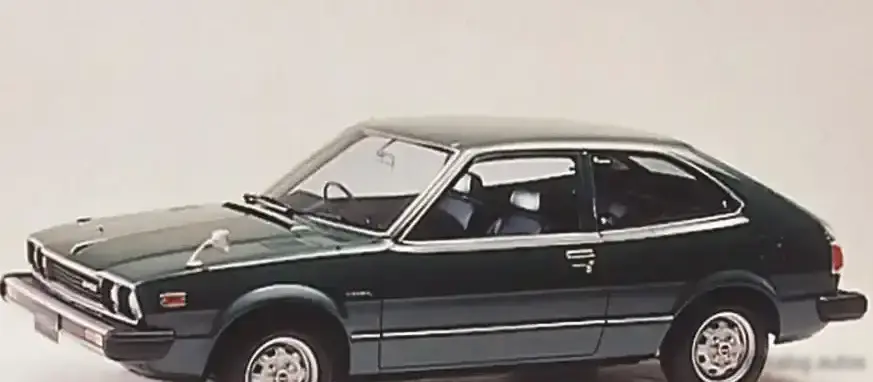
The Honda Accord first generation, designated SJ and SY, represented Honda’s initial foray into the compact car market, specifically aimed at challenging established American and European sedans. Produced between 1976 and 1981, the Accord was a pivotal model for Honda, establishing the brand’s reputation for reliability and fuel efficiency in international markets. The 1.6 EX (SY) variant, equipped with an 80 horsepower engine, was a key offering within the lineup, positioned as a well-equipped, economical option for buyers seeking a practical and dependable vehicle. This model played a significant role in building Honda’s presence, particularly in North America, where it offered a compelling alternative to larger, less fuel-efficient cars.
Technical Specifications
| Brand | Honda |
| Model | Accord |
| Generation | Accord I (SJ,SY) |
| Type (Engine) | 1.6 EX (SY) (80 Hp) |
| Start of production | 1976 |
| End of production | 1981 |
| Powertrain Architecture | Internal Combustion engine |
| Body type | Sedan |
| Seats | 5 |
| Doors | 4 |
| Fuel Type | Petrol (Gasoline) |
| Weight-to-power ratio | 11.9 kg/Hp, 84.4 Hp/tonne |
| Weight-to-torque ratio | 7.5 kg/Nm, 134 Nm/tonne |
| Power | 80 Hp @ 5300 rpm |
| Power per litre | 49.9 Hp/l |
| Torque | 127 Nm @ 3500 rpm (93.67 lb.-ft. @ 3500 rpm) |
| Engine layout | Front, Transverse |
| Engine displacement | 1602 cm3 (97.76 cu. in.) |
| Number of cylinders | 4 |
| Engine configuration | Inline |
| Cylinder Bore | 77 mm (3.03 in.) |
| Piston Stroke | 86 mm (3.39 in.) |
| Compression ratio | 8.4:1 |
| Engine aspiration | Naturally aspirated engine |
| Kerb Weight | 948 kg (2089.98 lbs.) |
| Fuel tank capacity | 50 l (13.21 US gal | 11 UK gal) |
| Length | 4345 mm (171.06 in.) |
| Width | 1620 mm (63.78 in.) |
| Height | 1360 mm (53.54 in.) |
| Wheelbase | 2380 mm (93.7 in.) |
| Front track | 1400 mm (55.12 in.) |
| Rear (Back) track | 1390 mm (54.72 in.) |
| Front overhang | 850 mm (33.46 in.) |
| Rear overhang | 1115 mm (43.9 in.) |
| Ride height (ground clearance) | 165 mm (6.5 in.) |
| Drivetrain Architecture | The Internal combustion engine (ICE) drives the front wheels of the vehicle. |
| Drive wheel | Front wheel drive |
| Number of gears and type of gearbox | 5 gears, manual transmission |
| Front suspension | Independent type McPherson |
| Rear suspension | McPherson |
| Front brakes | Disc |
| Rear brakes | Drum |
| Steering type | Steering rack and pinion |
| Power steering | Hydraulic Steering |
Powertrain & Engine Architecture
The 1.6 EX (SY) Accord was powered by Honda’s SOHC 1602cc inline-four cylinder engine, internally designated as part of the A-series engine family. This engine featured a cast iron block and an aluminum cylinder head, a common configuration for the era. Fuel delivery was managed by a carburetor, typical for vehicles of this period, providing a balance between cost and performance. The engine utilized a timing belt to drive the camshaft, a relatively advanced feature for the time, contributing to quieter operation and reduced maintenance compared to timing chains. The 80 horsepower output was achieved at 5300 rpm, while peak torque of 127 Nm (93.67 lb-ft) arrived at 3500 rpm. The engine’s transverse mounting and front-wheel drive configuration were relatively novel for Honda, marking a shift away from their traditional rear-wheel drive layouts.
Driving Characteristics
The 1.6L engine in the Accord provided adequate, though not exhilarating, performance. With 80 horsepower propelling a vehicle weighing approximately 948 kg (2089.98 lbs), acceleration was modest. The five-speed manual transmission offered a reasonable level of control, allowing drivers to keep the engine within its optimal power band. Compared to later, more powerful Accord variants, such as those equipped with larger engines, the 1.6 EX (SY) prioritized fuel economy and ease of driving over outright speed. The gear ratios were tuned for everyday usability, emphasizing smooth cruising and acceptable acceleration in typical traffic conditions. While not a sports car, the Accord 1.6 offered a comfortable and predictable driving experience.
Equipment & Trim Levels
The 1.6 EX (SY) trim level represented a step up from the base Accord models. Standard features typically included cloth upholstery, a basic AM/FM radio, and a heater/defroster system. The “EX” designation indicated a higher level of equipment compared to the more spartan base trims. Optional extras could include a more advanced radio with cassette player, upgraded interior trim, and occasionally, air conditioning, depending on the market. The interior design was functional and straightforward, prioritizing practicality and durability. The dashboard layout was simple, with clearly marked gauges and controls.
Chassis & Braking
The first-generation Accord utilized a McPherson strut suspension system at both the front and rear, providing a comfortable ride and predictable handling. The front suspension featured coil springs and a stabilizer bar, while the rear suspension employed a simpler configuration. Braking duties were handled by disc brakes at the front and drum brakes at the rear, a common setup for vehicles in this class during the late 1970s. The steering system was a rack-and-pinion setup with hydraulic power assistance, offering responsive steering feel and reduced driver effort. The chassis was designed to provide a balance between rigidity and weight, contributing to the car’s overall handling characteristics.
Market Reception & Comparison
The Honda Accord 1.6 EX (SY) was generally well-received by automotive critics and consumers alike. It was praised for its fuel efficiency, reliability, and comfortable ride. Compared to other compact sedans of the era, the Accord offered a compelling combination of features and value. While the 1.6L engine wasn’t the most powerful in its class, it was considered adequate for most drivers. The Accord’s front-wheel drive layout and independent suspension provided a more refined driving experience than many of its rear-wheel drive competitors. In terms of fuel economy, the 1.6L Accord consistently outperformed larger, less efficient vehicles, making it an attractive option for buyers concerned about rising fuel costs.
Legacy
The Honda Accord’s first generation, and the 1.6 EX (SY) variant in particular, laid the foundation for the model’s long-term success. The engine, while not known for exceptional performance, proved to be remarkably durable and reliable. Today, well-maintained examples of the first-generation Accord are sought after by collectors and enthusiasts. The 1.6L engine’s simplicity makes it relatively easy to maintain and repair, contributing to its longevity. The Accord’s reputation for reliability and fuel efficiency helped establish Honda as a major player in the automotive industry, and the 1.6 EX (SY) played a crucial role in that early success. The car remains a testament to Honda’s commitment to quality and innovation.