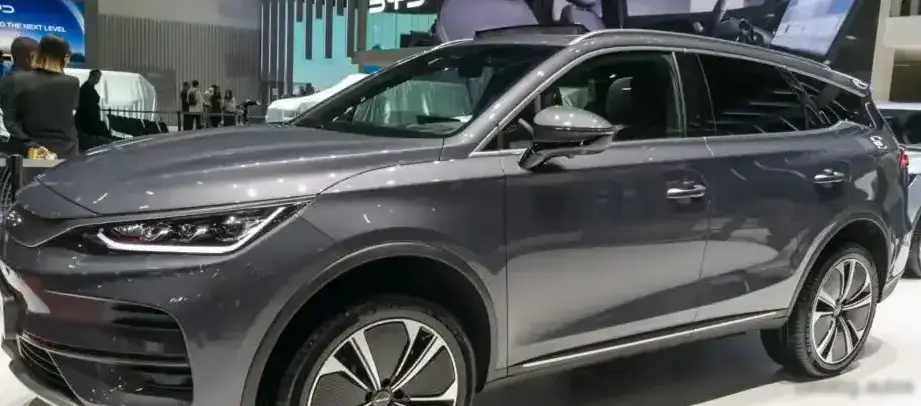
The BYD Tang II DM-i 1.5Ti (197 Hp) Plug-in Hybrid E-CVT, introduced in April 2021 and produced through October 2024, represents a significant iteration of BYD’s popular Tang SUV. This variant, part of the Tang II (facelift 2021) generation, positioned itself as a technologically advanced and fuel-efficient option within the BYD lineup, catering to consumers seeking a blend of electric driving capability and the range security of a gasoline engine. It’s a key example of BYD’s commitment to new energy vehicles and their ‘DM-i’ (Dual Mode – Intelligent) hybrid technology. The Tang II is a mid-size crossover SUV, typically configured with six or seven seats, designed primarily for the Chinese domestic market, though export versions have become increasingly common.
Technical Specifications
| Brand | BYD |
| Model | Tang |
| Generation | Tang II (facelift 2021) |
| Type (Engine) | DM-i 1.5Ti (197 Hp) Plug-in Hybrid E-CVT |
| Start of production | April, 2021 |
| End of production | October, 2024 |
| Powertrain Architecture | PHEV (Plug-in Hybrid Electric Vehicle) |
| Body type | SUV, Crossover |
| Seats | 6-7 |
| Doors | 5 |
| Fuel consumption (economy) – combined (NEDC) | 5.3 l/100 km (44.4 US mpg, 53.3 UK mpg, 18.9 km/l) |
| Fuel Type | Petrol / electricity |
| Acceleration 0 – 100 km/h | 8.7 sec |
| Acceleration 0 – 62 mph | 8.7 sec |
| Acceleration 0 – 60 mph | 8.3 sec |
| Gross battery capacity | 9.98 kWh |
| Battery technology | Lithium iron phosphate (LiFePO4) |
| Battery location | Below the floor |
| All-electric range (NEDC) | 52 km (32.31 mi) |
| Electric motor power | 197 Hp |
| Electric motor Torque | 316 Nm (233.07 lb.-ft.) |
| System power | 197 Hp |
| Power | 139 Hp |
| Torque | 231 Nm (170.38 lb.-ft.) |
| Engine layout | Front, Transverse |
| Engine Model/Code | Xiaoyun / BYD476ZQC |
| Engine displacement | 1497 cm3 (91.35 cu. in.) |
| Number of cylinders | 4 |
| Engine configuration | Inline |
| Number of valves per cylinder | 4 |
| Fuel injection system | Direct injection |
| Engine aspiration | Turbocharger |
| Engine oil capacity | 3.7 l (3.91 US qt | 3.26 UK qt) |
| Coolant | 8.5 l (8.98 US qt | 7.48 UK qt) |
| Fuel tank capacity | 53 l (14 US gal | 11.66 UK gal) |
| Length | 4870 mm (191.73 in.) |
| Width | 1950 mm (76.77 in.) |
| Height | 1725 mm (67.91 in.) |
| Wheelbase | 2820 mm (111.02 in.) |
| Front track | 1650 mm (64.96 in.) |
| Rear (Back) track | 1630 mm (64.17 in.) |
| Minimum turning circle | 11.8 m (38.71 ft.) |
| Drivetrain Architecture | Front wheel drive. PHEV. ICE and electric motor drive front wheels. |
| Number of gears and type of gearbox | automatic transmission CVT |
| Front suspension | Independent type McPherson |
| Rear suspension | Independent multi-link suspension |
| Front brakes | Ventilated discs |
| Rear brakes | Disc |
| Assisting systems | ABS (Anti-lock braking system) |
| Steering type | Steering rack and pinion |
| Power steering | Electric Steering |
| Tires size | 245/45 R20 |
| Wheel rims size | 20 |
Powertrain & Engine Architecture
The Tang II DM-i 1.5Ti utilizes BYD’s DM-i hybrid system, which centers around a 1.5-liter turbocharged four-cylinder gasoline engine (BYD476ZQC, often referred to as ‘Xiaoyun’). This engine produces 139 horsepower and 231 Nm (170.38 lb-ft) of torque. The engine is paired with a 197 horsepower electric motor integrated into the E-CVT (electrically controlled continuously variable transmission). This isn’t a traditional CVT; it’s a single-speed transmission that primarily relies on the electric motor for driving, with the gasoline engine acting as a generator or providing power directly when needed. The 9.98 kWh Lithium Iron Phosphate (LiFePO4) battery pack, located under the floor, provides an all-electric range of 52 km (32.31 miles) under NEDC testing. The engine features direct fuel injection and variable valve timing (VVT) to optimize efficiency and performance. The DM-i system prioritizes electric driving, switching to hybrid mode seamlessly based on driving conditions and battery charge level.
Driving Characteristics
The 1.5Ti DM-i variant offers a noticeably different driving experience compared to gasoline-only or higher-output Tang II models. The emphasis is on smooth, quiet operation, particularly in electric mode. Acceleration from 0-60 mph takes approximately 8.3 seconds, which is respectable for a vehicle of this size, but not particularly sporty. The E-CVT provides seamless acceleration, lacking the stepped gear changes of a traditional automatic. In hybrid mode, the engine kicks in smoothly to provide additional power or maintain speed, but it’s less intrusive than in some other hybrid systems. The front-wheel-drive configuration provides adequate traction for most conditions, but it doesn’t offer the all-weather capability of an all-wheel-drive system. The steering is light and precise, making it easy to maneuver in urban environments.
Equipment & Trim Levels
The Tang II DM-i 1.5Ti typically came well-equipped, reflecting its position as a mid-range offering. Standard features generally included a large touchscreen infotainment system, a digital instrument cluster, leather upholstery, automatic climate control, and a suite of advanced driver-assistance systems (ADAS) such as adaptive cruise control, lane keeping assist, and automatic emergency braking. Higher trim levels offered additional features like a panoramic sunroof, premium audio system, ventilated front seats, and a 360-degree camera system. Interior color schemes varied, with options for black, brown, and beige upholstery.
Chassis & Braking
The Tang II utilizes an independent McPherson strut suspension at the front and an independent multi-link suspension at the rear, providing a comfortable ride quality. Stabilizer bars are fitted to both axles to reduce body roll during cornering. The braking system consists of ventilated discs at the front and solid discs at the rear, providing adequate stopping power. ABS (Anti-lock Braking System) is standard. The suspension tuning is geared towards comfort rather than sporty handling, prioritizing a smooth ride over sharp responsiveness.
Market Reception & Comparison
The Tang II DM-i 1.5Ti was generally well-received in the Chinese market, praised for its fuel efficiency, smooth driving experience, and spacious interior. Critics noted that the acceleration wasn’t particularly exhilarating, but it was sufficient for everyday driving. Compared to the gasoline-only Tang II models, the DM-i variant offered significantly better fuel economy and lower emissions. Compared to other plug-in hybrid SUVs in its class, the Tang II DM-i offered a competitive range and a well-equipped interior at a reasonable price point. Reliability reports have been generally positive, with the DM-i system proving to be relatively robust.
Legacy
The BYD Tang II DM-i 1.5Ti represents a pivotal step in BYD’s transition towards becoming a leading manufacturer of new energy vehicles. The DM-i technology has become a cornerstone of BYD’s hybrid strategy, and the Tang II helped to establish BYD as a credible competitor in the plug-in hybrid SUV segment. On the used car market, these models hold their value reasonably well, particularly those with lower mileage and well-maintained batteries. The longevity of the LiFePO4 battery pack is a key factor in the long-term reliability and desirability of these vehicles. As BYD expands its global presence, the Tang II DM-i 1.5Ti will likely be remembered as a significant model in the company’s history.