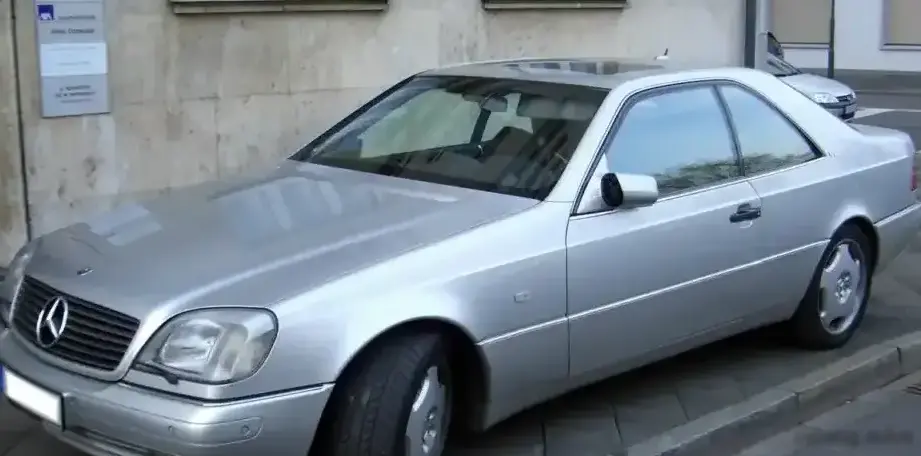
The Mercedes-Benz CL 500, specifically the C215 facelift model produced from September 2002 to August 2003, represents a high point in grand touring luxury from the German automaker. Positioned as a premium offering within the CL range, it slotted above the CL 430 and below the performance-oriented CL 600. This generation, known internally as the C215, received a significant facelift in 2002, updating the exterior styling and interior technology. The CL 500 combined a powerful V8 engine with a sophisticated automatic transmission, aiming to deliver a refined and effortless driving experience. It was primarily marketed towards buyers seeking a luxurious coupe with strong performance and advanced features.
Technical Specifications
| Brand | Mercedes-Benz |
| Model | CL |
| Generation | CL (C215, facelift 2002) |
| Type (Engine) | CL 500 V8 (306 Hp) 5G-TRONIC |
| Start of production | September, 2002 |
| End of production | August, 2003 |
| Powertrain Architecture | Internal Combustion engine |
| Body type | Coupe |
| Seats | 4 |
| Doors | 2 |
| Fuel consumption (economy) – urban (NEDC) | 18 l/100 km (13.1 US mpg, 15.7 UK mpg, 5.6 km/l) |
| Fuel consumption (economy) – extra urban (NEDC) | 8.7 l/100 km (27 US mpg, 32.5 UK mpg, 11.5 km/l) |
| Fuel consumption (economy) – combined (NEDC) | 11.9 l/100 km (19.8 US mpg, 23.7 UK mpg, 8.4 km/l) |
| CO2 emissions (NEDC) | 285 g/km |
| Fuel Type | Petrol (Gasoline) |
| Acceleration 0 – 100 km/h | 6.5 sec |
| Acceleration 0 – 62 mph | 6.5 sec |
| Acceleration 0 – 60 mph | 6.2 sec |
| Maximum speed | 250 km/h (155.34 mph), Electronically limited |
| Emission standard | Euro 4 |
| Weight-to-power ratio | 5.9 kg/Hp, 169.1 Hp/tonne |
| Weight-to-torque ratio | 3.9 kg/Nm, 254.1 Nm/tonne |
| Power | 306 Hp @ 5600 rpm |
| Power per litre | 61.6 Hp/l |
| Torque | 460 Nm @ 2700-4250 rpm (339.28 lb.-ft. @ 2700-4250 rpm) |
| Maximum engine speed | 6000 rpm |
| Engine layout | Front, Longitudinal |
| Engine Model/Code | M 113.960 |
| Engine displacement | 4966 cm3 (303.04 cu. in.) |
| Number of cylinders | 8 |
| Engine configuration | V-engine |
| Cylinder Bore | 97 mm (3.82 in.) |
| Piston Stroke | 84 mm (3.31 in.) |
| Compression ratio | 10:1 |
| Number of valves per cylinder | 3 |
| Fuel injection system | Multi-port manifold injection |
| Engine aspiration | Naturally aspirated engine |
| Valvetrain | SOHC |
| Engine oil capacity | 8 l (8.45 US qt | 7.04 UK qt) |
| Coolant | 11.5 l (12.15 US qt | 10.12 UK qt) |
| Kerb Weight | 1810 kg (3990.37 lbs.) |
| Max. weight | 2340 kg (5158.82 lbs.) |
| Max load | 530 kg (1168.45 lbs.) |
| Trunk (boot) space – minimum | 450 l (15.89 cu. ft.) |
| Fuel tank capacity | 88 l (23.25 US gal | 19.36 UK gal) |
| Max. roof load | 100 kg (220.46 lbs.) |
| Length | 4993 mm (196.57 in.) |
| Width | 1857 mm (73.11 in.) |
| Width including mirrors | 2104 mm (82.83 in.) |
| Height | 1398 mm (55.04 in.) |
| Wheelbase | 2885 mm (113.58 in.) |
| Front track | 1577 mm (62.09 in.) |
| Rear (Back) track | 1578 mm (62.13 in.) |
| Front overhang | 922 mm (36.3 in.) |
| Rear overhang | 1186 mm (46.69 in.) |
| Drag coefficient (Cd) | 0.28 |
| Minimum turning circle (turning diameter) | 11.5 m (37.73 ft.) |
| Drivetrain Architecture | The Internal combustion engine (ICE) drives the rear wheels of the vehicle. |
| Drive wheel | Rear wheel drive |
| Number of gears and type of gearbox | 5 gears, automatic transmission |
| Front suspension | Hydraulic elements, Double wishbone, Transverse stabilizer |
| Rear suspension | Hydraulic elements, Independent multi-link suspension, Transverse stabilizer |
| Front brakes | Ventilated discs, 330 mm |
| Rear brakes | Ventilated discs, 300 mm |
| Assisting systems | ABS (Anti-lock braking system) |
| Steering type | Steering rack and pinion |
| Power steering | Hydraulic Steering |
| Tires size | 225/55 R17 |
| Wheel rims size | 7.5J x 17 |
Powertrain & Engine Architecture
The CL 500 was powered by the M113.960 5.0-liter naturally aspirated V8 engine. This engine, a cornerstone of Mercedes-Benz’s engine lineup at the time, featured a three-valve-per-cylinder design (two intake, one exhaust) and a relatively conservative 10:1 compression ratio. Fuel delivery was handled by a multi-port fuel injection system. The engine produced 306 horsepower at 5600 rpm and 460 Nm (339 lb-ft) of torque between 2700 and 4250 rpm. The engine’s architecture was a 90-degree V configuration, contributing to its smooth operation. Paired with the engine was the 5G-TRONIC automatic transmission, a five-speed unit known for its smooth shifts and adaptive learning capabilities. This transmission was designed to optimize fuel efficiency and provide a comfortable driving experience.
Driving Characteristics
The CL 500’s 5.0-liter V8 and 5G-TRONIC transmission delivered a blend of performance and refinement. Acceleration from 0 to 60 mph took approximately 6.2 seconds, and the car was electronically limited to a top speed of 155 mph. While not as overtly sporty as some competitors, the CL 500 offered ample power for effortless cruising and confident overtaking. The automatic transmission, while smooth, wasn’t particularly quick to downshift compared to more modern transmissions or manual options available in other CL models. The gear ratios were tuned for comfort and fuel economy rather than outright performance. Compared to the CL 600 with its turbocharged V12, the CL 500 felt less urgent, but it offered a more manageable and predictable power delivery.
Equipment & Trim Levels
The CL 500 came standard with a comprehensive list of luxury features. Leather upholstery was standard, along with wood trim, automatic climate control, power-adjustable seats with memory function, and a premium sound system. The facelifted model (2002-2003) benefited from updated COMAND infotainment system with navigation capabilities. Optional extras included features like active body control (ABC) suspension, which minimized body roll and provided a supremely comfortable ride, as well as various interior customization options, such as different leather colors and trim materials. Parking sensors and a sunroof were also popular options.
Chassis & Braking
The CL 500 featured a robust chassis designed for both comfort and handling. The front suspension utilized a double wishbone setup with a transverse stabilizer, while the rear employed an independent multi-link suspension, also with a stabilizer bar. Braking duties were handled by ventilated disc brakes on all four wheels, providing ample stopping power. Anti-lock braking system (ABS) was standard. The suspension was tuned to prioritize ride comfort, resulting in a smooth and isolated driving experience. The standard tire size was 225/55 R17, mounted on 7.5J x 17 inch wheels.
Market Reception & Comparison
The CL 500 was generally well-received by automotive critics, who praised its luxurious interior, comfortable ride, and powerful engine. However, some reviewers noted that the automatic transmission could feel a bit sluggish at times. Compared to the CL 430, the CL 500 offered a significant performance upgrade, while remaining more affordable than the flagship CL 600. Fuel economy, while not a primary concern for buyers in this segment, was reasonable for a vehicle of its size and performance, averaging around 19.8 US mpg in combined driving. Reliability was generally good, although the complex electronic systems could occasionally require attention.
Legacy
The Mercedes-Benz CL 500 (C215 facelift) remains a desirable grand tourer in the used car market. The M113 V8 engine is known for its durability and relatively straightforward maintenance. While the car’s age means that maintenance costs can be higher due to the need for replacement parts and specialized service, the CL 500 continues to offer a compelling combination of luxury, performance, and style. The 5G-TRONIC transmission, while not the most advanced by today’s standards, has proven to be reasonably reliable with proper maintenance. The C215 CL, and the 500 variant in particular, represents a high watermark for Mercedes-Benz’s commitment to building luxurious and capable coupes.