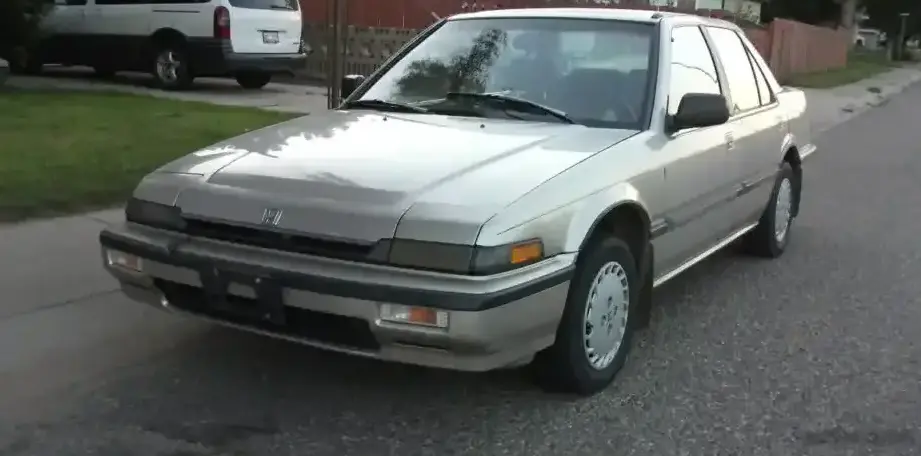
The Honda Accord III, specifically the CA5 variant with the 2.0-liter 16-valve engine producing 133 horsepower, represents a significant step forward in Honda’s commitment to refining the mid-size sedan. Produced from 1987 to 1989, this model occupied a middle ground within the CA4/CA5 Accord lineup, offering a balance between performance and affordability. It built upon the success of the second-generation Accord, further solidifying Honda’s reputation for reliability and fuel efficiency in the North American market. The CA5 distinguished itself from the base CA4 models through its more powerful engine and, often, a higher level of standard equipment.
Technical Specifications
| Brand | Honda |
| Model | Accord |
| Generation | Accord III (CA4, CA5) |
| Type (Engine) | 2.0 i 16V (CA5) (133 Hp) |
| Start of Production | 1987 |
| End of Production | 1989 |
| Powertrain Architecture | Internal Combustion Engine |
| Body Type | Sedan |
| Fuel Type | Petrol (Gasoline) |
| Power | 133 Hp |
| Engine Aspiration | Naturally Aspirated |
Powertrain & Engine Architecture
The heart of the CA5 Accord is the F20A SOHC 16-valve inline-four cylinder engine. This engine displaced 1,955 cc (1.9 liters, though often marketed as 2.0 liters) and featured multi-point fuel injection, a significant upgrade over the carburetor systems found in earlier Accords. The SOHC (Single Overhead Camshaft) design simplified the valvetrain, contributing to the engine’s reliability and ease of maintenance. The F20A produced 133 horsepower at 6,000 rpm and 131 lb-ft of torque at 4,800 rpm. While not a high-revving powerhouse, the engine delivered a broad torque curve, making it suitable for everyday driving. The CA5 was typically paired with a four-speed automatic transmission, although a five-speed manual transmission was also available. The automatic transmission, while providing convenience, did slightly diminish the car’s acceleration compared to the manual version. The engine block itself was constructed from cast iron, known for its durability, while the cylinder head was made of aluminum, helping to reduce weight.
Driving Characteristics
The 1987-1989 Honda Accord CA5 with the 2.0-liter engine and automatic transmission offered a comfortable and refined driving experience for its time. Acceleration was adequate for merging onto highways and passing slower traffic, but it wasn’t particularly sporty. The automatic transmission featured relatively conservative gear ratios, prioritizing fuel economy over outright performance. The shift points were generally smooth, but the transmission lacked the responsiveness of more modern units. Steering was light and precise, making the car easy to maneuver in urban environments. The suspension, consisting of independent front suspension with MacPherson struts and a rear independent suspension with trailing arms, provided a good balance between ride comfort and handling. Compared to the base CA4 model with its 1.5-liter engine, the CA5 offered noticeably more power and a more relaxed driving experience, especially when fully loaded with passengers or cargo. Compared to the later, more powerful Accord models, the CA5 felt less eager to rev, but its predictable power delivery made it a user-friendly vehicle.
Equipment & Trim Levels
The CA5 Accord typically came standard with features such as air conditioning, power steering, and an AM/FM stereo. Higher trim levels, often denoted by “DX” or “LX” designations, added features like power windows, power door locks, cruise control, and upgraded interior upholstery. The interior of the CA5 was generally well-appointed for its price point, with comfortable seats and a functional dashboard layout. The instrument panel featured a speedometer, tachometer, fuel gauge, and temperature gauge. Optional extras included a sunroof, upgraded sound systems, and alloy wheels. The interior trim materials were typically cloth, with higher trims offering more luxurious fabrics. The CA5 aimed for a balance of comfort and practicality, offering a reasonably well-equipped interior without venturing into luxury territory.
Chassis & Braking
The Accord III CA5 utilized a unibody construction, providing a good level of structural rigidity. The front suspension featured MacPherson struts, coil springs, and an anti-roll bar, while the rear suspension employed a trailing arm design with coil springs. Braking duties were handled by disc brakes in the front and drum brakes in the rear. The braking system was adequate for normal driving conditions, but it lacked the stopping power of more modern braking systems. The CA5’s chassis was designed to provide a comfortable ride while maintaining reasonable handling characteristics. The steering system was a rack-and-pinion setup, offering precise steering feel. The tires were typically 185/65R14, providing a good balance between ride comfort and grip.
Market Reception & Comparison
The 1987-1989 Honda Accord CA5 was well-received by automotive critics and consumers alike. It was praised for its reliability, fuel efficiency, and comfortable ride. The 2.0-liter engine was considered a good compromise between performance and economy. Compared to its competitors, such as the Toyota Camry and Ford Tempo, the Accord offered a more refined driving experience and a reputation for long-term durability. Fuel economy was a strong point, with the CA5 achieving around 22 mpg city and 29 mpg highway. The automatic transmission, while not the sportiest option, was generally considered reliable. Some critics noted that the interior styling was somewhat conservative, but the overall build quality was praised. The CA5’s price point positioned it as a competitive offering in the mid-size sedan segment.
Legacy
The Honda Accord III CA5, particularly the 2.0-liter 16-valve variant, has proven to be a remarkably durable and reliable vehicle. Many examples are still on the road today, a testament to Honda’s engineering prowess. The F20A engine is known for its longevity, and with proper maintenance, it can easily exceed 200,000 miles. The automatic transmission, while not without its potential issues, is generally considered reliable. In the used car market, the CA5 Accord is often sought after by enthusiasts and collectors who appreciate its simplicity, reliability, and classic styling. Parts availability is generally good, although some trim-specific components may be difficult to find. The CA5 represents a pivotal moment in Honda’s history, solidifying the Accord’s position as a leading mid-size sedan and establishing Honda’s reputation for building high-quality, long-lasting vehicles.