
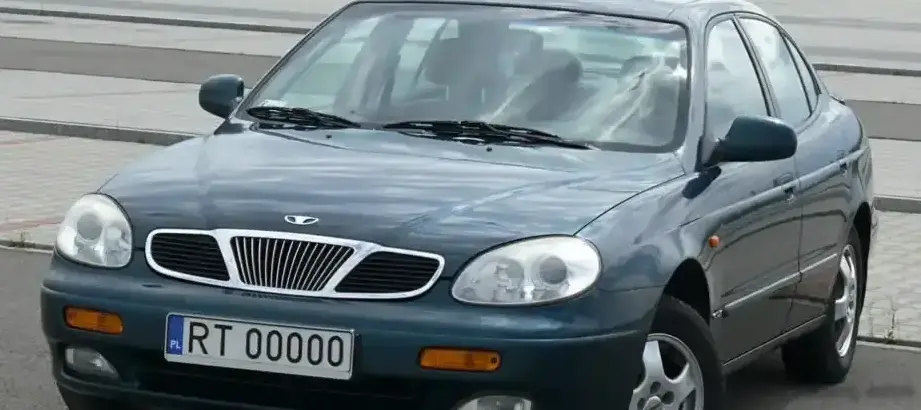
The Daewoo Leganza, specifically the KLAV 2.0 variant with the automatic transmission, represented Daewoo’s attempt to enter the mid-size sedan market with a focus on comfort and value. Produced from 1997 to 2001, the Leganza was positioned as a more upscale offering compared to Daewoo’s earlier models like the Espero and Cielo. It was primarily marketed in Europe, South America, and select Asian markets, including Australia, and was intended to compete with established players like the Ford Mondeo, Opel Vectra, and Toyota Camry. The Leganza was built upon the J-platform, shared with other GM vehicles, and aimed to provide a refined driving experience with a relatively spacious interior.
Technical Specifications
| Brand | Daewoo |
| Model | Leganza |
| Generation | Leganza (KLAV) |
| Type (Engine) | 2.0 (136 Hp) Automatic |
| Start of production | 1997 |
| End of production | 2001 |
| Powertrain Architecture | Internal Combustion engine |
| Body type | Sedan |
| Seats | 5 |
| Doors | 4 |
| Fuel consumption (urban) | 15.8 l/100 km (14.9 US mpg, 17.9 UK mpg, 6.3 km/l) |
| Fuel consumption (extra urban) | 7.5 l/100 km (31.4 US mpg, 37.7 UK mpg, 13.3 km/l) |
| Fuel Type | Petrol (Gasoline) |
| Acceleration 0 – 100 km/h | 12.5 sec |
| Acceleration 0 – 62 mph | 12.5 sec |
| Acceleration 0 – 60 mph | 11.9 sec |
| Maximum speed | 192 km/h (119.3 mph) |
| Weight-to-power ratio | 10.1 kg/Hp, 99.3 Hp/tonne |
| Weight-to-torque ratio | 7.4 kg/Nm, 134.3 Nm/tonne |
| Power | 136 Hp @ 5600 rpm |
| Power per litre | 68.1 Hp/l |
| Torque | 184 Nm @ 4000 rpm (135.71 lb.-ft. @ 4000 rpm) |
| Engine layout | Front, Transverse |
| Engine displacement | 1998 cm3 (121.93 cu. in.) |
| Number of cylinders | 4 |
| Engine configuration | Inline |
| Cylinder Bore | 86 mm (3.39 in.) |
| Piston Stroke | 86 mm (3.39 in.) |
| Compression ratio | 9.5:1 |
| Number of valves per cylinder | 4 |
| Fuel injection system | Multi-port manifold injection |
| Engine aspiration | Naturally aspirated engine |
| Valvetrain | DOHC |
| Kerb Weight | 1370 kg (3020.33 lbs.) |
| Max. weight | 1830 kg (4034.46 lbs.) |
| Max load | 460 kg (1014.13 lbs.) |
| Trunk (boot) space – minimum | 400 l (14.13 cu. ft.) |
| Trunk (boot) space – maximum | 970 l (34.26 cu. ft.) |
| Fuel tank capacity | 65 l (17.17 US gal, 14.3 UK gal) |
| Length | 4671 mm (183.9 in.) |
| Width | 1779 mm (70.04 in.) |
| Height | 1437 mm (56.57 in.) |
| Wheelbase | 2670 mm (105.12 in.) |
| Front track | 1515 mm (59.65 in.) |
| Rear (Back) track | 1507 mm (59.33 in.) |
| Drivetrain Architecture | The Internal combustion engine (ICE) drives the front wheels of the vehicle. |
| Drive wheel | Front wheel drive |
| Number of gears and type of gearbox | 4 gears, automatic transmission |
| Front suspension | Spring Strut |
| Rear suspension | Coil spring |
| Front brakes | Ventilated discs |
| Rear brakes | Disc |
| Assisting systems | ABS (Anti-lock braking system) |
| Steering type | Steering rack and pinion |
| Power steering | Hydraulic Steering |
| Tires size | 205/60 R15 |
| Wheel rims size | 6J x 15 |
Powertrain & Engine Architecture
The KLAV 2.0 Leganza was powered by a 1998cc, inline-four cylinder engine. This engine, internally designated as the X20SED, was a naturally aspirated unit featuring a dual overhead camshaft (DOHC) valvetrain and multi-point fuel injection. The engine produced 136 horsepower at 5600 rpm and 184 Nm (135.71 lb-ft) of torque at 4000 rpm. The compression ratio was set at 9.5:1. The engine’s design prioritized smooth operation and reasonable fuel efficiency over outright performance. The four-speed automatic transmission was a key component of this variant, offering convenience but impacting acceleration compared to the available five-speed manual. The automatic transmission was designed for smooth shifts, but it wasn’t particularly quick or responsive.
Driving Characteristics
The 2.0L automatic Leganza offered a comfortable, if not particularly exciting, driving experience. Acceleration from 0-60 mph took around 11.9 seconds, and top speed was approximately 119 mph. The automatic transmission, while providing ease of use, resulted in noticeable power loss compared to the manual transmission version. Gear ratios were tuned for fuel economy and relaxed cruising, rather than spirited driving. The Leganza felt stable and composed on the highway, but its handling wasn’t as sharp or engaging as some of its European competitors. The engine provided adequate power for everyday driving situations, but overtaking maneuvers required careful planning.
Equipment & Trim Levels
The 2.0L automatic Leganza typically came equipped with features such as power windows, power door locks, central locking, air conditioning, and an AM/FM radio with cassette player. Higher trim levels offered options like alloy wheels, a sunroof, leather upholstery, and upgraded audio systems. The interior was generally well-appointed for its price point, with comfortable seats and a reasonably spacious cabin. The dashboard layout was functional but somewhat dated, even for the late 1990s. Safety features included ABS anti-lock brakes, but airbags were often optional depending on the market.
Chassis & Braking
The Leganza utilized a front-wheel-drive layout with a MacPherson strut suspension in the front and a coil spring suspension in the rear. The front brakes were ventilated discs, while the rear brakes were solid discs. The suspension was tuned for comfort, providing a relatively smooth ride over uneven surfaces. The steering was hydraulic power-assisted rack and pinion, offering reasonable precision but lacking significant feedback. Tire size was typically 205/60 R15. The chassis was designed to provide a balance between ride comfort and handling stability, but it wasn’t particularly sporty or agile.
Market Reception & Comparison
The Daewoo Leganza received mixed reviews from automotive critics. It was generally praised for its spacious interior, comfortable ride, and competitive price. However, it was often criticized for its uninspired styling, lackluster performance, and somewhat dated technology. Compared to the manual transmission version, the 2.0L automatic Leganza offered less engaging driving dynamics. Fuel economy was average for its class, with urban consumption around 15.8 l/100km and extra-urban consumption around 7.5 l/100km. Reliability was generally considered acceptable, but some owners reported issues with the automatic transmission and electrical components.
Legacy
The Daewoo Leganza, while not a resounding success, played a role in establishing Daewoo as a contender in the mid-size sedan market. The 2.0L automatic variant, while not the most desirable version due to its performance limitations, offered a comfortable and affordable option for buyers seeking a practical family car. Today, the Leganza is a relatively rare sight on the roads, and parts availability can be challenging. However, well-maintained examples are sought after by enthusiasts and collectors who appreciate its unique character and historical significance. The powertrain, while not known for exceptional durability, can provide reliable service with proper maintenance. The Leganza represents a snapshot of Daewoo’s ambitions during a period of rapid expansion and ultimately, its eventual acquisition by General Motors.
