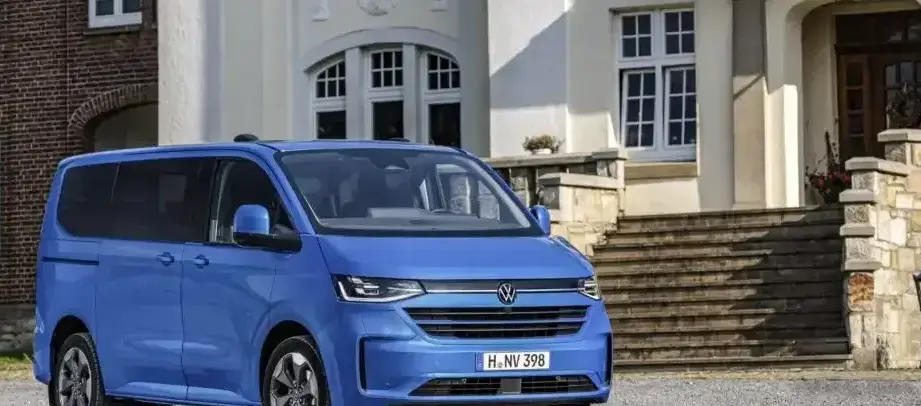
The Volkswagen Caravelle (T7) 2.0 TDI 150 hp represents a significant iteration in Volkswagen’s long-running line of passenger vans, launched in August 2024. Positioned as a versatile option within the T7 generation, this variant caters to families and businesses seeking a balance between fuel efficiency, practicality, and reasonable performance. The T7 Caravelle builds upon the foundation of the 1HX0/A3 platform, offering a modern take on the classic Caravelle formula. This specific 2.0 TDI engine and manual transmission combination aims to provide a cost-effective entry point into the T7 range, while still delivering the space and functionality expected of a Volkswagen van.
Technical Specifications
| Brand | Volkswagen |
| Model | Caravelle |
| Generation | Caravelle (T7) |
| Type (Engine) | 2.0 TDI (150 Hp) |
| Start of production | August, 2024 |
| Powertrain Architecture | Internal Combustion engine |
| Body type | Van |
| Seats | 8-9 |
| Doors | 4-5 |
| Combined fuel consumption (WLTP) | 7.2-7.4 l/100 km |
| Combined fuel consumption (US mpg) | 32.7 – 31.8 |
| Combined fuel consumption (UK mpg) | 39.2 – 38.2 |
| Combined fuel consumption (km/l) | 13.9 – 13.5 |
| CO2 emissions (WLTP) | 189-193 g/km |
| Fuel Type | Diesel |
| Acceleration 0 – 100 km/h | 13.4 sec |
| Acceleration 0 – 62 mph | 13.4 sec |
| Acceleration 0 – 60 mph | 12.7 sec |
| Maximum speed | 175 km/h (108.74 mph) |
| Emission standard | Euro 6e |
| Weight-to-power ratio | 14.1 kg/Hp, 70.9 Hp/tonne |
| Weight-to-torque ratio | 5.9 kg/Nm, 170.1 Nm/tonne |
| Power | 150 Hp |
| Power per litre | 75.2 Hp/l |
| Torque | 360 Nm (265.52 lb.-ft.) |
| Engine layout | Front, Transverse |
| Engine Model/Code | Panther |
| Engine displacement | 1996 cm3 (121.8 cu. in.) |
| Number of cylinders | 4 |
| Engine configuration | Inline |
| Cylinder Bore | 84.01 mm (3.31 in.) |
| Piston Stroke | 90.03 mm (3.54 in.) |
| Number of valves per cylinder | 4 |
| Fuel injection system | Diesel Commonrail |
| Engine aspiration | Turbocharger, Intercooler |
| Valvetrain | DOHC |
| Engine systems | Start & Stop System, Particulate filter |
| Kerb Weight | 2116-2178 kg (4664.98 – 4801.67 lbs.) |
| Max. weight | 3100-3110 kg (6834.33 – 6856.38 lbs.) |
| Max load | 932-984 kg (2054.71 – 2169.35 lbs.) |
| Fuel tank capacity | 55 l (14.53 US gal | 12.1 UK gal) |
| AdBlue tank | 20 l (5.28 US gal | 4.4 UK gal) |
| Max. roof load | 170 kg (374.79 lbs.) |
| Permitted trailer load with brakes (12%) | 2500 kg (5511.56 lbs.) |
| Permitted trailer load without brakes | 750 kg (1653.47 lbs.) |
| Permitted towbar download | 100 kg (220.46 lbs.) |
| Length | 5050 mm (198.82 in.) |
| Width | 2032 mm (80 in.) |
| Width including mirrors | 2275 mm (89.57 in.) |
| Height | 1980 mm (77.95 in.) |
| Wheelbase | 3100 mm (122.05 in.) |
| Front overhang | 958 mm (37.72 in.) |
| Rear overhang | 992 mm (39.06 in.) |
| Minimum turning circle | 12.5 m (41.01 ft.) |
| Approach angle | 16.5° |
| Departure angle | 16.4° |
| Ramp-over angle | 13.1° |
| Drivetrain Architecture | Front wheel drive |
| Number of gears | 6 gears, manual transmission |
| Assisting systems | ABS (Anti-lock braking system) |
| Steering type | Steering rack and pinion |
| Power steering | Electric Steering |
| Tires size | 215/65 R16; 215/60 R17 |
| Wheel rims size | 6.5J x 16; 6.5J x 17 |
Powertrain & Engine Architecture
The heart of the Caravelle T7 2.0 TDI is the Panther engine, a 1996cc inline four-cylinder diesel. This engine utilizes a common rail direct injection system, delivering fuel at extremely high pressure for optimized combustion. The engine is turbocharged and intercooled, enhancing power output and efficiency. The DOHC (Double Overhead Camshaft) valvetrain, with four valves per cylinder, further contributes to the engine’s breathing and overall performance. The 150 hp output is achieved through careful calibration of the engine management system, balancing power with fuel economy and emissions compliance (Euro 6e). The engine is paired with a six-speed manual transmission, providing drivers with full control over gear selection. This transmission is chosen for its robustness and efficiency, although a DSG (Dual Clutch Gearbox) was available as an option on higher trims.
Driving Characteristics
The 2.0 TDI 150 hp Caravelle offers a practical and comfortable driving experience. Acceleration is not its strong suit, with a 0-60 mph time of around 12.7 seconds, but it provides sufficient power for everyday driving and highway cruising. The manual transmission allows for precise control, and the engine delivers a usable amount of torque (360 Nm / 265.52 lb.-ft.) from relatively low RPMs. Compared to higher-output TDI variants (like the 200 hp version), this engine prioritizes fuel efficiency over outright performance. The gear ratios are tuned for economy, meaning the engine may need to be worked harder when fully loaded or tackling steep inclines. The front-wheel-drive configuration provides adequate traction in most conditions, but can struggle in slippery environments compared to all-wheel-drive options available on other T7 models.
Equipment & Trim Levels
The 2.0 TDI 150 hp Caravelle typically served as a mid-range trim level, offering a good balance of features and affordability. Standard equipment generally included air conditioning, power windows, central locking, and a basic audio system. Interior upholstery was typically cloth, with options for upgraded materials and leather available. Dashboard configuration was functional and straightforward, prioritizing usability over luxury. Common optional extras included parking sensors, a touchscreen infotainment system with navigation, cruise control, and heated seats. The Caravelle’s modular seating arrangement allowed for flexible configurations, accommodating up to nine passengers depending on the chosen layout.
Chassis & Braking
The T7 Caravelle utilizes a front-wheel-drive chassis with independent suspension at the front and a semi-independent torsion beam suspension at the rear. This setup provides a comfortable ride quality, although it’s not as sporty as some more sophisticated suspension designs. The braking system typically features disc brakes at the front and drum brakes at the rear, with ABS (Anti-lock Braking System) as standard. Stabilizer bars are fitted to both the front and rear axles to reduce body roll during cornering. The suspension and braking components are tuned to handle the Caravelle’s weight and passenger capacity effectively.
Market Reception & Comparison
The Caravelle T7 2.0 TDI 150 hp was generally well-received by critics as a practical and economical people carrier. Its fuel economy (7.2-7.4 l/100 km) was a key selling point, making it an attractive option for families and businesses looking to minimize running costs. Compared to the more powerful TDI variants, this engine offered a lower purchase price and potentially lower maintenance costs. However, some reviewers noted its lack of outright performance, particularly when fully loaded. Against competitors like the Mercedes-Benz V-Class and the Ford Tourneo Custom, the Caravelle T7 offered a compelling combination of space, practicality, and value.
Legacy
The 2.0 TDI engine, in various iterations, has proven to be a reliable and durable powerplant in the Volkswagen Group. While early common rail diesels had some issues with particulate filters and injector reliability, the Panther engine benefits from years of refinement. The T7 Caravelle 2.0 TDI 150 hp is likely to hold its value reasonably well in the used car market, particularly examples that have been well-maintained. Its practicality and fuel efficiency continue to make it an appealing option for those seeking a versatile and economical people carrier. Regular servicing, including timely replacement of the timing belt and maintenance of the diesel particulate filter, will be crucial for ensuring the long-term reliability of this powertrain.