
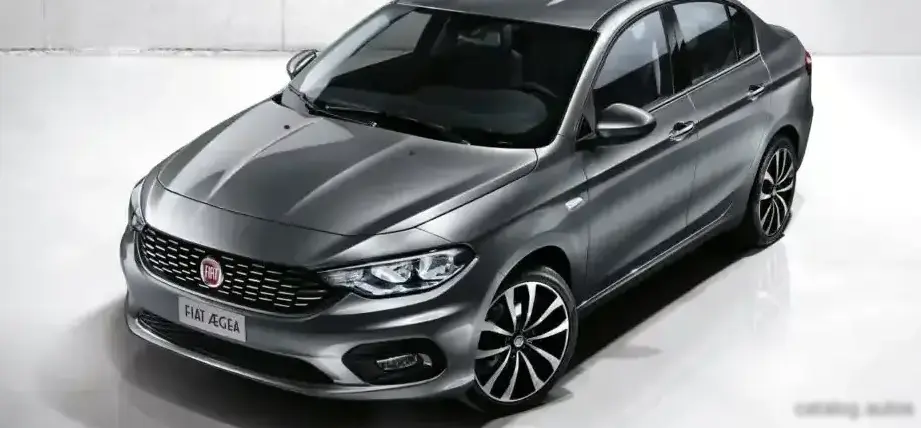
The Fiat Egea (project code 356) 1.6 Multijet II (120 hp) with a Dual Clutch Transmission (DCT) was a key variant in the Egea lineup, produced from 2016 to 2019. Positioned as a mid-range offering, it aimed to balance fuel efficiency with acceptable performance and modern convenience. The Egea, designed as a replacement for both the Bravo and Linea, was intended to be a globally competitive C-segment sedan, primarily targeting European and Turkish markets. This particular engine and transmission combination represented Fiat’s effort to provide a diesel option with the ease of use of an automatic gearbox, appealing to a broader customer base.
Technical Specifications
| Brand | Fiat |
| Model | Egea |
| Generation | Egea (356) |
| Type (Engine) | 1.6 Multijet II (120 Hp) DCT |
| Start of production | 2016 |
| End of production | 2019 |
| Powertrain Architecture | Internal Combustion engine |
| Body type | Sedan |
| Seats | 5 |
| Doors | 4 |
| Fuel consumption (urban) | 4.5 l/100 km (52.3 US mpg, 62.8 UK mpg, 22.2 km/l) |
| Fuel consumption (extra urban) | 3.5 l/100 km (67.2 US mpg, 80.7 UK mpg, 28.6 km/l) |
| Fuel consumption (combined) | 3.9 l/100 km (60.3 US mpg, 72.4 UK mpg, 25.6 km/l) |
| CO2 emissions | 102 g/km |
| Fuel Type | Diesel |
| Acceleration 0 – 100 km/h | 9.8 sec |
| Acceleration 0 – 62 mph | 9.8 sec |
| Acceleration 0 – 60 mph | 9.3 sec |
| Maximum speed | 200 km/h (124.27 mph) |
| Emission standard | Euro 6 |
| Weight-to-power ratio | 10.8 kg/Hp, 92.7 Hp/tonne |
| Weight-to-torque ratio | 4 kg/Nm, 247.1 Nm/tonne |
| Power | 120 Hp @ 3750 rpm |
| Power per litre | 75.1 Hp/l |
| Torque | 320 Nm @ 1750 rpm (236.02 lb.-ft. @ 1750 rpm) |
| Engine layout | Front, Transverse |
| Engine Model/Code | 55260384 |
| Engine displacement | 1598 cm3 (97.52 cu. in.) |
| Number of cylinders | 4 |
| Engine configuration | Inline |
| Cylinder Bore | 79.5 mm (3.13 in.) |
| Piston Stroke | 80.5 mm (3.17 in.) |
| Compression ratio | 16.5:1 |
| Number of valves per cylinder | 4 |
| Fuel injection system | Diesel Commonrail |
| Engine aspiration | Turbocharger, Intercooler |
| Valvetrain | DOHC |
| Engine oil capacity | 4.8 l (5.07 US qt | 4.22 UK qt) |
| Coolant | 6.1 l (6.45 US qt | 5.37 UK qt) |
| Kerb Weight | 1295 kg (2854.99 lbs.) |
| Trunk (boot) space – minimum | 520 l (18.36 cu. ft.) |
| Fuel tank capacity | 45 l (11.89 US gal | 9.9 UK gal) |
| Max. roof load | 55 kg (121.25 lbs.) |
| Length | 4532 mm (178.43 in.) |
| Width | 1792 mm (70.55 in.) |
| Width including mirrors | 2002 mm (78.82 in.) |
| Height | 1497 mm (58.94 in.) |
| Wheelbase | 2636 mm (103.78 in.) |
| Front track | 1542 mm (60.71 in.) |
| Rear (Back) track | 1543 mm (60.75 in.) |
| Front overhang | 893 mm (35.16 in.) |
| Rear overhang | 1003 mm (39.49 in.) |
| Minimum turning circle | 10.9 m (35.76 ft.) |
| Drivetrain Architecture | Front wheel drive |
| Number of gears and type of gearbox | 6 gears, automatic transmission DCT |
| Front suspension | Independent type McPherson |
| Rear suspension | Torsion |
| Front brakes | Disc, 281×26 mm |
| Rear brakes | Disc, 251×10 mm |
| Assisting systems | ABS (Anti-lock braking system) |
| Steering type | Steering rack and pinion |
| Power steering | Electric Steering |
| Tires size | 195/65 R15; 205/55 R16; 225/45 R17 |
| Wheel rims size | 6J x 15; 6.5J x 16; 7J x 17 |
Powertrain & Engine Architecture
The heart of this Egea variant is the 1.6 Multijet II diesel engine, part of Fiat’s widely used family of small-displacement diesel engines. The engine code 55260384 designates a specific iteration of this powerplant. It features a common rail direct injection system, delivering fuel at extremely high pressures for optimized combustion. The engine utilizes a turbocharger with an intercooler to boost power and efficiency. The double overhead camshaft (DOHC) valvetrain, with four valves per cylinder, contributes to improved breathing and overall performance. The 16.5:1 compression ratio is typical for a diesel engine, maximizing thermal efficiency. Paired with this engine is a six-speed Dual Clutch Transmission (DCT). This DCT provides faster and smoother gear changes compared to a traditional torque converter automatic, contributing to a more engaging driving experience and improved fuel economy. The DCT’s electronic control unit manages the clutch packs and gear selection for optimal performance.
Driving Characteristics
The 120 hp output, combined with the 320 Nm (236 lb-ft) of torque available from 1750 rpm, provided adequate performance for everyday driving. Acceleration from 0-60 mph took approximately 9.3 seconds, and top speed was around 124 mph. While not a sports car, the engine offered sufficient power for highway cruising and overtaking. The DCT transmission contributed to a more responsive feel than a traditional automatic, although it wasn’t as quick-shifting as some of the more advanced DCTs found in performance vehicles. Compared to the higher-output 1.6 Multijet (130 hp) or the petrol variants, this version prioritized fuel economy over outright performance. The gear ratios were tuned for efficiency, with taller gearing in higher gears to reduce engine speed at cruising speeds.
Equipment & Trim Levels
The 1.6 Multijet II DCT trim typically included standard features such as air conditioning, power windows, central locking, and a basic audio system with USB connectivity. Safety equipment included ABS, electronic stability control, and multiple airbags. Higher trim levels offered options like alloy wheels, a touchscreen infotainment system, rear parking sensors, and cruise control. Interior upholstery was generally cloth, with the option of leather upgrades. The dashboard layout was functional and straightforward, prioritizing usability over luxury.
Chassis & Braking
The Egea utilized a McPherson strut front suspension and a torsion beam rear suspension. This setup provided a good balance between ride comfort and handling. The front brakes were ventilated discs, while the rear brakes were solid discs. ABS (Anti-lock Braking System) was standard. The steering was electrically assisted, providing light and precise control. The suspension tuning was geared towards comfort, making it suitable for long journeys. Stabilizer bars were included to reduce body roll during cornering.
Market Reception & Comparison
The Fiat Egea 1.6 Multijet II DCT was generally well-received by automotive critics for its fuel efficiency and comfortable ride. However, some reviewers noted that the engine could be somewhat noisy, a common characteristic of small diesel engines. Compared to the petrol variants, the diesel offered significantly better fuel economy, making it a popular choice for drivers covering long distances. Against competitors like the Volkswagen Golf, Ford Focus, and Peugeot 308, the Egea offered a competitive price point and a generous level of standard equipment. Reliability reports were generally positive, with the 1.6 Multijet engine proving to be a durable and dependable unit.
Legacy
The 1.6 Multijet II engine has proven to be a robust and reliable powertrain. In the used car market, Egea models equipped with this engine and DCT transmission are generally sought after for their fuel efficiency and relatively low running costs. While diesel engine technology is facing increasing scrutiny due to emissions concerns, the 1.6 Multijet II remains a viable option for those seeking an economical and practical family sedan. Regular maintenance, including oil changes and filter replacements, is crucial for ensuring the long-term reliability of this powertrain. The DCT transmission, while generally reliable, may require occasional servicing to maintain optimal performance.

