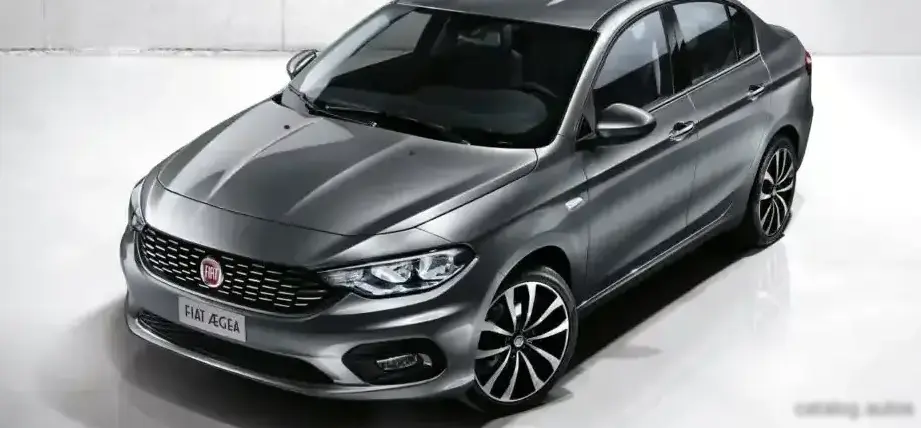
The Fiat Egea, known as the Tipo outside of Italy, represents Fiat’s entry into the competitive C-segment sedan market. Introduced in 2015 and receiving a significant facelift in 2020, the Egea aimed to offer a practical and affordable vehicle with a focus on fuel efficiency and comfort. The 1.3 Multijet II variant, producing 95 horsepower, was a key component of the Egea lineup, particularly in European markets where diesel engines remained popular. This version was positioned as the entry-level diesel option, appealing to buyers prioritizing economy over outright performance. Production of this specific configuration ran from 2020 onwards, coinciding with the facelifted model.
Technical Specifications
| Brand | Fiat |
| Model | Egea |
| Generation | Egea (356, facelift 2020) |
| Type (Engine) | 1.3 Multijet II (95 Hp) |
| Start of production | 2020 |
| Powertrain Architecture | Internal Combustion engine |
| Body type | Sedan |
| Seats | 5 |
| Doors | 4 |
| Combined fuel consumption (WLTP) | 4.1-4.2 l/100 km (57.4 – 56 US mpg, 68.9 – 67.3 UK mpg, 24.4 – 23.8 km/l) |
| CO2 emissions (WLTP) | 110-113 g/km |
| Fuel Type | Diesel |
| Acceleration 0 – 100 km/h | 12.8 sec |
| Acceleration 0 – 62 mph | 12.8 sec |
| Acceleration 0 – 60 mph | 12.2 sec |
| Maximum speed | 184 km/h (114.33 mph) |
| Emission standard | Euro 6d-FINAL |
| Weight-to-power ratio | 13.1 kg/Hp, 76.6 Hp/tonne |
| Weight-to-torque ratio | 6.2 kg/Nm, 161.3 Nm/tonne |
| Power | 95 Hp @ 3750 rpm |
| Power per litre | 76.1 Hp/l |
| Torque | 200 Nm @ 1500 rpm (147.51 lb.-ft. @ 1500 rpm) |
| Engine layout | Front, Transverse |
| Engine Model/Code | 46345266 |
| Engine displacement | 1248 cm3 (76.16 cu. in.) |
| Number of cylinders | 4 |
| Engine configuration | Inline |
| Cylinder Bore | 69.6 mm (2.74 in.) |
| Piston Stroke | 82 mm (3.23 in.) |
| Compression ratio | 16.8:1 |
| Number of valves per cylinder | 4 |
| Fuel injection system | Diesel Commonrail |
| Engine aspiration | Turbocharger, Intercooler |
| Valvetrain | DOHC |
| Engine oil capacity | 3.9 l (4.12 US qt | 3.43 UK qt) |
| Coolant | 6.1 l (6.45 US qt | 5.37 UK qt) |
| Kerb Weight | 1240 kg (2733.73 lbs.) |
| Max. weight | 1740 kg (3836.04 lbs.) |
| Max load | 500 kg (1102.31 lbs.) |
| Trunk (boot) space – minimum | 520 l (18.36 cu. ft.) |
| Fuel tank capacity | 50 l (13.21 US gal | 11 UK gal) |
| Max. roof load | 45 kg (99.21 lbs.) |
| Permitted trailer load with brakes (12%) | 1200 kg (2645.55 lbs.) |
| Permitted trailer load without brakes | 500 kg (1102.31 lbs.) |
| Permitted towbar download | 60 kg (132.28 lbs.) |
| Length | 4532 mm (178.43 in.) |
| Width | 1792 mm (70.55 in.) |
| Width including mirrors | 2002 mm (78.82 in.) |
| Height | 1497 mm (58.94 in.) |
| Wheelbase | 2636 mm (103.78 in.) |
| Front track | 1542 mm (60.71 in.) |
| Rear (Back) track | 1543 mm (60.75 in.) |
| Front overhang | 893 mm (35.16 in.) |
| Rear overhang | 1003 mm (39.49 in.) |
| Minimum turning circle (turning diameter) | 10.9 m (35.76 ft.) |
| Drivetrain Architecture | The Internal combustion engine (ICE) drives the front wheels of the vehicle. |
| Drive wheel | Front wheel drive |
| Number of gears and type of gearbox | 5 gears, manual transmission |
| Front suspension | Independent type McPherson |
| Rear suspension | Torsion |
| Front brakes | Disc |
| Rear brakes | Drum |
| Assisting systems | ABS (Anti-lock braking system) |
| Steering type | Steering rack and pinion |
| Power steering | Electric Steering |
| Tires size | 195/65 R15; 205/55 R16; 225/45 R17 |
| Wheel rims size | 6J x 15; 6.5J x 16; 7J x 17 |
Powertrain & Engine Architecture
The heart of this Egea variant is the 1.3 Multijet II diesel engine, a member of Fiat’s family of turbocharged common rail diesel engines. This engine, designated with code 46345266, is a four-cylinder, inline configuration displacing 1248cc. It features a turbocharger with an intercooler to enhance power and efficiency. The engine utilizes a sophisticated common rail direct injection system, delivering fuel at extremely high pressures for optimized combustion. The DOHC (Double Overhead Camshaft) valvetrain, with four valves per cylinder, further contributes to the engine’s breathing efficiency. A key feature of the Multijet II technology is the ability to perform multiple fuel injections per combustion cycle, improving refinement and reducing noise. This particular engine is paired with a 5-speed manual transmission, chosen for its simplicity and cost-effectiveness in the entry-level segment. The transmission’s gear ratios are geared towards fuel economy rather than spirited acceleration.
Driving Characteristics
The 95 horsepower and 200 Nm (147.51 lb-ft) of torque produced by the 1.3 Multijet II engine provide adequate, but not exhilarating, performance. Acceleration from 0-60 mph takes around 12.2 seconds, and top speed is rated at 184 km/h (114.33 mph). In real-world driving, the engine feels most comfortable in the mid-range, with readily available torque from 1500 rpm. This makes it suitable for everyday commuting and highway cruising. Compared to higher-output versions of the Egea, such as those with the 1.6-liter gasoline engine, the 1.3 Multijet II feels noticeably slower, particularly during overtaking maneuvers. However, the manual transmission allows for a degree of driver control, and the engine is relatively responsive when pushed. The 5-speed gearbox, while functional, lacks the refinement and wider gear spread of more modern transmissions.
Equipment & Trim Levels
The 1.3 Multijet II variant of the Egea typically came equipped with a base level of features, reflecting its position as the entry-level diesel model. Standard equipment generally included air conditioning, power steering, electric front windows, and a basic audio system. Safety features such as ABS (Anti-lock Braking System) and driver/passenger airbags were also standard. Interior upholstery was typically cloth, and the dashboard featured a functional, if somewhat basic, design. Optional extras available for this trim level included alloy wheels, rear parking sensors, a touchscreen infotainment system, and cruise control. Higher trim levels of the Egea offered more luxurious features, such as leather upholstery, automatic climate control, and advanced driver-assistance systems.
Chassis & Braking
The Egea’s chassis utilizes an independent McPherson strut suspension at the front and a torsion beam suspension at the rear. This setup provides a reasonable balance between ride comfort and handling. The front brakes are discs, while the rear brakes are drums, a cost-saving measure common in this segment. The steering is electrically assisted, providing light and easy steering feel. The suspension is tuned for comfort, absorbing bumps and imperfections in the road reasonably well. However, the torsion beam rear suspension can feel less composed than a fully independent setup during cornering. Stabilizer bars are present, contributing to reduced body roll.
Market Reception & Comparison
The Fiat Egea 1.3 Multijet II was generally well-received by critics as a practical and economical choice. Its fuel efficiency, with combined consumption figures of 4.1-4.2 l/100 km, was a major selling point. Compared to the gasoline-powered Egea variants, the diesel model offered significantly better fuel economy. However, some critics noted the engine’s lack of refinement and relatively slow acceleration. Compared to other diesel-powered C-segment sedans, such as the Volkswagen Golf or Ford Focus, the Egea offered a more affordable price point, but lacked some of their sophistication and driving dynamics. Reliability reports suggest the 1.3 Multijet II engine is generally robust, but regular maintenance is crucial to prevent issues with the diesel particulate filter (DPF).
Legacy
The 1.3 Multijet II engine has proven to be a durable and reliable powerplant, and examples of the Egea equipped with this engine continue to be found on the used car market. While not known for its performance, its fuel efficiency and relatively low running costs make it an attractive option for budget-conscious buyers. The engine’s simplicity also means that maintenance and repairs are generally affordable. However, potential buyers should be aware of the potential for DPF issues, particularly if the vehicle has been primarily used for short journeys. Overall, the Fiat Egea 1.3 Multijet II represents a sensible and practical choice in the C-segment sedan market, offering a good balance of economy, comfort, and reliability.