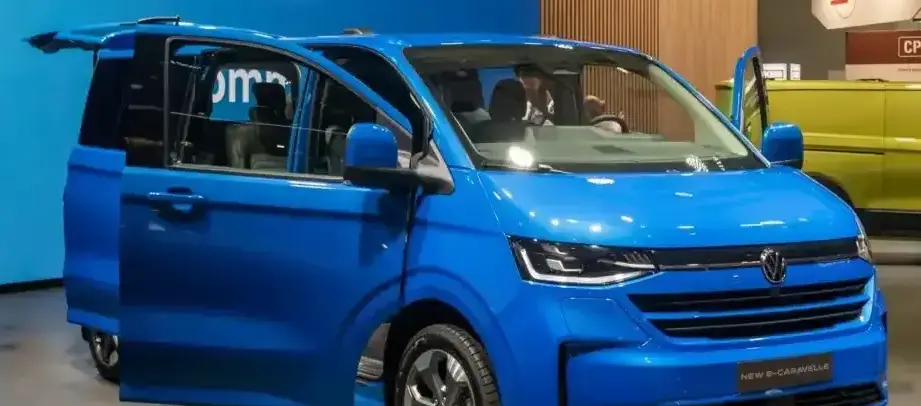
The Volkswagen Caravelle (T7) Long 2.0 TDI, introduced in August 2024, represents the latest iteration of Volkswagen’s popular multi-purpose vehicle (MPV). Positioned as a versatile option within the T7 range, this variant caters to families and businesses requiring substantial passenger and cargo space. The “Long” designation indicates an extended wheelbase, providing increased interior room compared to the standard Caravelle T7. This model is primarily aimed at the European market, where MPVs remain a significant segment, offering a practical alternative to SUVs. It builds upon the foundation of the MQB platform, shared with other Volkswagen Group vehicles, and emphasizes comfort, practicality, and efficiency.
Technical Specifications
| Brand | Volkswagen |
| Model | Caravelle |
| Generation | Caravelle (T7) Long |
| Type (Engine) | 2.0 TDI (150 Hp) |
| Start of production | August, 2024 |
| Powertrain Architecture | Internal Combustion engine |
| Body type | Van |
| Seats | 8-9 |
| Doors | 4-5 |
| Combined fuel consumption (WLTP) | 7.3-7.4 l/100 km |
| Combined fuel consumption (US mpg) | 32.2 – 31.8 |
| Combined fuel consumption (UK mpg) | 38.7 – 38.2 |
| Combined fuel consumption (km/l) | 13.7 – 13.5 |
| CO2 emissions (WLTP) | 191-195 g/km |
| Fuel Type | Diesel |
| Acceleration 0 – 100 km/h | 13.4 sec |
| Acceleration 0 – 62 mph | 13.4 sec |
| Acceleration 0 – 60 mph | 12.7 sec |
| Maximum speed | 175 km/h (108.74 mph) |
| Emission standard | Euro 6e |
| Weight-to-power ratio | 14.4 kg/Hp, 69.4 Hp/tonne |
| Weight-to-torque ratio | 6 kg/Nm, 166.5 Nm/tonne |
| Power | 150 Hp |
| Power per litre | 75.2 Hp/l |
| Torque | 360 Nm (265.52 lb.-ft.) |
| Engine layout | Front, Transverse |
| Engine Model/Code | Panther |
| Engine displacement | 1996 cm3 (121.8 cu. in.) |
| Number of cylinders | 4 |
| Engine configuration | Inline |
| Cylinder Bore | 84.01 mm (3.31 in.) |
| Piston Stroke | 90.03 mm (3.54 in.) |
| Number of valves per cylinder | 4 |
| Fuel injection system | Diesel Commonrail |
| Engine aspiration | Turbocharger, Intercooler |
| Valvetrain | DOHC |
| Engine systems | Start & Stop System, Particulate filter |
| Kerb Weight | 2162-2224 kg (4766.39 – 4903.08 lbs.) |
| Max. weight | 3175 kg (6999.68 lbs.) |
| Max load | 951-1013 kg (2096.6 – 2233.28 lbs.) |
| Fuel tank capacity | 55 l (14.53 US gal | 12.1 UK gal) |
| AdBlue tank | 20 l (5.28 US gal | 4.4 UK gal) |
| Max. roof load | 170 kg (374.79 lbs.) |
| Permitted trailer load with brakes (12%) | 2300 kg (5070.63 lbs.) |
| Permitted trailer load without brakes | 750 kg (1653.47 lbs.) |
| Permitted towbar download | 100 kg (220.46 lbs.) |
| Length | 5450 mm (214.57 in.) |
| Width | 2032 mm (80 in.) |
| Width including mirrors | 2275 mm (89.57 in.) |
| Height | 1979 mm (77.91 in.) |
| Wheelbase | 3500 mm (137.8 in.) |
| Front overhang | 958 mm (37.72 in.) |
| Rear overhang | 992 mm (39.06 in.) |
| Minimum turning circle | 13.8 m (45.28 ft.) |
| Approach angle | 17.2° |
| Departure angle | 16.4° |
| Ramp-over angle | 11.7° |
| Drivetrain Architecture | ICE, Front wheel drive |
| Drive wheel | Front wheel drive |
| Number of gears | 6 |
| Gearbox type | Manual transmission |
| Assisting systems | ABS (Anti-lock braking system) |
| Steering type | Steering rack and pinion |
| Power steering | Electric Steering |
| Tires size | 215/65 R16; 215/60 R17 |
| Wheel rims size | 6.5J x 16; 6.5J x 17 |
Powertrain & Engine Architecture
The Caravelle T7 Long 2.0 TDI utilizes the Panther engine, a four-cylinder, inline diesel engine with a displacement of 1996 cc. This engine is a member of the Volkswagen Group’s modular engine family, known for its efficiency and adaptability. It employs a turbocharger with an intercooler to boost power output and improve combustion efficiency. The engine features a common rail direct injection system, delivering fuel directly into the cylinders at high pressure for optimized fuel atomization and combustion. The valvetrain is a dual overhead camshaft (DOHC) design, controlling the intake and exhaust valves for precise engine timing. The 150 horsepower and 360 Nm (265.52 lb.-ft.) of torque are respectable figures for this class of vehicle, prioritizing fuel economy over outright performance. The engine is paired with a 6-speed manual transmission, sending power to the front wheels. The inclusion of a Start & Stop system and a particulate filter demonstrates Volkswagen’s commitment to reducing emissions and meeting stringent Euro 6e standards.
Driving Characteristics
The 2.0 TDI 150 hp powertrain in the Caravelle T7 Long delivers a comfortable and practical driving experience, rather than a sporty one. Acceleration is adequate, with a 0-60 mph time of around 12.7 seconds, but it’s not designed for rapid overtaking. The manual transmission offers precise gear changes, but requires more driver involvement than an automatic. The gear ratios are tuned for fuel efficiency, meaning the engine operates at lower RPMs during cruising. Compared to higher-output TDI variants (like the 200 hp version), this engine feels less strained when fully loaded with passengers and luggage. However, it lacks the punch and responsiveness of those more powerful options. The front-wheel-drive configuration provides predictable handling, but can exhibit some torque steer under hard acceleration. Overall, this powertrain prioritizes usability and economy, making it well-suited for long journeys and everyday driving.
Equipment & Trim Levels
The Caravelle T7 Long 2.0 TDI typically comes with a generous level of standard equipment. This includes features like air conditioning, a touchscreen infotainment system with Bluetooth connectivity, and a multi-function steering wheel. Interior upholstery is typically cloth, but leather options are available as upgrades. The dashboard layout is modern and functional, with a focus on ergonomics. Optional extras include features like navigation, parking sensors, adaptive cruise control, and a panoramic sunroof. Trim levels vary depending on the market, but generally offer progressively more luxurious appointments and technology features as you move up the range. The Caravelle is designed to be a flexible vehicle, with configurable seating arrangements to accommodate varying passenger and cargo needs.
Chassis & Braking
The Caravelle T7 Long utilizes a robust chassis designed to handle the vehicle’s weight and provide a comfortable ride. The suspension consists of independent suspension at the front and a semi-independent suspension at the rear. Braking is typically accomplished with disc brakes on the front wheels and drum brakes on the rear wheels, although some higher-spec models may feature disc brakes all around. Anti-lock Braking System (ABS) is standard, enhancing braking performance and stability. The steering is rack and pinion with electric power assistance, providing precise and responsive steering feel. Stabilizer bars are fitted to both the front and rear axles to reduce body roll during cornering.
Market Reception & Comparison
The Volkswagen Caravelle T7 Long 2.0 TDI has been generally well-received by automotive critics for its practicality, comfort, and fuel efficiency. However, some reviewers have noted that the 150 hp engine can feel underpowered when the vehicle is fully loaded. Compared to other trims in the Caravelle lineup, this variant offers a more affordable entry point, making it accessible to a wider range of buyers. Its fuel economy of 7.3-7.4 l/100 km (32.2-31.8 US mpg) is competitive within its class. Reliability is generally good, as Volkswagen’s diesel engines have a proven track record. However, potential owners should be aware of the potential costs associated with maintaining the diesel particulate filter and AdBlue system.
Legacy
The 2.0 TDI engine has become a mainstay in the Volkswagen Group’s lineup, known for its durability and fuel efficiency. The Caravelle T7 Long 2.0 TDI is expected to maintain a strong resale value in the used car market, due to its practicality and reputation for reliability. While newer electric and hybrid MPVs are emerging, the Caravelle T7 Long 2.0 TDI continues to offer a compelling combination of space, comfort, and affordability for those seeking a versatile and practical vehicle.